

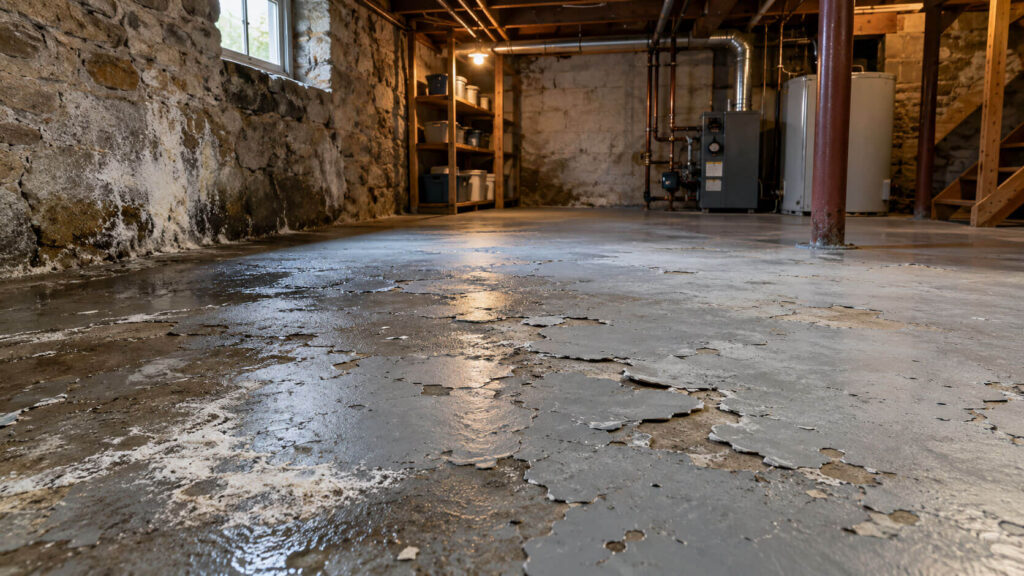
Why Painted Basement Floors Start Peeling in Hudson Valley Homes
A basement floor that starts looking chalky, peeling, or blotchy usually isn’t just a cosmetic problem. In a lot of Hudson Valley homes, it’s the first visible sign that moisture has been moving through the slab for a while. Homeowners often notice the paint long before they notice the real issue underneath.
That’s what makes this problem frustrating. The floor may seem dry most of the time, then suddenly the coating starts lifting after a stretch of rain, spring melt, or a humid summer. In older homes with stone foundations, uneven grading, or a history of damp basements, paint failure is often a clue that the floor has been dealing with moisture pressure for years. If you’ve already seen damp spots elsewhere in the basement, it can be worth comparing the issue with broader spring drainage problems around Hudson Valley homes.
What usually causes basement floor paint to fail
The short version: paint does not like moisture, and basement slabs rarely stay as dry as they look. Even when there is no obvious puddling, moisture vapor can move up through concrete and weaken the bond between the slab and the coating.
In real-world inspections, contractors usually start by looking for one of a few patterns:
- Moisture vapor coming up through the slab
- Minor seepage at the perimeter where the slab meets the foundation wall
- Old paint or sealer that was applied over a dirty or unprepared surface
- Hydrostatic pressure pushing water through cracks or cold joints
- Condensation from humid basement air, especially in summer
That last one surprises a lot of homeowners. A basement floor can fail even when no liquid water is visibly entering the space. The problem is often moisture migrating through the concrete, not a dramatic leak. That is why a floor can look fine after a dry week and then start blistering after a wet one.
Why the stain or peeling rarely tells the whole story
One of the most common homeowner assumptions is that the peeled area points directly to the source of the moisture. That is not always true. The stain on the floor is often just where the coating finally gave up, not where the water first entered.
Contractors tend to check the perimeter first, then drainage conditions outside the house, then the slab itself. In practice, the problem may start at a downspout dumping too close to the foundation, a negative grade along one side of the house, or saturated soil after a heavy storm. In neighborhoods with mature trees and older lots, roots and uneven settling can make those drainage patterns even less predictable.
If the exterior water path is part of the problem, the repair may need to start outside rather than in the basement. That is why some homeowners end up needing basement water drainage solutions before they spend money on a new coating that will just peel again.
The expensive mistake: repainting over a moisture problem
A quick repaint feels like the easy fix, and it is usually the wrong one. Fresh paint or sealer can make the basement look better for a few months, but if moisture is still moving through the slab, the new coating is just going to fail again. Sometimes it fails faster than the original layer because the first coating trapped moisture in a new way.
This is where homeowners get into trouble with cosmetic repairs. The floor may seem “sealed,” but the underlying moisture is still there. Once that happens, the bond keeps breaking, the concrete surface starts dusting, and the repair gets more expensive because the slab now needs more prep before anything can stick.
Contractors who work in damp basements usually pay attention to whether the failure is only on the surface or whether the slab is already spalling, softening, or showing white efflorescence. Those details tell you whether the issue is mostly cosmetic or whether the concrete itself is being affected by ongoing moisture movement.
What contractors typically inspect first
When a basement floor coating is failing, the first inspection is rarely about the paint itself. It is usually about why the floor got wet in the first place.
The usual checklist
- Signs of efflorescence or white mineral deposits
- Cracks, cold joints, and perimeter gaps
- Downspout discharge and grading around the house
- Whether the basement has a sump pump or drainage system
- Humidity levels and ventilation in the space
- Previous coating history, including any epoxy or sealer products used before
This is one of those situations where older Hudson Valley construction matters. Stone foundations, partial basements, slab additions, and mixed-era renovations all behave differently. A basement in a 1950s ranch is not going to fail for the same reason as a stone-walled cellar in a farmhouse or a slab in a later addition.
When the problem is bigger than the floor paint
Sometimes the coating is just the messenger. If the basement stays damp after storms, if the walls sweat in humid weather, or if there is visible seepage at the slab edge, the real issue may involve foundation and waterproofing problems beneath the slab.
That does not automatically mean a major excavation project. But it does mean the repair should be based on moisture conditions, not guesswork. A good contractor will want to know whether the water is entering through the slab, through the wall-floor joint, or because the basement is simply acting like a cold surface in a humid season.
In some homes, the right answer is exterior drainage correction. In others, it may be interior water management, crack treatment, or a better moisture barrier strategy. The point is to solve the movement of water, not just the appearance of the floor.
Why DIY fixes often fail in basement spaces
There are plenty of store-bought products that promise a permanent finish. The problem is that basement floors are a poor place to trust a shortcut. If the slab has dust, efflorescence, old adhesive residue, or moisture vapor coming through it, the new coating usually loses adhesion sooner than expected.
Common DIY mistakes include:
- Skipping proper cleaning and concrete profiling
- Applying coating over existing peeling paint
- Using the wrong product for damp concrete
- Ignoring cracks and perimeter gaps
- Trying to coat a floor before fixing the drainage outside
The counterintuitive part is that the better the floor looks at first, the easier it is to fool yourself into thinking the problem is solved. A shiny finish does not prove the slab is dry enough to stay coated. In fact, it often just means the moisture has not pushed hard enough yet.
How to tell whether the floor can be repaired or needs more than paint
A basement floor can sometimes be refinished successfully, but only if the moisture source is under control. A contractor will usually want to know whether the slab has recurring dampness, whether water ever pools, and whether there is evidence of seasonal failure. If the damage is limited to one area and the concrete is still sound, a properly prepared coating system may be possible.
If the coating keeps failing in the same spots, or if the basement already has signs of groundwater pressure, it may make more sense to look at basement flooring installation contractors who can advise on more durable alternatives for the space. In a damp basement, the right flooring solution is usually the one that matches the moisture reality, not the one that looks best in a showroom.
That often means being honest about how the basement is used. A storage room has different needs than a finished family space, a laundry area, or a workshop. In the Hudson Valley, a lot of basements serve more than one purpose, and the floor choice has to handle that reality.
What delayed repairs usually cost homeowners
When painted basement floors are left alone, the cost does not usually stay put. Once the coating fails, moisture can keep working on the surface. That can lead to more cleaning problems, dusting concrete, odor, or in some cases mold growth on anything stored directly on the floor.
Delaying the repair also makes prep harder later. Peeling coatings need to be removed before anything new can bond properly, and that labor adds up. If the slab has already absorbed years of moisture, the next solution may require better drainage work, crack repair, or a different floor assembly entirely.
That is why the cheapest-looking fix is often the most expensive one over time.
What a smart next step looks like
If the peeling is minor and recent, start by figuring out when it happens. After storms? During spring thaw? On humid weeks? That pattern matters more than the appearance of the coating itself.
Homeowners usually get the best results when they approach the problem in this order:
- Check exterior drainage and downspout discharge
- Look for cracks, efflorescence, and perimeter moisture inside
- Assess humidity and ventilation in the basement
- Determine whether the slab is actually suitable for a new coating
- Choose a repair based on moisture conditions, not just appearance
If the basement has a history of dampness, it is often worth treating the issue as part of a larger moisture-management plan rather than a single paint job.
Frequently Asked Questions
Can I repaint a basement floor that is peeling?
Sometimes, but only if the moisture problem is solved first. Repainting over active dampness usually leads to the same failure again.
Is peeling basement floor paint always a sign of water intrusion?
Not always. High humidity and poor surface prep can also cause failure, but recurring peeling usually points to a moisture issue somewhere in the slab or around the foundation.
Why does my basement floor peel more after heavy rain?
That usually means exterior drainage, groundwater, or hydrostatic pressure is affecting the slab. Heavy rain often exposes a problem that was already there.
Should I worry about mold if the floor paint is peeling?
If the basement stays damp or smells musty, it is worth paying attention. Peeling paint itself is not mold, but moisture conditions that damage coatings can also support mold growth on stored items or nearby materials.
What kind of contractor should I call first?
Start with someone who understands moisture, foundations, and basement conditions rather than a purely cosmetic coating job. The right diagnosis matters more than the finish.
Is basement floor paint a bad idea in older Hudson Valley homes?
Not automatically, but older homes often have more moisture variables to account for. Stone foundations, uneven grading, and seasonal dampness can make a standard coating less reliable unless the underlying conditions are addressed first.
If your basement floor coating is peeling, the smartest move is to treat it as a moisture clue, not just a finish problem. A trusted local contractor can help sort out whether you are looking at a simple prep issue, a drainage fix, or a bigger foundation concern before the repair becomes more expensive than it needs to be.
