

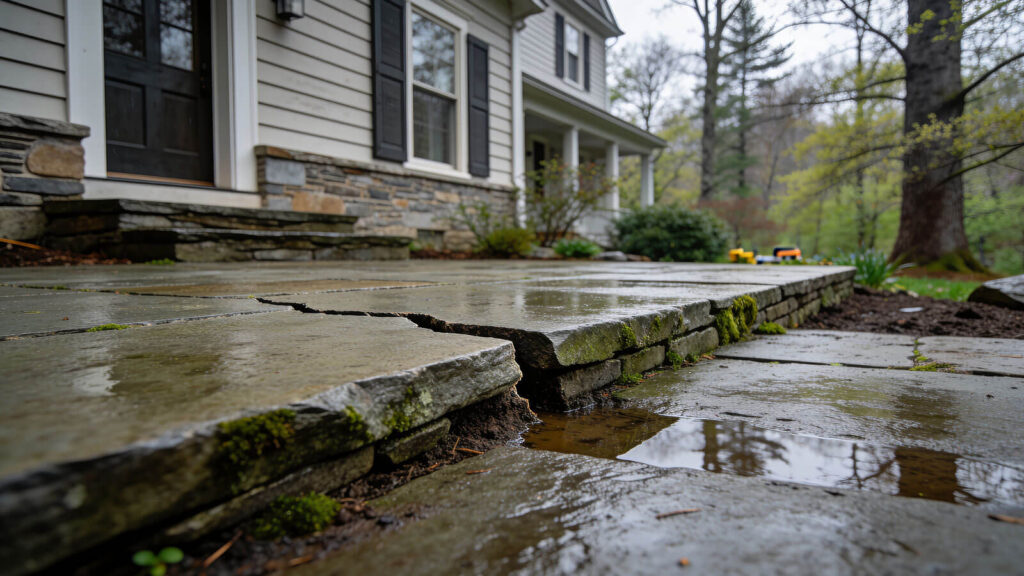
Why Hudson Valley Patio Cracks Happen — and When a “Simple Repair” Is Actually a Bigger Masonry Problem
A cracked patio looks like a surface issue until the first hard rain or freeze-thaw cycle makes it worse. What starts as a hairline split can turn into a trip hazard, a drainage problem, or a sign that the base beneath the slab is failing. Around the Hudson Valley, that matters more than a lot of homeowners realize. Older properties, heavy spring runoff, mature trees, and shifting soils can all work against exterior masonry year after year.
The tricky part is that patio cracks are easy to misread. Some really are cosmetic. Others are telling you the slab is moving because water is collecting where it shouldn’t, the base wasn’t compacted correctly, or the masonry is no longer supported evenly. That’s why contractors usually look beyond the crack itself and start with the surrounding conditions: grading, gutter discharge, nearby tree roots, and whether the patio is tied into the house in a way that’s creating stress.
If you’re trying to figure out whether the damage is minor or something more serious, it helps to understand how patios fail in the first place. In many cases, the real issue is not the visible crack at all. It’s the water, soil movement, or settling underneath it. That’s also why homeowners who are comparing patching options with professional masonry services often get better long-term results than those who try to seal over the problem and hope for the best.
What Usually Causes Patio Cracks in the Hudson Valley
Patios crack for a mix of reasons, but water and movement are the usual suspects. Once moisture gets under a slab, freeze-thaw cycles can push, lift, and separate sections in ways that aren’t obvious at first. A patio that looks stable in October may show larger fractures by March after a wet winter and repeated freezing nights.
Drainage problems are a major contributor. If downspouts empty near the patio, if the grade slopes back toward the house, or if runoff from a driveway or hillside is being funneled across the slab, the base can soften and shift. That’s why it’s worth looking at drainage problems around the patio before assuming the concrete or stone itself is the only issue.
Other common causes include:
- poor base preparation during the original installation
- settling soil after years of moisture cycles
- tree roots lifting or pressing at the edges
- heavy loads placed on older masonry
- improper expansion joints or missing control joints
- water pooling at seams, steps, or low spots
One counterintuitive thing contractors see all the time: the stain or crack you notice is not always above the actual source of failure. Water moves, soil shifts, and stress travels. A visible split near the center of the patio may be the result of a drainage issue several feet away. That’s one reason a quick patch can fail even when it looks neat on day one.
When a Crack Is Cosmetic and When It’s Structural
Not every crack means the patio needs to be replaced. Narrow surface cracks, especially in older slabs, can sometimes be managed if the base is stable and the slab isn’t moving. But the shape and behavior of the crack matter more than the width alone.
Contractors usually pay close attention to whether the crack is widening, whether one side has shifted in height, and whether the problem comes back after a repair. If there’s visible heaving, sinking, or separation near the house, that points to movement rather than a simple surface flaw. If pavers are drifting, mortar joints are opening repeatedly, or water collects in the same low spot after every storm, the patio is probably telling you something bigger.
These are the signs that usually justify a closer inspection:
- cracks that keep reopening after sealing
- uneven slabs or tripping edges
- water puddling along the same line every time it rains
- gaps forming near steps, walls, or the foundation
- sections that sound hollow when tapped
- new cracks appearing after winter
The big mistake homeowners make is treating every crack like a cosmetic defect. Sometimes the repair is straightforward. Other times, the patio is failing because the underlying base has been compromised, and the best long-term answer is partial rebuild or full replacement. That decision is easier to make early than after another season of movement.
Why Quick Fixes Often Fail
Sealants and patch products can buy time, but they rarely solve movement. If the patio is actively settling, anything rigid you place over the crack will eventually split again. That’s especially true in a climate like the Hudson Valley, where temperature swings put constant stress on exterior materials.
Homeowners often try to cover the damage with a cosmetic patch, then get frustrated when the crack returns a few months later. From a contractor’s perspective, that usually means the root issue was never addressed. The same is true when someone repoints a joint or fills a gap without checking the slope, the drainage path, or the stability of the base beneath the slab.
If the patio is part of a larger outdoor system — say it connects to steps, a retaining edge, or an attached deck area — the failure may also affect adjacent structures. That’s where a broader review becomes more valuable than isolated repair. In some cases, the right comparison is not “repair or ignore,” but repair versus rebuild decisions for outdoor spaces, especially when multiple outdoor surfaces are aging at once.
What Experienced Contractors Check First
Good masonry work starts with diagnosis. Before anyone talks about patching, replacement, or resurfacing, experienced contractors usually look at the conditions around the patio. The crack itself matters, but the surrounding clues often explain why it happened and whether the fix will hold.
The first things worth checking
- how water moves away from the house and patio
- whether gutters and downspouts are dumping too close to the slab
- signs of soft or washout-prone soil near the edges
- evidence of settlement, heaving, or frost movement
- the condition of joints, edging, and nearby masonry
- whether nearby trees may be contributing root pressure
That broader inspection matters because a patio is rarely just a patio. It’s tied into the property’s drainage, grading, and exterior construction. On sloped lots, which are common in parts of the Hudson Valley, a bad runoff path can keep feeding the same failure point year after year.
If you’re in a county where older stonework and mixed-age renovations are common, it can also help to compare repair options with local masonry specialists who understand how these structures age differently. Homeowners often find it useful to look at Dutchess County masonry contractors or Putnam County masonry services when the question is no longer “Can this crack be sealed?” but “Is this patio still structurally worth saving?”
When Repair Makes Sense — and When Replacement Is the Smarter Move
Repair makes sense when the patio is fundamentally stable, the crack is limited, and the surrounding drainage is under control. In those cases, a careful masonry repair can extend the life of the surface and keep the problem from spreading. But when the slab is moving, patching becomes a short-term delay, not a solution.
Replacement starts to make more sense when the base has failed, the slab has multiple large cracks, or the patio has become uneven enough to create a safety problem. In that situation, repairing one section usually just pushes attention to the next weak point. That’s where homeowners sometimes spend more over time trying to preserve a surface that has already reached the end of its useful life.
The tradeoff is often about more than appearance. A failing patio can affect drainage near the foundation, create water intrusion risk at the house, or undermine nearby walkways and steps. If the patio is part of a larger outdoor rebuild, it may be worth discussing whether the project should be approached as a repair or part of a broader plan with deck and patio construction contractors.
Why Timing Matters More Than Most People Think
Patio damage is one of those problems that tends to get more expensive by waiting. A small crack in summer can become a larger split after one wet winter. Once water starts entering the opening, freeze-thaw cycles do the rest. That’s especially true in shaded areas, near tree cover, or where snow lingers longer in cold months.
Delay also gives the surrounding issues time to compound. Water intrusion can soften the base. Soil washout can enlarge the void beneath the slab. Tiny movement can turn into visible settlement. By the time the patio feels unsafe underfoot, the repair is no longer about filling a gap — it’s about rebuilding what failed underneath it.
That’s why a minor inspection now is usually a better financial move than a major repair after another season of weather. Homeowners often think they’re saving money by waiting, but in exterior masonry, waiting can convert a manageable fix into a structural headache.
Local Conditions That Make Patio Problems Worse
Hudson Valley homes deal with a combination of moisture, mature landscaping, older construction, and weather swings that aren’t kind to masonry. Stone foundations, aging drainage lines, long driveways, and slope-heavy lots all add stress to outdoor surfaces. A patio that would hold up fine in a drier, flatter region may break down faster here simply because the property is working against it.
Wooded lots are especially common trouble spots. Leaves clog drainage paths, roots move soil, and shaded patios dry more slowly after storms. Add in winter freeze-thaw cycles and heavy spring rain, and the base beneath a patio can see constant movement. This is one reason local contractors often treat drainage and grading as part of the masonry conversation, not separate issues.
If the patio is part of a larger exterior problem — for example, water is pooling near the foundation, or the same storm that cracks the slab also floods a walkout area — homeowners in Westchester may also benefit from looking into masonry repair help in Westchester County when the damage is no longer isolated to one surface.
Practical Next Steps for Homeowners
If you’ve noticed cracking, start by documenting what changed. Take photos after rain and again during dry weather. Note whether the crack is growing, whether water gathers nearby, and whether the patio feels uneven underfoot. Those details help separate a cosmetic issue from a movement problem.
Then look beyond the crack. Check gutters, downspouts, nearby planting beds, and any area where water may be getting trapped. If the patio sits near a slope, retaining wall, or older foundation, those conditions matter. A good contractor will want that context before recommending a repair method.
And if a repair estimate seems surprisingly simple, ask what the contractor believes caused the crack in the first place. A fair estimate should explain whether the issue is surface-level, base-related, or tied to drainage. If that explanation is missing, the fix may be too.
Frequently Asked Questions
Can a cracked patio be repaired without replacing the whole thing?
Sometimes. If the slab is stable and the crack is mostly cosmetic, repair can make sense. If the patio is settling, heaving, or repeatedly cracking, replacement or partial rebuild is often the better long-term move.
Why do patio cracks keep coming back after sealing?
Because sealing the surface doesn’t stop movement underneath it. If drainage, soil settlement, or frost heave is the real cause, the crack will usually return.
Is a narrow crack something I can ignore for a while?
Only if it isn’t changing, trapping water, or creating uneven edges. Once a crack starts widening or collecting moisture, it’s better to inspect it sooner rather than later.
What makes patio damage worse in winter?
Water gets into the crack, freezes, expands, and pushes the masonry apart. Repeated freeze-thaw cycles are one of the biggest reasons small cracks become larger failures.
Should I check drainage before calling for masonry repair?
Yes. Drainage is often part of the problem. Even a strong repair won’t last if downspouts, grading, or runoff are still sending water toward the patio.
When is a patio more likely to need replacement than repair?
When there are multiple cracks, obvious settlement, unstable base conditions, or trip hazards. If the surface is moving, patching usually only postpones the real fix.
When a patio starts cracking, the smartest move is usually to diagnose the cause before spending money on the symptom. A trusted local masonry professional can help you sort out whether you’re looking at a repair, a drainage correction, or a larger rebuild — and that kind of clarity can save a lot of stress later.