

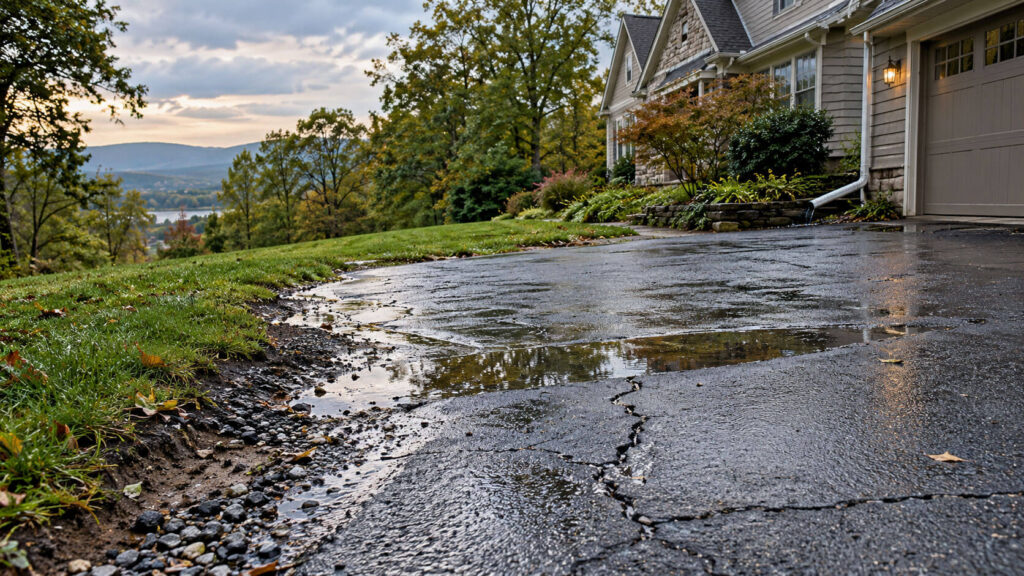
Why Hudson Valley Driveway Cracks Keep Coming Back: What’s Really Going on Under the Surface
A cracked driveway is easy to dismiss as cosmetic until the same split starts widening every spring, a low spot turns into a puddle, or water begins finding its way toward the garage and foundation. That’s when the “just patch it” plan usually stops working. In a region with freeze/thaw cycles, steep grades, mature trees, and plenty of older homes, driveway cracking is often less about the pavement itself and more about what’s happening underneath it.
That’s why the smartest first question is rarely “How do I fill this crack?” It’s “Why is the driveway moving in the first place?” The answer often sits somewhere between drainage, base failure, soil settlement, and edge deterioration. If you’ve been comparing repairs, it helps to think beyond pavement and look at the broader water-management picture, including spring drainage problems Hudson Valley homeowners should check before the next hard rain.
Why driveway cracks keep returning in this region
Hudson Valley driveways take a beating from weather patterns that are rough on both asphalt and the materials below it. Water gets into small openings, freezes, expands, and works the surface apart. Then thawing lets the base shift again. After enough cycles, a hairline crack becomes a seam, a seam becomes a break, and the damaged area starts telegraphing into surrounding pavement.
But cold weather is only part of the story. The bigger issue is usually water management. When runoff funnels toward the driveway instead of away from it, the stone base underneath softens. Once the sub-base loses support, the pavement above it starts to flex and fail. This is why a driveway can crack in one place and look fine in another even though the whole surface is the same age.
Contractors usually look first at the edges, slope, and surrounding hardscape. If the driveway border is breaking down, that often points to poor drainage, gutter discharge problems, or soil washing out from the sides. In some cases the real culprit is not the driveway at all but the way the property sheds water from the roofline and nearby landscape.
The mistake homeowners make most often: treating the crack, not the cause
Sealants and patch products have their place, but they only work when the driveway is fundamentally stable. If water is still moving through the same weak point, the repair is temporary at best. That’s the part homeowners often underestimate because a fresh patch looks finished. It isn’t.
A patch can also hide a deeper issue for a while, which is why many driveway problems get misread as minor cosmetic wear. In reality, the crack may be warning you about a failing base, poor compaction, or runoff from a nearby downspout. The expensive mistake is spending on surface fixes while the damage keeps spreading underneath.
This is also where a lot of internet advice falls short. A driveway in a newer subdivision on stable grading does not behave like an older Hudson Valley property with a stone foundation, mature trees, and seasonal saturation around the edges. The right fix depends on what the property is doing with water, not just what the crack looks like on a dry afternoon.
What contractors usually inspect first
Before recommending any repair, a good contractor is usually trying to answer four questions:
- Is the crack isolated, or is the whole driveway moving?
- Is water pooling on top of the pavement or undercutting it from the sides?
- Are there signs of base failure, such as sinking, edge crumble, or repeated patch failure?
- Is nearby runoff from roofs, swales, or grading contributing to the damage?
That inspection matters because the correct solution can range from a simple crack fill to partial reconstruction. Sometimes the driveway is salvageable with proper resurfacing. Other times the surface is only the symptom, and the real fix involves grading, drainage correction, or replacing sections of weakened base material.
When drainage is part of the problem, homeowners often need more than a paving repair. In those cases, it makes sense to look at broader landscaping drainage fixes so the same water issue doesn’t keep damaging the pavement after every storm.
Counterintuitive but true: the visible crack is often not the worst problem
One of the more surprising things about driveway failure is that the visible crack is sometimes the least expensive part of the problem. The real cost shows up in the hidden layers: saturated base stone, washed-out edges, soft subgrade, and runoff patterns that continue after the surface is repaired. A driveway can look like it needs a simple patch while actually being one storm away from more widespread failure.
That is especially true when the crack runs beside a low spot, a downspout outlet, or the driveway’s downhill edge. Water follows the path of least resistance. Once it starts moving below the surface, you can have a stable-looking top layer sitting over compromised material. That’s why a contractor may recommend correcting drainage first even if the pavement damage seems modest.
When a crack is just a crack, and when it’s a warning sign
Not every crack means major reconstruction. Narrow cracks that haven’t shifted much, haven’t widened seasonally, and aren’t associated with sinking or pooling can often be repaired successfully. But once the pavement starts separating, dipping, or crumbling at the edges, the repair strategy changes.
Watch for these signs that the problem is progressing:
- Cracks reopening after previous repairs
- Pooling water that stays around after rain
- Raised edges or sinking sections
- Loose asphalt chunks near the crack line
- Soft spots that feel spongy under vehicle tires
- Cracks that line up with gutter discharge or slope changes
Those symptoms usually suggest the pavement is losing support or repeatedly getting soaked. At that point, the repair conversation should shift from cosmetics to cause.
Why delaying driveway repairs gets more expensive faster than people expect
Small cracks let water in. Water weakens the base. Weak base lets the surface shift. That’s the cycle, and it tends to accelerate rather than stay flat. The longer the problem sits, the more likely it is that a simple patch becomes a larger section repair or full replacement.
There’s also a ripple effect homeowners don’t always connect right away. Driveway drainage problems can push water toward the garage slab, basement wall, or foundation perimeter. If you’re already seeing moisture near the house, it may be worth reviewing foundation and waterproofing services before the issue spreads into a more expensive moisture problem.
That’s one reason contractors are often cautious about “quick fixes” on older properties. A fast patch might buy time, but if the grading is wrong or the downspouts are dumping too close to the driveway edge, the same failure tends to return.
What a smart repair plan usually looks like
The right approach depends on the severity of the damage, but in practice a good repair plan usually goes in this order:
- Identify where water is coming from and where it’s going.
- Check whether the base is stable or already compromised.
- Fix drainage problems before patching the pavement.
- Choose a repair method that matches the extent of movement.
- Address gutters, downspouts, and grading so the repair holds.
If the problem starts at the roof edge, it’s worth looking at gutter and downspout drainage help as part of the solution. A downspout that dumps beside the driveway may be the reason the base keeps softening after every storm.
And if the pavement itself has reached the point where patching no longer makes sense, an experienced paving contractor can help determine whether resurfacing or replacement is the better long-term move. That’s where asphalt and paving contractors become useful not just for the visible repair, but for evaluating whether the base, slope, and drainage are actually repairable in place.
Why Hudson Valley homes need a different lens
Older homes here often sit on properties that were never designed with modern stormwater expectations. Add in steep driveways, mature trees, clay-heavy soil in some pockets, and long private drives, and water has plenty of chances to move where it shouldn’t. Even a well-built driveway can struggle if the surrounding site sheds water poorly.
After a heavy rain or a late freeze, it’s worth paying attention to the whole exterior, not just the pavement. A cracked driveway may be one of the first visible clues that runoff is building elsewhere on the property. A good place to start is a set of post-storm exterior drainage checks, especially if you’ve noticed new puddles, erosion, or damp spots near the house or garage.
In other words, the driveway is often the messenger. The message is usually about water.
Frequently Asked Questions
Can I just fill driveway cracks myself?
Yes, if the crack is narrow and the pavement is otherwise stable. But if water is pooling, the base is sinking, or the crack keeps reopening, a surface fill will not solve the underlying problem.
How do I know if the problem is drainage-related?
Look for pooling water, soil erosion along the edges, downspouts discharging nearby, or cracking that gets worse after storms and freeze/thaw cycles. Those are strong clues that water is part of the issue.
Is driveway cracking always a sign that the whole driveway needs replacement?
No. Some cracks can be repaired successfully. The deciding factor is usually whether the base is still solid and whether water is being managed properly around the driveway.
Why do repairs fail so often after winter?
Because frozen water expands inside cracks and weak spots. If the drainage issue wasn’t corrected, winter tends to expose the same flaw again and again.
Should I fix the driveway or the gutters first?
If roof runoff is contributing to the problem, the gutters and downspouts should be addressed first. Otherwise the driveway repair may fail sooner than expected.
When is it time to bring in a contractor?
If the crack is widening, the driveway is sinking, or water is clearly involved, it’s worth getting a professional opinion before the repair gets larger and more expensive.
When driveway cracks keep coming back, the right fix usually starts with understanding how the property handles water. A trusted local contractor can help separate a simple surface issue from a deeper drainage or base problem, which is often the difference between a repair that lasts and one that quietly fails again next season.
