

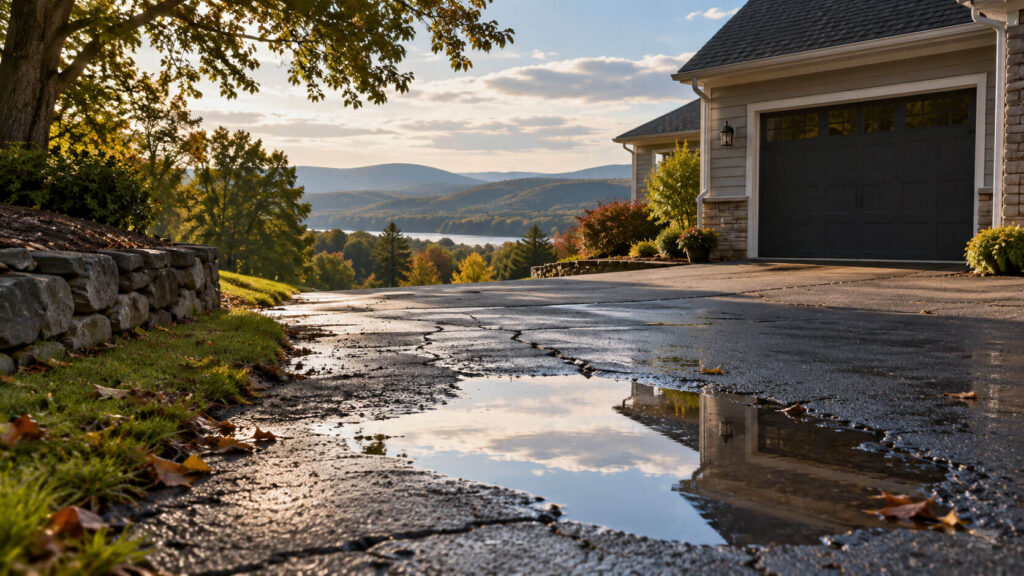
Why a Driveway Starts Failing Faster Than Homeowners Expect in the Hudson Valley
A driveway rarely goes from “fine” to “bad” overnight. What usually happens is more frustrating: one side starts holding water, a crack opens near the edge, and then a mild winter turns a small grading problem into a recurring repair bill. By the time a homeowner notices the slope issue, the underlying problem has often been working for a while. That is especially true on older properties with settled soil, mature trees, stone walls, and long stretches of pavement that were installed to match the land instead of correcting it.
That is why driveway regrading is less about making the surface look neat and more about fixing how water moves across the property. If runoff is heading toward the house, under the slab edge, or repeatedly washing out one side of the drive, paving patchwork alone usually won’t solve it. In many cases, the real issue is part driveway, part drainage, and part how the surrounding grade was handled years ago. Homeowners comparing options often end up looking at asphalt and paving contractors before they realize the bigger question is whether the surface needs correction, not just resurfacing.
In the Hudson Valley, that distinction matters. Freeze-thaw cycles open small gaps. Heavy spring rain finds low spots. Summer storms push water off rooflines and into the same trouble areas again and again. A driveway that was “good enough” for years can become a problem once drainage shifts, gutters overflow, or the subgrade softens.
What Driveway Regrading Actually Fixes
Regrading is meant to correct slope so water sheds away from the wrong places. That may sound simple, but in practice it often involves more than reshaping the asphalt or stone surface. Contractors are usually looking at the base, the edges, adjacent lawn slope, and whether runoff has somewhere safe to go. If those pieces don’t work together, a regraded drive can still fail.
Typical issues include water pooling near the garage, edge collapse along one side, cracking where the surface settled unevenly, and rutting caused by repeated soft spots underneath. On long private drives, especially those with a steeper approach or a crown that has flattened out over time, drainage can become a seasonal headache. What looks like a “bad driveway” is sometimes really a site drainage issue showing up on the driveway first.
That is why a good contractor won’t just ask where the cracks are. They’ll want to know where water comes from during a storm, where it leaves, and whether the problem gets worse during snowmelt or after gutters dump extra volume in one spot. If you want to understand the larger drainage picture, it helps to look at drainage problems around the driveway as part of the broader site, not just as a pavement issue.
Signs the Grade Is Wrong, Even If the Driveway Still Looks Usable
Homeowners often wait until the damage is obvious. The trouble is that driveway grading problems usually leave smaller clues first.
- Water sits in the same low area after rain instead of draining within a reasonable time.
- One edge of the driveway keeps breaking down while the rest looks intact.
- Soil or mulch keeps washing onto the pavement from the yard.
- The garage threshold or basement entry area stays damp after storms.
- Cracks widen every season in the same location.
- The drive feels slightly soft or uneven in spots under tires.
One counterintuitive thing homeowners miss: the visible crack is often not the real problem. The crack is frequently just where the surface is admitting defeat. The cause may be saturation below the base, poor discharge from a downspout, or runoff coming from a slope above the driveway. Fixing only the crack leaves the water problem intact.
What Contractors Usually Inspect First
Experienced contractors tend to start with water, not pavement. They’ll look at the surrounding topography, the way the drive ties into the garage, the condition of the base, and whether the edges are being undermined by runoff. They also pay attention to features homeowners sometimes overlook: downspout outlets, swales, hardscaping, retaining walls, and tree roots.
In older Hudson Valley neighborhoods, the surface may have been patched several times already. That can hide the original shape of the drive. On rural properties, the issue may be more about long-term erosion than asphalt failure. On tighter suburban lots, the culprit is often concentrated runoff from roofs and hard surfaces with nowhere good to go. When that happens, grading work may need to be coordinated with gutter and downspout runoff so water is not simply redirected from one problem area to another.
A contractor who understands the full system will also check whether the driveway slope is sending water toward the foundation. Once that happens, the repair conversation expands quickly. Now you are not just talking about pavement; you are talking about basement moisture, settlement, and the risk of repeated water intrusion. In those cases, it makes sense to think about foundation and waterproofing services before the next big rain pushes the issue farther underground.
Why DIY Fixes Often Miss the Real Problem
There is nothing wrong with trying to maintain a driveway. Raking back gravel, sealing isolated cracks, or improving surface runoff can buy time. But once the slope itself is wrong, DIY patching usually becomes a short-term cover-up.
One common mistake is adding material to fill a low spot without correcting why that spot settled. Another is sealing cracks before the base has dried out. That can trap moisture and make the next cycle of freezing and thawing more damaging. Homeowners also tend to underestimate how much water comes off a roofline, especially when a gutter system dumps onto the driveway edge. If that runoff is not controlled, the same repaired area can fail again almost immediately.
This is where a broader property approach matters. Sometimes the driveway is only one part of the solution, and the right fix includes yard regrading, drainage improvements, or even landscape work. That is why some projects overlap with landscaping drainage fixes rather than purely paving work.
Repair vs. Resurfacing vs. Regrading: What Actually Makes Sense
Not every driveway needs to be torn up. But not every crack should be treated like a surface-only issue either.
If the pavement is generally stable and the drainage issue is minor, a targeted repair may be enough. If the surface is aged but structurally sound, resurfacing can extend its life. But if water is pooling because the slope is wrong, regrading may be the only correction that addresses the cause. In some cases, the best plan is a combination: stabilize the base, improve drainage, then resurface or pave.
Homeowners get into trouble when they choose the cheapest visible fix and assume it equals the right fix. That usually leads to repeated work, more disruption, and a higher total cost over time. A contractor with the right experience will often be more interested in preventing repeat failure than in selling the quickest patch.
Where Delays Become Expensive
Small grading issues are easy to live with until they aren’t. The cost escalation usually happens when water starts affecting adjacent structures or when the subbase keeps moving.
Once the driveway edge erodes, the pavement loses support. Once the base softens, cracking spreads. Once runoff reaches the garage slab or foundation, the repair scope can expand beyond the original surface issue. In Hudson Valley homes with older foundations, that progression can be especially costly because moisture finds weaknesses fast.
Delaying repairs also creates seasonal risk. A minor drainage flaw in October can turn into a winter problem after freezing water expands in the wrong place. By spring, the same spot may have visible sinking, wider cracks, or surface breakup that wasn’t there before.
What Good Contractor Guidance Looks Like
Good guidance starts with diagnosis, not a sales pitch. The right local contractor should be able to explain whether the issue is surface wear, base failure, drainage direction, or a combination of all three. If they only talk about patching the visible damage, that is a red flag.
It also helps to work with the right type of local contractor for the actual problem. Some driveways need paving expertise. Others need excavation, drainage correction, or help from a waterproofing specialist. A homeowner does not need to guess the trade category perfectly, but they should expect the problem to be explained in plain language before any repair starts.
On properties with persistent runoff issues, a contractor may recommend keeping the driveway work aligned with the rest of the site plan. That might include drainage improvements, edge stabilization, or changes to the way stormwater exits the property. The best repairs solve the source, not just the symptom.
How Homeowners Can Prepare Before Getting Estimates
A little preparation makes driveway estimates more useful. Before meeting with a contractor, it helps to note where water pools, which side of the driveway fails first, whether the issue changes during heavy rain, and whether downspouts or nearby slopes seem to contribute. Photos taken during or right after a storm are especially helpful.
If possible, mention whether the property has a septic system, a long private drive, or a basement that already shows moisture issues. Those details matter more than most homeowners realize. They can change how drainage is handled and how aggressive the repair needs to be.
It is also worth asking what the contractor expects to inspect beneath the surface. Base conditions, edge support, drainage path, and surrounding grade should all be part of the conversation. If those are not being discussed, the estimate may be too narrow.
Frequently Asked Questions
How do I know if my driveway needs regrading or just patching?
If water keeps pooling in the same place, patching alone usually will not fix it. Regrading is more likely when the slope is wrong or the edge keeps washing out. Patching makes more sense for isolated surface damage on an otherwise stable drive.
Can driveway drainage problems affect my foundation?
Yes. If runoff is directed toward the house, it can contribute to basement seepage, settling, or moisture near the foundation. That is especially important on older homes with stone or aging foundation walls.
Why does my driveway keep cracking in the same spot?
Repeated cracking often points to a base issue, poor drainage, or movement under the surface. Sealing the crack without fixing the cause usually gives you the same crack again.
Is resurfacing enough if the driveway looks worn but not collapsed?
Sometimes. If the base is still sound and the drainage is acceptable, resurfacing can extend the life of the driveway. If the slope is off or water is undermining the edges, resurfacing alone is usually a temporary fix.
Should I address gutter runoff before fixing the driveway?
Very often, yes. If downspouts are dumping near the driveway, the same water that causes erosion or soft spots will keep coming back. Solving upstream runoff first can make the driveway repair last longer.
What’s the biggest mistake homeowners make with driveway repairs?
Assuming the visible damage is the whole problem. In practice, the bigger issue is often how water is moving around the property. Once that is ignored, repairs tend to fail early.
If your driveway is starting to hold water, settle unevenly, or push runoff toward the house, it is worth getting a clear local assessment before the problem grows. The right contractor will focus on the cause, not just the surface, which usually saves money and frustration in the long run.