

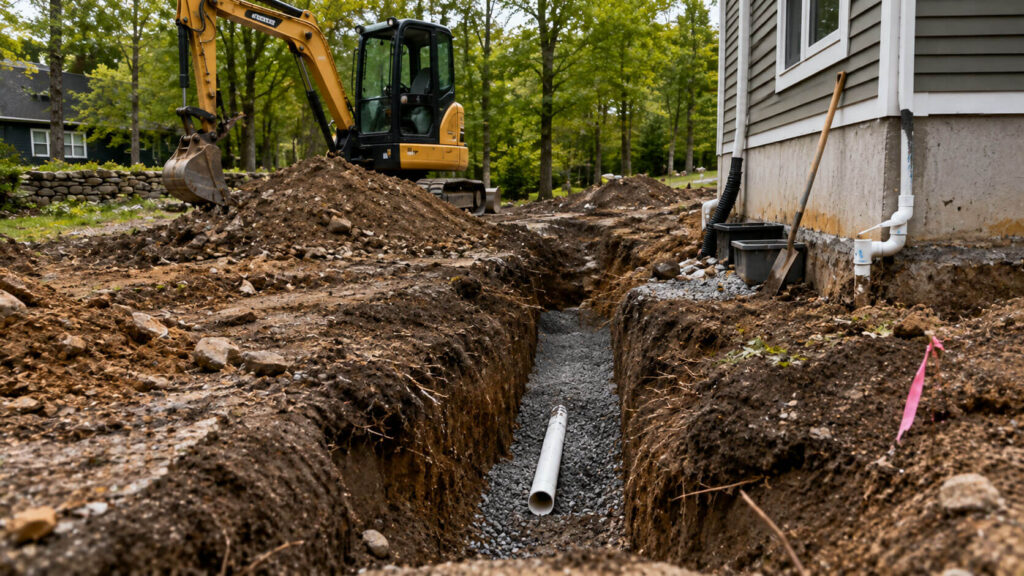
Why excavation projects in the Hudson Valley often cost more than homeowners expect has less to do with the digging itself and more to do with everything the digging exposes. Once a contractor opens up a yard, driveway edge, foundation perimeter, or drainage path, the real story starts to show: old utilities, poor grading, buried water problems, and small issues that have been hiding for years. That’s why a project that looks straightforward on paper can quickly turn into something bigger, slower, and more expensive if the site isn’t evaluated properly from the start.
Why excavation work rarely stays “just excavation”
On a flat, dry, modern lot, excavation can be pretty clean. The Hudson Valley is rarely that cooperative. Sloped properties, stone foundations, mature tree roots, long driveways, and stubborn runoff patterns all change how a site behaves once ground is disturbed. A narrow trench for drainage, a footing dig for a new structure, or a driveway edge repair can uncover water infiltration, unstable soil, or old material that was never installed to current standards.
This is also where homeowners get caught off guard. They’ll often focus on the visible part of the job—new patio base, driveway extension, foundation access, or grading correction—while overlooking the conditions that make the project succeed or fail. Contractors usually start by looking at where water is coming from, where it wants to go, and what’s likely hidden below the surface. That assessment matters just as much as the machine work itself.
If your project may touch more than one trade, it can be worth working with contractors who can coordinate permitted site work before the job gets split into disconnected pieces that don’t resolve the underlying issue.
The warning signs homeowners tend to miss
One of the most common mistakes is assuming a cosmetic problem is isolated. A cracked driveway apron may actually be a grading problem. Damp basement walls may point to surface runoff, not just a tired waterproof coating. A patio that keeps settling on one side may have an issue with drainage or fill compaction under the base, not the top layer of material.
Another thing that gets missed is timing. Problems that only show up after heavy rain, spring thaw, or a long freeze often mean the site is already under stress. In the Hudson Valley, that stress is intensified by freeze-thaw cycles, snowmelt, clay-heavy soils in some areas, and the way older properties were built before modern drainage expectations.
Counterintuitively, the loudest or most visible problem is often not the expensive one. A cracked surface can be relatively minor; the real cost shows up when water has already been moving underneath it for years, undermining soil, washing out base material, or pushing moisture toward the foundation.
What contractors usually inspect first
Experienced contractors tend to look at a few things before recommending any excavation or site work:
- Where surface water is pooling after rain
- Whether downspouts, gutters, and discharge lines are moving water far enough away
- How the grade falls near the home and driveway
- Whether soil is soft, saturated, or showing signs of erosion
- Any visible cracks, settling, or movement near the foundation, patio, or retaining edges
- What utilities, septic components, or buried lines may be in the way
That last point matters more than many homeowners realize. On older rural and suburban properties, there can be surprises: old electrical runs, septic tie-ins, abandoned drainage lines, or previous repair patches that were never documented well. The more layers a property has accumulated, the more likely excavation becomes a problem-solving job instead of a simple install.
Why drainage is usually part of the real conversation
Excavation and drainage are tied together on far more projects than homeowners expect. If water isn’t controlled before or during site work, the new work can fail early. A driveway repair can crack if runoff keeps cutting across the edge. A new patio can shift if the base stays wet. Foundation work can be wasted if the surrounding grade still sends water toward the house.
That’s why it often makes sense to think about drainage problems before they affect excavation plans. Even if the excavation is the immediate priority, the water path should be part of the design conversation from day one.
In a region with wooded lots, steep slopes, and uneven seasonal moisture, drainage is not a side issue. It is often the reason a repair succeeds or fails.
Foundation, grading, and why small fixes don’t always stay small
Homeowners sometimes try to separate foundation concerns from outdoor site work, but contractors know those problems overlap constantly. Exterior excavation for a footing, waterproofing upgrade, or drainage correction often reveals what the basement wall has been dealing with all along. If the exterior soil is wrong, the interior symptom usually comes back.
That’s why homeowners dealing with recurring seepage, damp block walls, or persistent wet corners should be careful about quick patch jobs. A surface sealant can buy time, but it rarely solves a pressure problem. In many cases, the more durable fix involves proper grading, exterior drainage, or help from foundation and waterproofing specialists who can address the moisture source rather than only the symptom.
And this is where delaying repairs gets expensive. Water doesn’t politely wait. It weakens soil, degrades finished materials, and can move damage deeper into the structure. A small exterior correction in the right season is usually cheaper than emergency restoration after repeated water intrusion.
Driveways, patios, and the hidden cost of poor prep
Some of the most frustrating callbacks happen when a surface job was installed over a compromised base or ignored drainage pattern. Asphalt, concrete, pavers, and compacted gravel all depend on what’s underneath them. If the subgrade stays wet or unstable, the surface starts telling on the mistake fast.
That’s why driveway extensions, curb-edge repairs, and hardscape changes often need more planning than homeowners expect. In some cases, it’s worth comparing the plan with driveway and paving contractors early, especially when the work involves grading, slope correction, or access changes near an existing paved area.
The same logic applies to deck and patio projects involving grading or footings. A beautiful finish on top of poorly managed water is a short-term win and a long-term headache.
The contractor reality behind “quick” excavation fixes
There’s a temptation to treat site work like a one-day cleanup. But experienced contractors know the sequence matters. Dig before solving drainage, and the hole can become a water trap. Build before confirming grade, and the new work can settle unevenly. Repair one section of a problem area while ignoring the surrounding runoff, and the issue simply migrates.
This is one reason homeowners sometimes end up frustrated with repeated repairs. The first contractor may not have been wrong about the immediate issue, but the full site conditions were never addressed. That’s not a small distinction. It changes how long the repair lasts.
For homeowners sorting through options and trying to understand what belongs in a bigger project versus a smaller one, the HV Trades service categories can help frame the decision without forcing everything into one trade category.
What to ask before work starts
Good excavation and site work should come with clear answers, not vague promises. Homeowners do better when they ask practical questions early:
- What is the likely cause of the problem, not just the visible symptom?
- Where is water coming from, and where will it be directed after the repair?
- Are permits or inspections likely to be needed?
- Could the project expose drainage, foundation, or utility issues?
- What happens if the contractor finds unstable soil, buried debris, or old patchwork?
Those questions are useful because they force the project to be evaluated like a real property issue, not just a quote. And if the scope may expand, it’s often smarter to start with homeowner resources for planning local projects than to commit to the cheapest estimate and hope nothing changes.
Why Hudson Valley properties need a little more scrutiny
Older homes, stone foundations, long private driveways, detached garages, and basement spaces that were never built for today’s water management expectations all make excavation more complicated here than in newer developments. Add heavy spring rain, snowmelt, and mature tree roots, and the margin for error gets smaller.
That doesn’t mean every project is difficult. It means the site deserves a real assessment before the first bucket comes out. On a well-drained property, excavation can be a straightforward improvement. On a property with chronic moisture, shifting fill, or old hardscape failures, it may be the starting point for a larger correction.
That distinction helps homeowners protect their budget, but it also protects resale value. Buyers notice settled driveways, damp basements, and obvious patchwork. A properly planned fix is usually easier to defend than a series of cosmetic repairs that never addressed the cause.
Frequently Asked Questions
How do I know if excavation work will turn into a bigger project?
If the area has drainage issues, signs of settlement, or old foundation moisture problems, there’s a good chance the scope could expand. Contractors usually confirm that by looking at the grade, runoff, and what’s under the surface before committing to the full plan.
Why does my driveway keep cracking in the same area?
Repeated cracking usually means the base, drainage, or soil support is failing. Surface patching alone often doesn’t last if water is still undermining the area.
Is dampness in the basement always a foundation problem?
Not always. Sometimes the source is poor grading, clogged gutters, short downspout discharge, or surface water collecting near the house. That’s why exterior conditions matter so much.
Do I need permits for excavation near the house?
Often, yes—especially if the work involves drainage changes, foundation exposure, structural support, or utility disturbance. Permit requirements vary by municipality, so it’s worth confirming before work begins.
What’s the biggest mistake homeowners make with site work?
Trying to fix the visible surface without correcting water flow or unstable base conditions. That usually leads to repeat repairs.
When should I bring in a contractor instead of trying to solve it myself?
If the issue involves drainage, foundation movement, utility lines, or a project that could affect multiple trades, it’s usually time to get professional input. The cost of getting the sequence wrong is often much higher than the cost of planning it properly.
If you’re trying to make sense of a project that may involve grading, drainage, or more than one kind of trade, the safest move is usually to get informed early and choose the right local help before the problem becomes harder to unwind.