

Why a Fence Starts Leaning in the Hudson Valley Before It Ever Fails
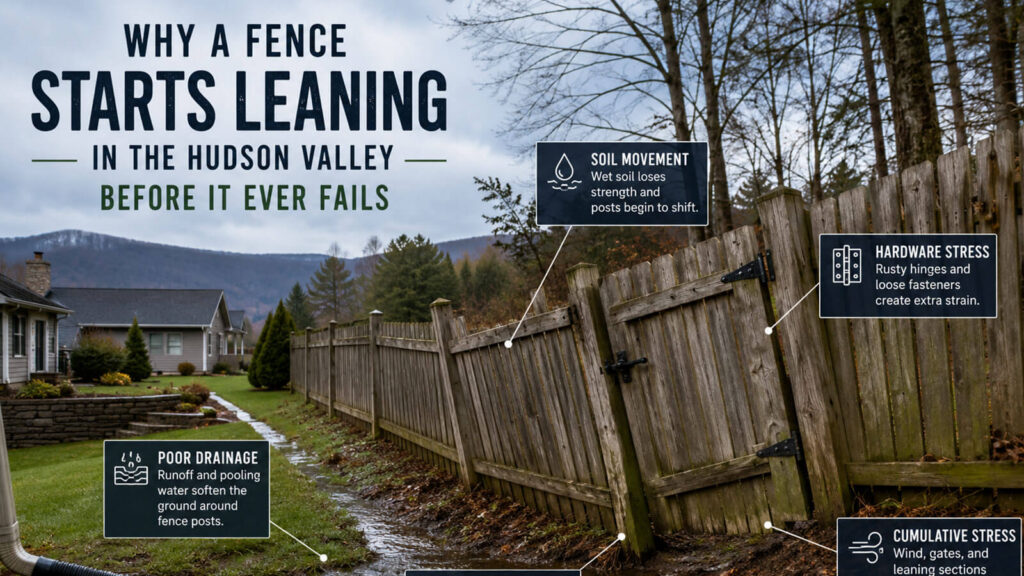
A fence rarely “just falls over.” More often, it starts with one post moving a little, a gate that suddenly stops latching cleanly, or a line of pickets that looks slightly off after a wet spring. By the time a homeowner notices the problem, the real issue is usually buried in soil movement, drainage, or aging hardware—not just the visible board or panel that looks crooked.
That’s especially true on older properties with mature trees, sloped yards, and freeze/thaw cycles that work on fence posts all winter. In places like Dutchess, Putnam, and Westchester counties, a fence can look fine one month and begin shifting after a heavy rain season or a rough winter. If you’re already noticing movement, it may be worth comparing what you’re seeing with yard drainage problems that could be softening the ground around the line.
The frustrating part is that fence problems are easy to underestimate. A homeowner sees a leaning section and assumes it’s a simple reset. A contractor usually sees a bigger question: why did the post move in the first place, and what else is still hidden under the surface?
What usually causes a fence to lean
Soil movement is the first place most experienced contractors look. Posts set in ground that stays wet for long stretches tend to loosen over time, especially in backyards with poor drainage or compacted clay. On older Hudson Valley lots, runoff from a driveway, patio, or uphill grading can keep one stretch of fence constantly saturated while the rest of the line stays stable.
Wood rot is another common culprit, but not always where homeowners expect it. The visible board may look weathered, while the actual structural failure is at the base of the post below grade. That’s one reason a fence can appear “fine” from the street but feel loose when you push on it.
Hardware matters too. Fasteners rust, brackets loosen, and gate posts take more stress than homeowners realize. A sagging gate can pull on the next section, which creates a chain reaction across the run. What looks like a single bad panel is often the end result of repeated strain.
The mistake homeowners make when they try to patch it quickly
The most common shortcut is adding a brace, replacing a few pickets, or packing more concrete around a post without addressing the reason the post moved. That can buy time, but it usually doesn’t solve the problem if the base is sitting in wet soil or the fence line is under constant wind load. In fact, a fast cosmetic repair can delay a more honest fix until the damage spreads.
Another issue is replacing only the visibly damaged section while ignoring the neighboring posts. Contractors often check the surrounding line because one failed post usually means nearby posts were set under the same conditions. If the soil is soft, the drainage is bad, or the fence is on a slope, the “fixed” area may start shifting again within a season or two.
This is where homeowners can get trapped by online advice that sounds simple but doesn’t match real site conditions. A fence in a dry, flat yard is not the same as a fence running along a wooded, sloped property with snowmelt pushing water downhill.
What a contractor usually checks first
Good fence repair starts with the ground, not the hardware store. Contractors typically look at post depth, footing condition, soil stability, and whether the fence line is fighting water. They’ll also inspect gates, end posts, corner posts, and any areas where the fence changes direction, because those are the points where stress builds fastest.
In tighter suburban neighborhoods, especially in parts of Westchester, privacy and setback concerns can complicate repairs. In rural and semi-rural areas of Dutchess or Putnam, the bigger issue is often long runs of fence exposed to wind, runoff, and uneven ground. That’s why homeowners searching for local fencing contractors usually get better results when they describe the site conditions, not just the visible damage.
Contractors also pay attention to whether the fence is wood, vinyl, chain-link, or split rail, because each one fails differently. Wood posts rot. Vinyl can crack or flex when the base loosens. Chain-link often reveals problems through leaning terminal posts or stretched tension. Split rail tends to settle and separate before it fully fails.
Why drainage problems are so often part of the story
Water is a bigger fence killer than most homeowners expect. If downspouts dump near the line, if a yard slopes toward the fence, or if snowmelt pools in the same area every winter, the soil around the posts gradually loses strength. Once that happens, even a properly installed fence can start shifting.
That’s why fence repairs sometimes turn into conversations about grading, gutters, or surface drainage. It’s not a sales tactic; it’s simply how the problem presents in the field. A fence can be repaired correctly and still fail early if the ground around it stays wet. In that sense, fence work and broader Dutchess County fencing services often overlap with yard drainage, hardscape edges, and runoff management.
A counterintuitive detail: the most obvious leaning section is not always where the problem started. Sometimes the actual cause is one or two posts away, where water collects or where the fence line meets a gate. The visible symptom is often just the weakest spot in a larger stress pattern.
When repair makes sense and when replacement is the better call
If the issue is isolated to one or two posts, and the rest of the line is structurally sound, repair can be a smart move. That said, repair only makes financial sense when the surrounding fence has enough life left to justify it. If multiple sections are rotting, hardware is rusting out, or the line has already been patched several times, replacement may be the better long-term decision.
Homeowners often hesitate here because a partial fix feels cheaper. Sometimes it is. But repeated piecemeal repairs can cost more than replacing the problem stretch once, especially if labor has to return multiple times. A contractor looking at the full line is usually thinking about durability, not just the immediate patch.
Fence age matters too. A 20-year-old wood fence with widespread base rot is not the same as a newer fence with one storm-damaged gate. The first one usually needs a broader plan. The second may only need a targeted repair and a few upgrades to keep it stable.
Why Hudson Valley properties can be harder on fences
Local conditions do not treat every fence the same. Mature tree roots can lift or disturb the ground. Winter freeze/thaw cycles can widen small footing problems. Heavy rainfall can turn a slightly soft area into a real leaning issue. On some properties, long driveways and detached outbuildings create runoff patterns that quietly affect fence lines year after year.
Wooded lots in Dutchess and Putnam often trap moisture longer than open yards. In Westchester, tighter lot lines and neighbor-facing privacy fences can make it harder to notice gradual movement until the gate starts binding or panels begin to drift out of alignment. That’s one reason homeowners in these areas benefit from getting broad-context guidance from fencing contractors in Putnam County or Westchester County fencing services when the problem is more than a single loose board.
Older homes also tend to have older fence systems, and older installations were not always built with today’s drainage or footing expectations. A lot of the trouble comes from assumptions made years ago that no longer hold up after a few bad winters.
What not to ignore while you’re looking at the fence
It’s worth checking the posts nearest the trouble spot, but also the area around the fence. Look for downspouts pointing toward the line, standing water after rain, soil pulling away from the post, loose caps, rusted hinges, and gates that don’t close smoothly anymore. Those details often tell you more than the panel itself does.
If the fence is part of a larger outdoor project, it can be smart to think about the rest of the yard layout at the same time. Privacy, access, grading, and usable space often overlap, especially when homeowners are already considering outdoor structure planning for patios, seating areas, or backyard transitions.
And if you’re not sure whether the issue is cosmetic or structural, that uncertainty is usually a sign to have it looked at sooner rather than later. Fence problems rarely improve on their own. They typically get more expensive once a leaning post starts affecting neighboring sections.
Practical next steps before the problem spreads
Start by documenting what has changed. Take a few photos from the same angle over a couple of weeks if you can. Note whether the problem gets worse after rain, snowmelt, or windy weather. That kind of pattern matters more than a single snapshot.
Then check whether the fence line is part of a drainage problem, a gate issue, or a broader settlement problem. If the ground feels soft or soggy, don’t assume a simple reset will hold. If the gate is dragging, look at the posts supporting it before replacing the latch. And if multiple sections are out of alignment, it may be time to get a professional opinion before the damage spreads.
For homeowners who want a broader place to start understanding related maintenance concerns, HV Trades also offers homeowner resources that can help connect the dots between drainage, exterior wear, and repair timing.
Frequently Asked Questions
Can a leaning fence be repaired, or does it always need replacement?
It depends on how many posts are affected and why they moved. One or two isolated failures can often be repaired. If the fence has widespread rot, repeated settling, or drainage problems, replacement may be the more durable option.
Why do fence posts loosen after heavy rain?
Heavy rain softens the soil around the post and can wash out support at the base. If the yard slopes toward the fence or water pools nearby, the problem usually comes back unless drainage is addressed.
Is a crooked gate a bigger problem than it looks?
Often, yes. A gate that sags or won’t latch can signal movement in the support posts, not just worn hinges. Contractors usually check the posts first because that’s where the real stress is.
Can I just add concrete around a loose post?
Sometimes that helps temporarily, but it doesn’t solve rot, poor drainage, or shallow footing depth. If the post is already compromised, adding more concrete can delay a proper fix without making it more reliable.
How do I know if the issue is from drainage?
Look for soft soil, standing water, runoff from gutters, or a pattern of movement after storms or snowmelt. Drainage issues often show up as repeated loosening in the same part of the fence line.
When should I bring in a contractor?
If the fence is shifting more than slightly, if a gate no longer aligns, or if multiple sections are involved, it’s time to get an evaluation. A contractor can tell the difference between a small repair and a larger stability problem before costs climb.
A fence issue is rarely just about one crooked panel. The sooner you understand what’s moving, why it’s moving, and whether water or soil is part of the problem, the easier it is to avoid repeated repairs. If you want a more confident read on the damage, working with a trusted local pro can save you from fixing the same section twice.