

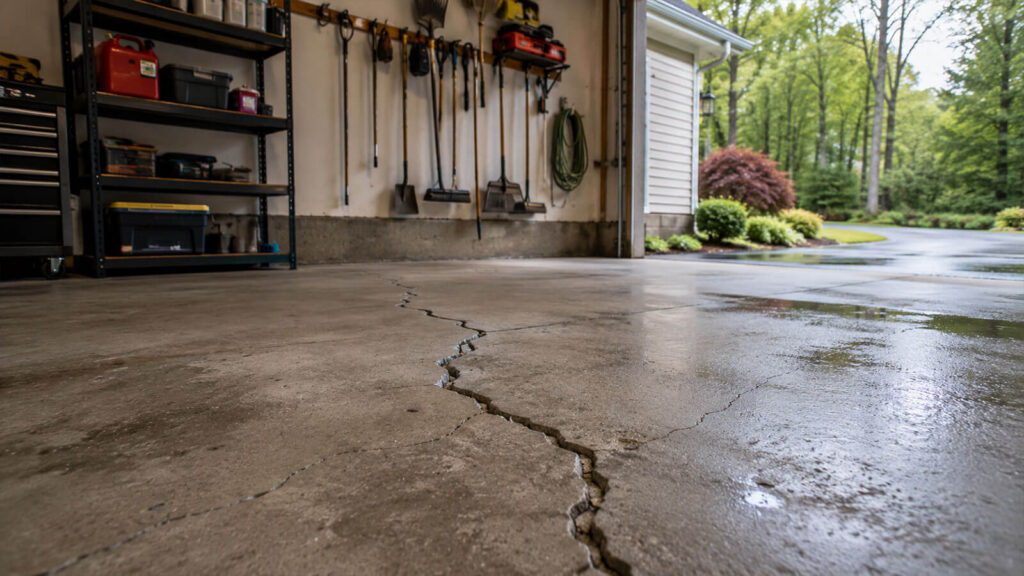
Garage floor cracks usually get dismissed the same way: “It’s just concrete settling.” Sometimes that’s true. Often it isn’t. A hairline crack in a garage slab can stay harmless for years, but a widening crack, a lifted edge, or repeated moisture along the same line can point to drainage problems, soil movement, or a foundation issue that is quietly getting more expensive in the background.
What a garage floor crack is really telling you
Concrete doesn’t crack for one reason. In the Hudson Valley, the usual suspects are freeze/thaw cycles, shifting soil, poor drainage, heavy runoff from roof lines, and slabs that were poured over ground that was never fully stabilized. Detached garages and older attached garages can be especially revealing because they often sit on simpler slabs with less reinforcement than the main house.
The tricky part is that the visible crack is not always the true problem. A crack may show where the slab finally gave way, but the cause can be outside the garage entirely. Water running off a roof, gutter overflow, or grading that sends water toward the slab can undermine the soil long before the concrete shows damage. That is why contractors usually look beyond the crack itself and check the surrounding drainage first.
If you want to understand the moisture side of the equation, it helps to look at spring drainage problems around Hudson Valley homes. A garage slab rarely behaves like an isolated surface. It is part of the whole water-management picture.
Cracks that are mostly cosmetic versus cracks that deserve attention
Not every crack means structural trouble. Some older slabs develop thin shrinkage cracks as the concrete cures. Those are common, especially in garages that were poured years ago and have gone through a lot of temperature swings.
The cracks that deserve a closer look tend to have one or more of these features:
- they are wider than a hairline and keep opening
- one side of the crack sits higher than the other
- the crack follows a pattern toward a door threshold or exterior wall
- water comes through the crack after storms or snowmelt
- the garage door starts binding or the slab near the opening feels uneven
Here is the counterintuitive part: the most alarming-looking crack is not always the worst one. A narrow crack with ongoing moisture, seasonal movement, or a soft spot beneath it can be more concerning than a wider but stable crack that has not changed in years. Experienced contractors pay attention to movement, not just appearance.
What contractors usually inspect first
Before anyone reaches for a patch, a good contractor will usually start with the conditions around the slab. That means looking at the roof runoff, downspout discharge, gutter performance, grading, and whether water tends to pool along the garage perimeter after heavy rain. If the garage shares a wall with the house, the inspection may extend to adjacent foundation walls, sill areas, or framing near the threshold.
In practical terms, the question is not “Can this crack be filled?” The better question is “Why did the slab move here?” If the cause is ignored, even a decent repair can fail early. That is why services such as gutter services that help control roof runoff can matter more than the patch itself when water is part of the problem.
Contractors also look for clues that the slab is telling a bigger story:
- settlement near one corner of the garage
- visible separation at the base of a wall
- spalling or flaking concrete near the crack
- evidence of long-term moisture along the slab edges
- poorly compacted fill under the floor
Why garage slab cracks get worse in the Hudson Valley
Local weather is hard on concrete. Freeze/thaw cycles push moisture into small openings, then expand it. Heavy rains can saturate the soil under and around a garage, and once that support softens, the slab starts to move. In wooded areas, roots and drainage patterns can complicate the issue further. On long driveways or properties with steep grades, water often travels farther than homeowners expect before it finally collects near a garage floor.
That is why a crack that seems minor in July can look much worse by late winter. Snowmelt, frozen discharge lines, and repeated wet-dry cycles create pressure from below and from the sides. On some properties, the garage slab is really the first place that pressure becomes visible.
When the drainage around the property needs correction, targeted fixes like landscaping drainage fixes that reduce water near the foundation can do more for long-term slab stability than a cosmetic concrete repair ever will.
Common homeowner mistakes that make the problem harder to solve
One of the most common mistakes is sealing the crack immediately without understanding why it formed. That can be fine for a stable cosmetic crack, but if water is actively entering or the slab is still moving, a quick patch often becomes a temporary disguise.
Another mistake is assuming that if the garage door still works, the slab must be fine. Not necessarily. Doors can keep operating while the floor is gradually changing shape. By the time a door starts scraping or the threshold feels off, the movement has usually been happening for a while.
Homeowners also sometimes ignore drainage because the crack only appears inside the garage. That is backwards. In many cases the real damage is outside the building line, where runoff, settled soil, or clogged gutters are sending water where it should never be.
When a simple repair is enough — and when it isn’t
If the crack is narrow, stable, dry, and not tied to any visible settlement, a straightforward repair may be reasonable. That might include cleaning the crack, filling it with an appropriate material, and watching it through a full season of weather changes.
But if the crack is widening, leaking, or paired with uneven slab movement, the repair conversation changes. At that point, a patch is only one small part of the answer. You may be looking at drainage correction, slab stabilization, threshold repair, or broader structural work. In some cases, it makes sense to involve foundation and waterproofing contractors to evaluate whether water intrusion or soil conditions are part of the issue.
For larger projects that involve the slab, framing, doorway adjustments, or repairs tied into adjacent parts of the structure, general contracting services for larger garage repairs can help coordinate the work so the problem is addressed as a whole instead of in disconnected pieces.
Why cheap fixes often fail first
There is a reason inexpensive crack fillers and surface sealers have a mixed reputation. They can work on a dormant crack, but they do very little if the slab is actively moving or if water is still feeding the problem. Concrete needs stable support. Without that, a repaired crack often reopens along the same line.
Another issue is that some repairs only treat the surface while the trouble is underneath. If the soil has settled, the slab edge may continue dropping even after the visible crack has been filled. That is when homeowners feel like they “already fixed it” and still end up spending more later.
If you’re not sure what type of contractor fits the problem, it is often smarter to find the right contractor trade for the problem before paying for a repair that does not address the real cause.
How to think about timing
Garage slab cracks are the kind of issue that can seem low priority right up until they aren’t. Delaying matters when moisture is involved, when the crack is changing seasonally, or when the garage sits close to the house foundation. Water does not need much of an opening to start widening a problem over time.
That doesn’t mean every crack is an emergency. It does mean a homeowner should watch for change. Mark the ends of the crack, take a photo, and note whether it looks different after heavy rain, snowmelt, or a freeze. Movement is what changes a maintenance item into a repair item.
What a practical homeowner should do next
Start by looking at the whole garage, not just the floor. Check gutters, downspouts, grading, the edge of the slab, and any signs of standing water after storms. If water is spilling near the garage, fix that first. If the crack is active, uneven, or tied to moisture, get a professional opinion before investing in cosmetic repairs.
The best repair plans are usually the boring ones: control the water, confirm the support under the slab, then decide whether sealing, patching, or a larger structural repair makes sense. That sequence saves money because it avoids treating the symptom first and the cause later.
Frequently Asked Questions
Is every garage floor crack a foundation problem?
No. Some are just shrinkage cracks in the concrete. The concern starts when the crack widens, leaks, or shows one side higher than the other.
Can I just fill the crack myself?
Yes, if it is stable and cosmetic. If the slab is moving or water is getting in, a DIY fill is usually temporary at best.
Why does the crack get worse after winter?
Freeze/thaw cycles force moisture in and out of the concrete and surrounding soil. That movement can open the crack further or expose a drainage issue that was already there.
Should I worry if the garage door still opens normally?
Not automatically, but it is not a guarantee that the slab is fine. Floors can shift long before the door operation becomes obviously affected.
What’s the biggest mistake homeowners make with garage slab cracks?
Fixing the crack before figuring out where the moisture or movement is coming from. That often leads to repeated repairs.
Who should inspect it first?
Usually a contractor familiar with concrete, drainage, and foundation conditions. If the issue seems broader, a general contractor or foundation specialist may be the better first step.
If the crack in your garage floor has been changing, leaking, or showing up after storms, it is worth getting a grounded opinion before it turns into a larger repair. The right local contractor can help you sort out whether you are dealing with a simple slab repair or a bigger drainage or foundation issue that deserves attention now rather than later.