

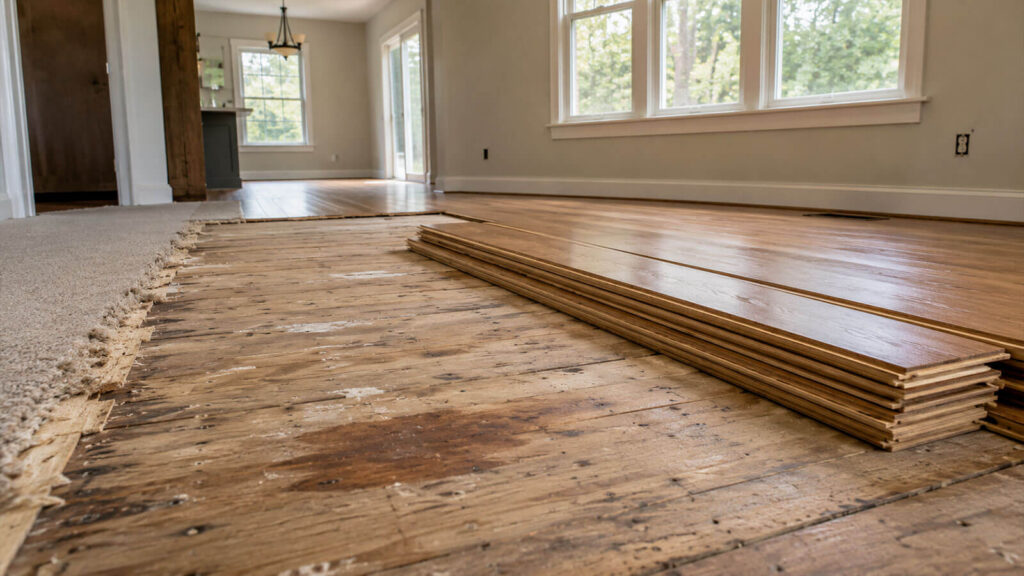
Hardwood floors can make a house feel instantly more finished, but the price tag is rarely just the boards and labor. What catches homeowners off guard is everything around the flooring: carpet removal, subfloor prep, transitions, trim work, moisture checks, and the small repairs that become obvious only after the old floor comes up. In older Hudson Valley homes, that “small project” can turn into a much more detailed one once contractors start looking below the surface, especially when there are signs of sagging, uneven rooms, or moisture or waterproofing issues below the floor.
If you are planning a carpet-to-hardwood upgrade, the smartest thing you can do is think in layers. The visible finish matters, but so does what is hiding underneath it. That is where budgets get stretched, and where homeowners most often underestimate the scope.
What actually drives hardwood installation cost
There is no single “per square foot” number that tells the whole story. Two rooms with the same square footage can cost very differently depending on what has to happen before the first plank goes down. The condition of the subfloor, the type of hardwood, whether the existing carpet is glued or stretched, and how much trim has to be removed and reinstalled all change the price.
Contractors usually start with the floor system itself, not the finish. They want to know whether the subfloor is flat enough, dry enough, and structurally sound enough to support the new material. If it is not, the installation cost climbs quickly because the labor is no longer just installation. It becomes prep, correction, and sometimes repair.
Older homes in Dutchess, Putnam, and Westchester counties often add a few layers of complication: settled framing, patched flooring from previous renovations, older baseboards that do not come off cleanly, and minor height differences between rooms. None of that is unusual. But each one adds time, and time is part of the cost.
Carpet removal is rarely the simple part
Homeowners often assume carpet removal is a quick cleanup job. Sometimes it is. More often, it reveals the exact reason the old flooring was hiding the room in the first place. Padding can be stapled aggressively, tack strips can break apart, and glued-down carpet on concrete or older underlayment can be stubborn enough to require extra labor.
What contractors often discover is that the carpet was doing more than covering the floor visually. It may have been masking movement, dips, squeaks, stains, or old water damage. That is one reason cheap shortcut estimates can be misleading. If someone quotes removal like it is a straight linear task without asking about the condition underneath, the quote is probably incomplete.
For homeowners comparing bids, it helps to ask what is included in the removal line item. Does it cover disposal? Tack strip removal? Staple cleanup? Is furniture moving included? A low number can look attractive right up until the extras start appearing one by one.
The hidden costs usually live in the prep work
This is where experienced contractors pay close attention. Hardwood installation depends on more than appearance; it depends on flatness, moisture, and fastening conditions. If the floor is not properly prepared, the finished product can squeak, gap, cup, or fail much sooner than expected.
Prep work may include leveling compounds, replacing damaged subfloor sections, fixing squeaks from loose framing, addressing transitions at doorways, and checking for moisture migration from below. In some homes, especially those with finished basements or crawlspaces, the issue is not the wood at all. It is the environment under it.
One counterintuitive thing homeowners often miss: the stain on a floor or the warp in a board is not always the actual problem. It is often the symptom of a broader moisture pattern, poor ventilation, or a drainage issue outside the home. That is why a good installer looks beyond the visible damage before recommending a finish system.
If the home has a history of basement seepage or damp lower-level rooms, it may be worth reviewing drainage problems that can lead to basement moisture before investing heavily in new flooring. Spending on hardwood while ignoring water entry is one of the most frustrating ways homeowners end up paying twice.
Where Hudson Valley homes are especially tricky
Regional housing patterns matter. In this area, many homes are older, and older homes do not always behave like modern builds. Stone foundations, seasonal movement, steep grading, long private driveways, and mature trees all create conditions that affect flooring decisions indirectly. Moisture from spring runoff, snowmelt, or heavy rain can travel in ways that do not show up until a floor starts to react.
Basements and first floors are especially sensitive. Even if the hardwood itself is installed properly, the surrounding conditions can create long-term trouble if the home has humidity swings or chronic dampness. That is why flooring projects in the Hudson Valley sometimes overlap with broader conversations about air sealing, crawlspace conditions, and exterior drainage.
There is also a practical design issue people overlook: some older homes were never built with today’s flooring heights in mind. Once carpet and pad come out, transitions at kitchens, hallways, stair nosings, and thresholds can become a real part of the job. What looked like a straightforward swap may require trim adjustments or even general contracting services for larger remodels if the project starts touching multiple finishes and structural details.
When hardwood costs more than homeowners expect
There are a few predictable moments when the budget starts climbing.
- The subfloor is uneven and needs correction.
- Moisture testing shows the room is not ready for installation.
- Old carpet glue, staples, or underlayment take longer to remove than expected.
- Baseboards, casings, or transitions need to be removed and reset carefully.
- Stair work or adjoining rooms need matching finishes.
- Hidden damage appears after the old flooring comes up.
That list is not meant to discourage the project. It is meant to keep expectations realistic. Homeowners usually feel better when the estimate includes the likely friction points up front instead of hiding them inside vague language like “additional prep as needed.”
When a contractor is transparent, they are usually telling you where the job can expand. That honesty matters more than the cheapest number on the page.
Why cheap flooring quotes can be expensive later
A low bid can be fine if the scope is genuinely simple. The problem is that some quotes are low because they exclude the very items that commonly arise during installation. That can mean surprise charges for leveling, disposal, trim work, moving furniture, or replacing sections of damaged underlayment.
Another common issue is labor quality. Hardwood installation is unforgiving around acclimation, fastening, expansion gaps, and moisture management. A rushed install may look acceptable on day one and still fail early because the conditions were never addressed correctly. Once boards start reacting to seasonal changes, the repair conversation becomes much more expensive.
This is why many homeowners value trusted local contractor help before committing to a project. It is not just about finding someone to install flooring. It is about understanding which parts of the house need to be checked first so the finished floor does not become a recurring problem.
What a good contractor checks before installation
Experienced installers usually do not start with style samples. They start with moisture, flatness, and structure. Then they move to the practical details that affect fit and finish.
- Is the subfloor dry and within an acceptable moisture range?
- Are there soft spots, squeaks, or loose sections?
- Is the room flat enough for the flooring type selected?
- Will the new floor meet adjoining surfaces cleanly?
- Are the baseboards and casing being removed or left in place?
- Is there evidence of past leaks, seepage, or condensation?
Those questions sound basic, but they are exactly where projects succeed or fail. Homeowners tend to think in terms of product. Contractors think in terms of system. That difference matters.
If the floor is being installed as part of a broader renovation, it may also make sense to look at homeowner resources for planning bigger projects so the flooring budget does not get separated from the rest of the remodeling scope. Floors touch nearly everything else in a room, and it is easy to miss that until the job is already underway.
Signs you should pause before installing new hardwood
There are a few warning signs that should slow the project down, not speed it up.
Persistent dampness, a musty smell, visible staining, cupping in adjacent rooms, recurring condensation at lower walls, or seasonal movement in the floor can all point to moisture or structural issues that should be addressed first. The same goes for older homes where the subfloor has already been patched multiple times or where the room feels spongy underfoot.
It is tempting to assume new flooring will “cover it up.” That approach almost never works for long. Hardwood is not forgiving when the conditions underneath are unstable. Even floating systems and engineered products have limits if the base is compromised.
If the home also has basement seepage, foundation cracks, or drainage concerns, it is worth looking into foundation waterproofing services before investing in premium flooring materials. The order matters. Fixing the environment first is usually cheaper than replacing boards later.
Practical ways to keep the project on budget
Homeowners can save money without cutting corners, but the savings usually come from planning rather than bargain hunting.
Get the room measured accurately. Ask what prep is likely before the job begins. Clarify whether furniture moving, trim removal, waste disposal, and transitions are included. If you are comparing materials, remember that the product price is only one part of the equation; installation difficulty can swing the final total more than the flooring itself.
It also helps to choose a contractor who will tell you when the room is not ready. That answer may be inconvenient, but it is cheaper than watching a fresh floor fail because moisture or leveling was ignored.
For larger homes or projects that may expand into multiple rooms, stairs, or trim updates, flooring installation contractors can help separate the real scope from the optimistic one. That distinction is what keeps flooring projects from turning into expensive surprises.
Frequently Asked Questions
How much does hardwood installation cost compared with carpet removal and replacement?
Hardwood installation usually costs more because the labor is more precise and the prep is more demanding. Carpet removal is only one part of the job. The real cost difference comes from subfloor prep, trim work, and how much correction is needed before installation.
Do I need to replace the subfloor before installing hardwood?
Not always. But if the subfloor is damaged, uneven, or holding moisture, replacement or repair may be necessary. A contractor should inspect for soft spots, movement, and any signs of prior water intrusion.
Can hardwood be installed over damp basements or crawlspaces?
It can be risky. Even if the floor itself is installed correctly, ongoing moisture from below can cause cupping, swelling, or failure over time. The source of moisture should be addressed first.
Is engineered hardwood a better choice for older Hudson Valley homes?
Sometimes, yes. Engineered hardwood can perform better in homes with seasonal humidity swings or minor substrate movement, but it still needs a stable, dry base. It is not a fix for drainage or foundation problems.
What should I ask before accepting a flooring estimate?
Ask what the estimate includes, what counts as extra prep, whether moisture testing is part of the process, and how transitions, trim, and disposal will be handled. The answer tells you a lot about how complete the quote really is.
Can I save money by removing the carpet myself?
Sometimes, but it depends on what is underneath. DIY removal can save labor if the room is straightforward, but it can also expose hidden issues, create disposal headaches, or leave behind staples and adhesive that still need professional cleanup.
Hardwood is one of the most satisfying upgrades a home can get, but it pays to approach it like a real construction project, not just a finish choice. If you want to protect the budget and avoid the usual mistakes, start with the conditions under the floor, then work outward from there. For homeowners comparing options, getting guidance from local professionals who understand the quirks of Hudson Valley homes is often the difference between a smooth project and an expensive reset.