

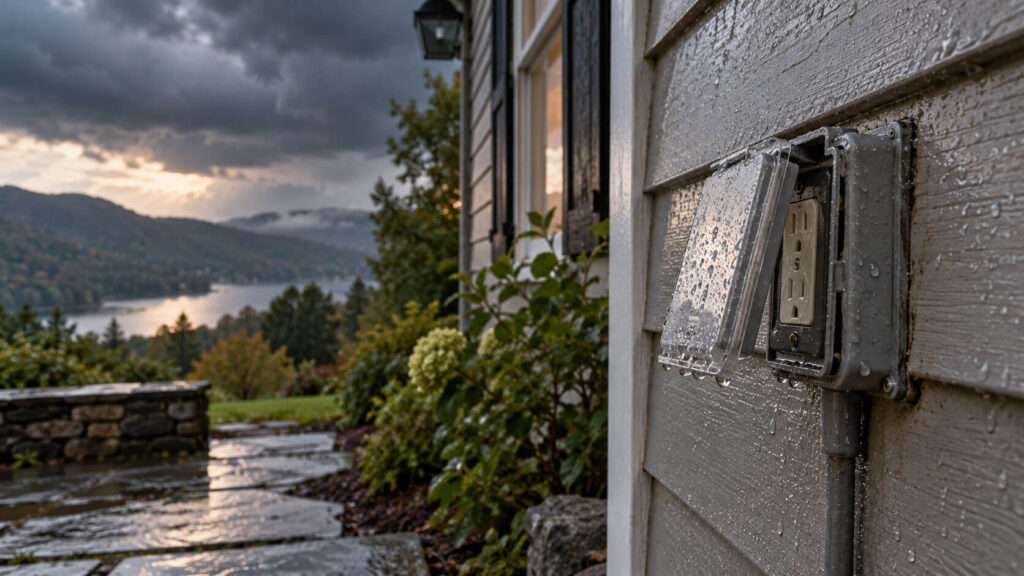
Why a Loose Outdoor Outlet in the Hudson Valley Deserves More Attention Than Most Homeowners Give It
A loose exterior outlet seems minor right up until the first hard rain, a wet extension cord, or a tripped breaker that keeps resetting for no obvious reason. It is one of those small household issues that homeowners often put off because the outlet still “works.” The problem is that outdoor electrical trouble rarely stays simple for long. Moisture finds weak points. GFCI protection starts doing its job. Covers crack, caulk fails, and a loose box can become a much bigger safety concern than it looked from the porch.
That is especially true in the Hudson Valley, where freeze/thaw cycles, heavy spring rain, snow melt, and older homes all conspire against exterior wiring. In a lot of local houses, outdoor outlets were installed years ago and never revisited unless they failed outright. By the time a homeowner notices flickering holiday lights or a plug that feels wobbly, there is usually more going on behind the cover than just a loose screw. If you are already seeing tripping, corrosion, or water staining, it is worth reading more about outdoor electrical safety in the Hudson Valley before the problem gets more expensive.
Why loose outdoor outlets are not just a cosmetic issue
An exterior receptacle has a harder life than most people realize. It is exposed to moisture, UV damage, temperature swings, insects, and whatever the home’s siding and trim are doing around it. Once the outlet box loosens, water intrusion becomes more likely, and even a small amount of movement can damage the connection points inside the box.
What contractors often inspect first is not the outlet face itself, but what is happening behind it: the box mounting, the condition of the wiring, the cover seal, and whether the circuit is protected the way it should be. A bad cover can let rain in. A failing box can let the outlet shift. A weak connection can arc or heat under load. That is how a “loose plug” turns into a repair that touches wiring, weatherproofing, and sometimes the circuit path upstream.
The counterintuitive part is that the visible symptom is often the least important clue. The outlet may wobble because the box is loose in the siding, not because the receptacle itself is bad. Or the problem may be on the circuit, with a marginal connection in a nearby junction box causing the outlet to trip whenever moisture shows up. That is why quick cosmetic fixes tend to fail.
What homeowners usually miss before the outlet starts failing
People often assume an outdoor outlet is only a problem if it sparks, stops working, or feels hot. In reality, the earlier signs are more subtle:
- the cover does not close tightly
- the outlet moves when a cord is plugged in
- the GFCI trips after rain or snow melt
- the faceplate is discolored or rusty
- there is a faint buzzing or intermittent power loss
- the caulk or sealant around the box is cracked
Homeowners also overlook how often outdoor outlet trouble is tied to other exterior wear. Rotting trim, failing siding caulk, gutter overflow, and splashback from bad grading can all feed the same moisture problem. If the outlet sits under a roofline where gutters dump water, or near a walkway that gets shoveled and salted every winter, it may fail faster than the rest of the exterior electrical system.
That is why some repairs keep coming back. The outlet gets replaced, but the real cause remains. For homeowners dealing with recurring trips, it may help to understand when an outdoor outlet keeps tripping, since the trip itself is often a symptom rather than the root issue.
How contractors tend to diagnose the problem
Good electricians usually start by asking whether the outlet is part of a GFCI-protected circuit and whether other exterior or garage receptacles are on the same line. In older Hudson Valley homes, one GFCI may protect several outlets in different locations, including detached garages, porches, basements, and even basement bathroom circuits. That can make the problem look random when it is actually tied to one upstream device or connection.
They will also check whether the outlet box is properly fastened, whether the device is rated for damp or wet locations, and whether the weatherproof cover is doing its job. A lot of homeowners are surprised to learn that a standard indoor-style cover is not enough outside. If the box is installed near grade, on an exposed wall, or beneath a roof edge that still catches wind-driven rain, the wrong cover can invite repeat failure.
In Dutchess County, for example, storm-related outlet issues often show up after a season of moisture exposure rather than one dramatic event. If you need targeted help, it is reasonable to look into electrical help in Dutchess County before the issue spreads to other exterior fixtures. Putnam County homeowners dealing with older porches, detached garages, or long side-yard runs may need a similar level of attention, which is where Putnam County electrical services become relevant.
Why DIY fixes can make outdoor outlet problems worse
This is one of the easier electrical problems to underestimate. Tightening a screw or swapping a cover sounds harmless. But if the box is loose, the wiring is brittle, or moisture has already reached the connection, a superficial fix can hide the warning signs without actually solving them.
Two common mistakes show up again and again:
- using indoor-rated parts outdoors because they “fit”
- sealing over a damp or damaged box so the problem stays trapped inside
That second mistake matters more than most homeowners think. If moisture is already inside the box, caulking the front edge can trap it there and accelerate corrosion. The repair may look better for a while, but the outlet can fail again as soon as temperatures swing or humidity rises.
There is also the issue of load. Outdoor outlets are often used for holiday lighting, power tools, sump pump accessories, dehumidifiers, or patio equipment. A loose outlet that only seems unreliable under load may be pointing to a connection problem deeper in the circuit. That is not the place to guess.
What makes Hudson Valley homes a little harder on exterior wiring
Older homes in the region often have a patchwork of updates. A porch outlet may be newer than the siding around it. A garage circuit may have been added years after the original panel. Stone foundations, aging trim, and wood siding can all make exterior weatherproofing more complicated than it looks from the outside.
Then there is the weather. Freeze/thaw cycles can loosen fasteners. Snow and ice can push water into seams. Summer humidity can speed corrosion. In wooded neighborhoods, leaves and debris can clog drainage around the house and keep lower walls damp for longer than expected. If the property has a steep grade or a long driveway, storm runoff can also find its way toward exposed exterior walls and outlets.
On top of that, many homes still rely on older electrical infrastructure that was never designed for today’s load. Outdoor kitchens, EV chargers, freezers in garages, and heavy seasonal lighting can stress circuits that were already marginal. That is one reason a loose outlet is worth investigating sooner rather than later: the issue may be the first visible sign of a broader electrical system that needs attention from licensed electrical contractors.
When the repair is bigger than the outlet
Sometimes the fix is straightforward. Replace the receptacle, secure the box, install the proper weatherproof cover, verify GFCI protection, and reseal the opening correctly. Other times, the outlet is just the place where hidden damage finally becomes visible.
Contractors start thinking bigger when they see:
- heat damage inside the box
- corroded conductors or rusted hardware
- repeated moisture intrusion despite prior repairs
- other exterior devices on the same failing circuit
- evidence that the box has shifted in the wall
Once those signs show up, the conversation can move from a simple outlet replacement to weatherproofing the opening, inspecting nearby wiring, and sometimes evaluating the route back to the panel. That does not mean every loose outlet is a major project. It does mean the “cheap fix” is not always the least expensive option if it has to be redone twice.
Homeowners in Westchester dealing with older homes, heavy tree cover, and storm-exposed walls may want to speak with an electrician in Westchester County if the outlet issue is part of a broader pattern of exterior electrical wear.
How to know when to stop using the outlet
If an outdoor outlet is visibly loose, sparks, feels warm, repeatedly trips, or shows rust and water staining, the safest move is to stop using it until it has been inspected. That is especially true if the outlet powers anything essential, like a sump pump accessory, outdoor freezer, or security equipment.
Even if the outlet appears to work, intermittent issues can worsen quickly once weather changes. A plug that fits loosely can create arcing over time. A cover that does not seal can let in just enough moisture to corrode the contacts. The result may not be dramatic. It may just become a persistent nuisance until one day the circuit refuses to reset.
That is why a cautious response is usually the smart one. Homeowners tend to wait for a total failure, but electrical problems often give enough warning if you know what to look for. The warning signs are not always dramatic; they are usually just inconvenient, intermittent, and easy to dismiss.
Practical next steps if you notice a loose exterior outlet
If the outlet is only slightly loose and there are no signs of heat, moisture, or damage, have it inspected soon rather than letting it ride through another storm season. If there is visible corrosion, a failing cover, or repeated tripping, move it higher on the priority list.
A contractor will typically want to confirm the outlet’s rating, check the box mounting, verify GFCI protection, and inspect nearby exterior penetrations for water entry. In some cases, the best long-term fix includes better cover hardware, improved sealing around the siding, or replacing other weather-worn components nearby so the problem does not keep returning.
If the outlet is part of a larger outdoor electrical concern, it can help to look at the whole system instead of one device at a time. That is usually where homeowners save money in the long run.
Frequently Asked Questions
Is a loose outdoor outlet dangerous right away?
Not every loose outlet is an emergency, but it should be taken seriously. If it is exposed to moisture, trips often, or shows signs of corrosion or heat, stop using it until it is inspected.
Why does my outdoor outlet trip after it rains?
Moisture is likely entering the outlet box, the cover, or a nearby connection. In some cases, the outlet is protected by a GFCI that is correctly detecting a fault caused by water intrusion.
Can I just replace the cover myself?
You can replace a cover if you are comfortable doing so safely, but that only helps if the box, wiring, and weatherproofing are sound. If the outlet is loose or damaged, the cover alone will not solve the problem.
What kind of cover should an exterior outlet have?
It should be rated for outdoor use and appropriate for the location. A covered outlet in a damp area is not the same as one fully exposed to rain. The wrong cover is a common reason repairs fail early.
Why do older Hudson Valley homes have more outdoor outlet issues?
Because many were built before today’s weatherproofing standards and have since gone through partial updates. Aging trim, settling, moisture exposure, and older electrical layouts all make exterior outlets more vulnerable.
Should I keep using an outlet if it only feels loose but still works?
That is usually the point where homeowners get into trouble. A loose outlet can worsen gradually, and the problem behind it may already be electrical or moisture-related even if power still seems normal.
If an outdoor outlet is acting up, the safest move is to treat it as a real maintenance issue rather than a minor annoyance. A little attention now can prevent repeated trips, water damage, and avoidable electrical repairs later. For homeowners who want a steadier path forward, working with experienced local professionals is usually the best way to protect the house without guessing.
