

Boiler Repair or Replacement? How Hudson Valley Homeowners Can Make the Right Call
When a boiler starts acting up in the middle of a cold spell, the decision is rarely as simple as “fix it” or “replace it.” What usually happens is more frustrating: the heat still works, but not quite right. A radiator runs cooler than the others. The system makes new noises. The energy bill creeps up. Then the question becomes whether you’re looking at a straightforward repair or the beginning of a much bigger heating problem.
That’s where a lot of homeowners get tripped up. The most expensive mistake is often waiting too long because the boiler is technically still running. In older Hudson Valley homes, that delay can turn a manageable repair into a rushed replacement during the coldest part of the season, when options are limited and labor availability tightens. If you’re already comparing repair costs and replacement quotes, it helps to talk with local HVAC contractors who understand how these systems age in real homes, not just on paper.
Why boiler decisions are rarely black and white
Boilers tend to fail in stages, not all at once. That matters. A homeowner may only see one symptom, while a contractor is looking at the larger pattern: corrosion in the heat exchanger, failing controls, pressure drops, chronic air in the lines, circulator issues, or evidence that the system has been patched repeatedly. Once one part starts giving trouble, it often exposes the next weak link.
In older houses around Dutchess, Putnam, and Westchester counties, the boiler itself is only part of the story. Distribution matters. So does insulation, piping condition, venting, and whether the home has been “updated” over time in ways that never quite matched the original system design. That’s why two boilers with the same age can have very different futures.
The warning signs that matter most
Some boiler issues are obvious. Others are easy to dismiss until they become expensive. The signs that usually deserve serious attention include:
- Repeated breakdowns in the same heating season
- Uneven heat between rooms or floors
- Rising fuel use with no clear weather explanation
- Short-cycling, where the boiler turns on and off too frequently
- Leaks around the unit, relief valve, or nearby piping
- New banging, whistling, or gurgling noises
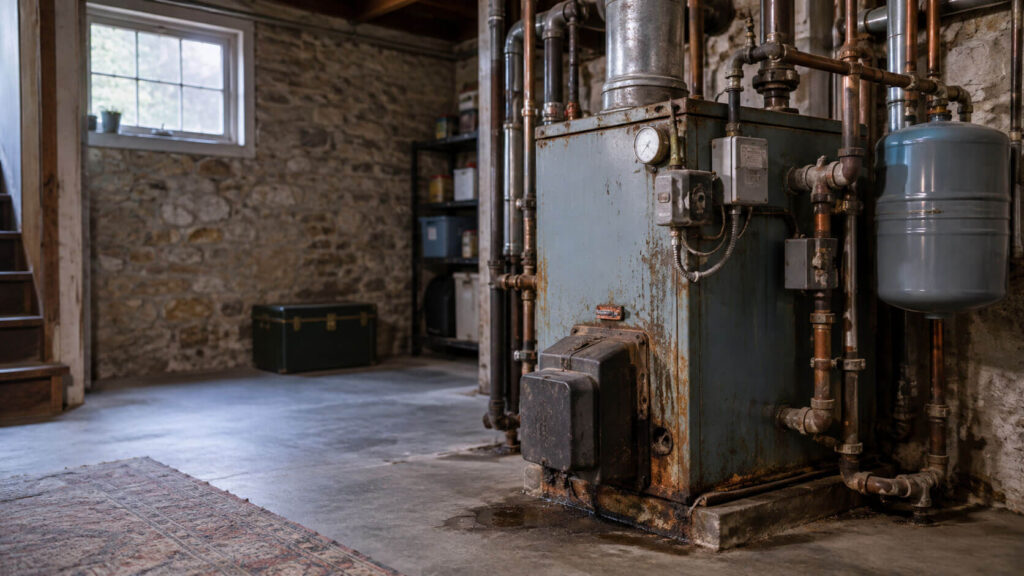
- Visible rust or corrosion on the boiler cabinet or connected pipes
- Problems with ignition, pilot light, or electronic controls
One counterintuitive point that surprises homeowners: the loudest symptom is not always the most expensive problem. A noisy circulator pump or air in the system can sound dramatic, but the deeper issue might be poor water quality, failing controls, or an aging installation that keeps stressing parts. Contractors usually know to inspect the whole system first instead of chasing the noise alone.
What contractors usually check before recommending replacement
A good heating contractor is not supposed to jump straight to replacement just because the boiler is old. Age matters, but condition matters more. The first things worth checking are usually the heat exchanger, combustion performance, flue and venting, pressure behavior, zone controls, and whether the unit has been serviced consistently.
They’ll also look at the surrounding equipment and the home itself. Is the boiler oversized for the house? Has the system been modified over the years with zone additions or repiping that never quite matched the original layout? Is the basement damp? Is there evidence of mineral buildup, soot, or chronic condensation? These details often tell the real story.
In some cases, what looks like “boiler trouble” is actually a system balance issue, thermostat problem, or heat loss problem elsewhere in the home. That’s why a careful diagnostic visit is more valuable than a quick guess.
When repair still makes sense
Repair is often the right move when the boiler is relatively young, the issue is isolated, and the rest of the system is in decent shape. A failing circulator, bad aquastat, pressure-relief issue, air elimination problem, or one-off leak does not automatically mean the whole boiler is done.
Repair also makes sense when the cost is reasonable compared with the remaining service life. Homeowners sometimes focus only on the price of the immediate fix, but that’s the wrong comparison. The better question is whether the repair buys meaningful time without setting up another failure in six months.
That said, patching a boiler that is already showing multiple signs of decline can be a false economy. A cheap fix that fails during a January cold snap is expensive in a very different way: emergency service, uncomfortable living conditions, and less time to choose a replacement carefully.
When replacement starts becoming the smarter call
Replacement becomes more compelling when the boiler has a history of recurring repairs, when major components are failing, or when the system is old enough that parts availability and efficiency are working against you. If the heat exchanger is compromised, the combustion issue is serious, or repair estimates are stacking up close to a substantial share of replacement cost, most experienced contractors will start steering the conversation toward a new unit.
There’s also a practical comfort angle that homeowners sometimes underestimate. An aging boiler may still run, but if it’s unreliable, noisy, or inefficient, it affects daily life more than people expect. Winter is long here. A heating system that you do not trust is a stress problem, not just a mechanical one.
For homeowners comparing options across counties, it can help to get a local perspective from HVAC contractors in Dutchess County or explore Putnam County HVAC services if the house is in that area and the system is already showing recurring problems.
Why Hudson Valley homes make boiler decisions a little more complicated
Older homes in the Hudson Valley often bring together a few factors that make heating systems harder to judge: aging piping, basements with moisture, long heating runs, retrofit additions, and years of piecemeal fixes. A boiler may be functioning exactly as installed, while the house around it has changed enough that the original setup no longer performs well.
Freeze-thaw cycles also matter. Small weaknesses in venting, piping insulation, exterior runs, or basement moisture tend to show up faster here than in milder climates. On rural properties, long driveways and detached garages can also complicate service access and fuel delivery timing. These are not small details when you’re trying to keep heat reliable through the coldest months.
And in some homes, the biggest issue is not the boiler itself but what it has been asked to do for decades. Old cast-iron radiators, mixed-age controls, and partially updated electrical systems can all contribute to a heating setup that is more fragile than it looks.
The repair shortcuts that often fail
There is a difference between a sensible repair and a shortcut that just postpones the real problem. Homeowners often get sold on the idea that replacing one part will “get a few more years” out of a boiler. Sometimes that’s true. Sometimes it’s just a way to delay a decision that should have been made sooner.
Common short-term fixes that do not solve the underlying issue include:
- Replacing one control on a system with broader corrosion or combustion issues
- Ignoring pressure problems because the boiler is still producing some heat
- Resetting a system repeatedly without diagnosing the cause of shutdowns
- Cleaning up a leak without checking whether surrounding piping has deteriorated
- Focusing only on the boiler while overlooking insulation, venting, or heat-loss issues
The hard truth is that some repairs are only worth doing if they’re part of a larger maintenance plan. Otherwise, homeowners end up paying for the same failure in a slightly different form.
How to compare repair and replacement without getting overwhelmed
Good decisions usually come down to a few practical questions:
How old is the boiler, and how consistently has it been maintained? Are the repairs isolated or repetitive? Is the home comfortable evenly, or are some rooms always lagging behind? Is the quote for repair addressing the cause, or just the symptom? Will a replacement meaningfully improve efficiency, comfort, and reliability?
It can also help to compare the near-term cost against the risk of waiting. A boiler on the edge may run for another season, but if that season ends with an emergency replacement, the total cost can be higher than making the decision calmly now.
Homeowners in Westchester who are dealing with older systems, tighter code expectations, or more complex retrofit work often benefit from trusted HVAC help in Westchester County before the problem turns into a rushed winter project.
What a thoughtful contractor conversation should sound like
Homeowners do not need to become heating experts. They just need a contractor willing to explain the system clearly. A useful conversation should cover why the boiler is failing, what the likely repair buys you, whether replacement is truly necessary, and what other parts of the system may need attention at the same time.
That last part matters. A boiler replacement without checking venting, piping condition, zones, controls, and drainage around the basement can leave you with a brand-new unit and the same old problems. Experienced contractors know the boiler is only one part of the comfort equation.
If a contractor cannot explain the diagnosis in plain language, or seems to be skipping the diagnostic step entirely, that is usually a sign to slow down.
Frequently Asked Questions
How do I know if my boiler is worth repairing?
If the issue is isolated, the boiler is not extremely old, and the system has been maintained, repair often makes sense. If the unit has recurring failures or major component problems, replacement may be the better investment.
Is it normal for an older boiler to be a little noisy?
Some sound is common, but new banging, whistling, or short-cycling usually signals a problem worth inspecting. Noise often points to air, pressure, scaling, or circulation issues.
Should I replace my boiler before it completely fails?
Usually, yes, if the boiler is aging and showing repeated problems. Waiting for a total failure can force a rushed decision during peak heating season.
Can a boiler still work well if my house feels unevenly heated?
It can, but uneven heat often means the issue is not only the boiler. Distribution, insulation, controls, and zoning may all be part of the problem.
What should I ask before approving a major repair?
Ask what caused the problem, whether the repair addresses the root issue, how long it is expected to last, and whether there are signs the system is nearing replacement territory.
Why do some boilers fail more often in older Hudson Valley homes?
Age, moisture, long heating runs, retrofit work, and freeze-thaw stress all affect performance. Older homes often ask more from their heating systems than the original design expected.
If your boiler is becoming harder to trust, the most useful next step is usually a clear diagnostic from a local professional who can explain the difference between a repair that buys time and a replacement that protects the home long term. That kind of guidance is what helps homeowners avoid expensive surprises.