

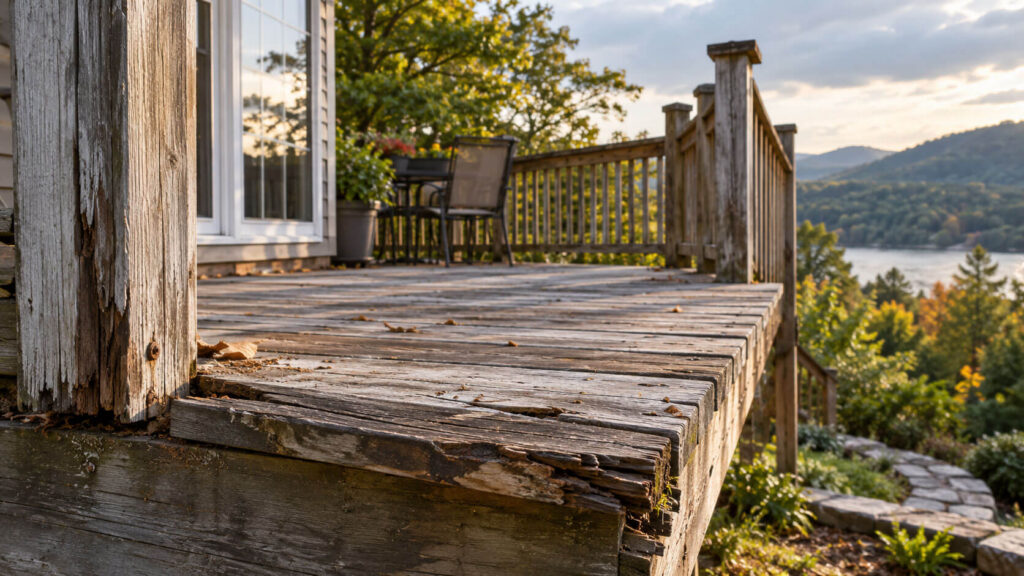
Old Deck Safety in the Hudson Valley: Warning Signs Homeowners Shouldn’t Brush Off
A deck rarely fails all at once. What usually happens is more frustrating: a board softens, a railing starts to move a little, a few fasteners rust out, and the whole structure slowly drifts from “fine for now” into “we should probably take a closer look.” By the time a homeowner notices the wobble, the problem is often less about a single bad board and more about hidden moisture damage, aging framing, or hardware that has been working loose for years.
That’s especially true in the Hudson Valley, where freeze/thaw cycles, heavy rain, mature trees, and older exterior construction all put extra stress on decks. If your deck is more than a few seasons old, the surface condition alone doesn’t tell you much. The real questions are underneath: what is the framing doing, how is the ledger attached, how is water draining, and whether the railings still actually hold under pressure. If you’re already seeing multiple warning signs, it may be time to speak with deck and patio construction contractors before a cosmetic issue turns into a safety issue.
Why old decks become unsafe faster than most homeowners expect
Decks age in layers. The surface boards may look serviceable long after the joists, posts, or ledger board have started to deteriorate. That’s part of what makes deck problems so easy to misread. Homeowners often focus on the most visible damage: a cracked board, a peeling stain job, or a few loose railing pickets. Contractors usually start somewhere else.
The first places worth inspecting are the connection points. A deck is only as strong as the hardware and framing holding it to the house and keeping it upright. That means lag bolts, joist hangers, flashing, post bases, and the ledger board deserve close attention. If water has been getting behind the ledger, the damage can spread inside the rim joist or house framing long before anything looks dramatic from the outside.
This is where cheap fixes tend to fail. Replacing a couple of deck boards can make the structure look better for a season, but it does nothing if the real issue is hidden rot or undersized support. In older Hudson Valley homes, especially those with additions, stone foundations, or patchwork exterior upgrades, decks are sometimes attached to structures that were never detailed as cleanly as they should have been.
The warning signs that deserve a real inspection
Some deck problems are obvious. Others are the kind people live with for years because they’ve normalized them. A small bounce on the stairs. A railing that feels “a little loose.” Boards that cup after every wet season. Those are not just cosmetic concerns.
- Soft or spongy deck boards, especially near edges and joints
- Posts that shift when pushed by hand
- Railing movement, even if it seems minor
- Rusting connectors, bolts, or hangers
- Dark staining around the ledger or fasteners
- Cracked or split support posts
- Visible sagging in the deck plane
- Steps that settle unevenly or pull away from the landing
One counterintuitive detail homeowners often miss: the stain on the ceiling or siding near a deck is not always directly below the actual problem. Water can travel along framing members, flashing gaps, or fastener penetrations before it finally shows itself. That means the visible damage is often the last stop, not the source.
If your deck has also taken a beating from winter weather or spring wind, it’s smart to check for spring storm damage around your home’s exterior. Deck issues often show up alongside loosened trim, shifted gutters, or water intrusion elsewhere on the home.
What contractors usually inspect first
A good contractor is not starting with the stain color or the deck’s age estimate. They’re checking whether the structure is actually sound. That usually means looking at the ledger attachment, support posts, beam sizing, joist spacing, footings, and whether the deck has proper flashing where it meets the house. Railings and stairs matter too, because those are often the first places where a failing deck gives itself away.
In older homes, especially ones with upgrades layered over time, contractors also look for mismatched repairs. It’s common to find a deck that has been “fixed” in stages with different hardware, questionable sistering, or posts resting on surfaces that were never meant to carry load. Those patchwork repairs can hide the real condition of the structure.
Moisture is another big one. In the Hudson Valley, shaded yards, wet soil, and dense landscaping can keep deck framing damp much longer than homeowners realize. That extra moisture accelerates rot, especially when drainage is poor or downspouts dump water near the support posts.
Repair, reinforce, or rebuild?
This is where a lot of homeowners get stuck, because the answer is not always obvious from the surface. A deck with isolated board damage may be a repair candidate. A deck with widespread rot at the ledger, failing posts, or movement at multiple points is a different story. At that stage, the question becomes whether your deck needs repair or a full rebuild, not whether a few quick fixes will buy more time.
Contractors usually think in terms of risk and longevity. If a repair leaves the same structural weak points in place, it may be money spent twice. That’s why some decks that look “mostly fine” end up needing more invasive work than expected. The safest-looking decks are not always the strongest ones, and the most weathered ones are not automatically beyond saving.
There’s also a practical cost issue here. Waiting until the damage spreads usually reduces your options. Once rot gets into framing or the ledger area, repairs start involving more labor, more material, and more time spent opening up the structure to see what’s actually going on.
Why DIY deck fixes can create bigger problems
Plenty of homeowners can replace a board or tighten a loose screw. That’s not the issue. The risk comes when a visible problem is treated as if it were the whole problem. A loose railing can sometimes be fixed properly. But if the post is attached to damaged framing, tightening hardware may create a false sense of safety without addressing the failure beneath it.
Another common misstep is sealing over damage too early. If wood is already holding moisture, paint or stain can trap it in. That doesn’t just shorten the life of the repair; it can hide the condition long enough for the structure to deteriorate further. Quick cosmetic improvements are popular because they feel productive. They are not always protective.
Older decks also deserve caution because many were built before current code expectations for flashing, attachment methods, and railing load standards. That doesn’t mean every older deck is unsafe. It does mean internet advice built around newer construction can be misleading when applied to an aging structure in the Hudson Valley.
What makes Hudson Valley decks especially vulnerable
Regional weather matters. Freeze/thaw cycles open up small gaps in wood and hardware. Heavy rain finds any weak point around fasteners or flashing. Snowmelt soaks the area around posts and footings. Mature trees can keep a deck damp and drop debris into seams where it holds moisture longer than it should.
Homes here also tend to have a mix of ages and construction styles. A deck may be attached to a newer addition on one side and an older exterior wall on the other. Or it may sit over uneven grade, with drainage running toward the structure during storms. Those conditions don’t automatically make a deck unsafe, but they do make inspection more important.
Detached decks near pools, side yards, or elevated entries deserve extra scrutiny because people rely on them daily. If you’re noticing broader exterior wear, and not just on the deck itself, it may also be worth looking into storm-related exterior damage before small failures start connecting to larger moisture problems.
When the problem is bigger than the deck surface
Sometimes a deck issue is really a broader exterior repair problem. Water intrusion around the ledger can affect siding, trim, rim joists, or even interior finishes if it has been going on long enough. Uneven settling near the deck can point to footing or drainage problems. Stair movement can indicate a support issue farther down the line than the homeowner expects.
That’s why structural deck work often overlaps with general contracting help for structural repairs. Once the job moves beyond surface replacement and into framing, support correction, or house-attachment concerns, the project starts behaving more like a structural repair than a cosmetic one.
Homeowners sometimes delay because the deck still “looks usable.” That phrase has caused plenty of expensive surprises. Usable for a few people on a dry day is not the same thing as safe under real-world use, weather changes, and seasonal movement.
How to think about deck maintenance before it turns into a project
The best time to address deck issues is before the structure announces them loudly. Regular cleaning helps, but the bigger maintenance win is visual and physical inspection: looking underneath, checking for soft spots, watching for loose connections, and paying attention to where water lingers after rain. If the deck stays wet for long stretches, something in the site conditions or drainage probably needs attention.
A simple rule of thumb: if the deck has more than one problem at once, it deserves a professional look. A single cracked board is one thing. A cracked board plus loose railing plus visible staining around the ledger is a pattern. And patterns are what contractors take seriously.
For homeowners planning to keep the house long-term, deck maintenance is not just about appearances. It protects resale value, reduces liability risk, and helps avoid the unpleasant kind of surprise where a “small repair” turns into a partial rebuild during the middle of outdoor season.
Frequently Asked Questions
How do I know if an old deck is actually unsafe?
Movement is a major clue. If the deck bounces, the railing shifts, support posts feel unstable, or boards are soft underfoot, it needs a closer inspection. Safety concerns usually come from structural issues, not just surface wear.
Is a loose railing always a big problem?
Not always, but it should never be ignored. A loose railing can be a hardware issue, or it can point to deeper framing deterioration. The difference matters, because the repair approach changes completely.
Can I just replace the deck boards and leave the frame alone?
Only if the framing is sound. Replacing surface boards is pointless if the ledger, posts, or joists are already failing. That’s one of the most common expensive mistakes homeowners make.
What does rot usually start with on a deck?
Rot often starts where water sits or enters repeatedly: around the ledger, fasteners, post bases, stairs, or areas with poor drainage. Shaded decks and poorly flashed connections tend to age the fastest.
Should I worry if my deck only looks weathered?
Weathering alone is not a safety issue. But if weathering comes with softness, movement, rusting hardware, or staining around connections, it may be hiding a structural problem.
When is rebuilding safer than repairing?
When multiple structural components are compromised or repairs would leave the same weak points in place. A contractor can help judge whether the deck is still worth saving or whether a rebuild is the better long-term move.
If your deck is showing more than cosmetic wear, the safest next step is usually a proper evaluation from a local contractor who understands older Hudson Valley homes, seasonal moisture, and the difference between a surface fix and a structural issue. That kind of guidance can save money, reduce stress, and keep a small problem from becoming a full reconstruction project.
