

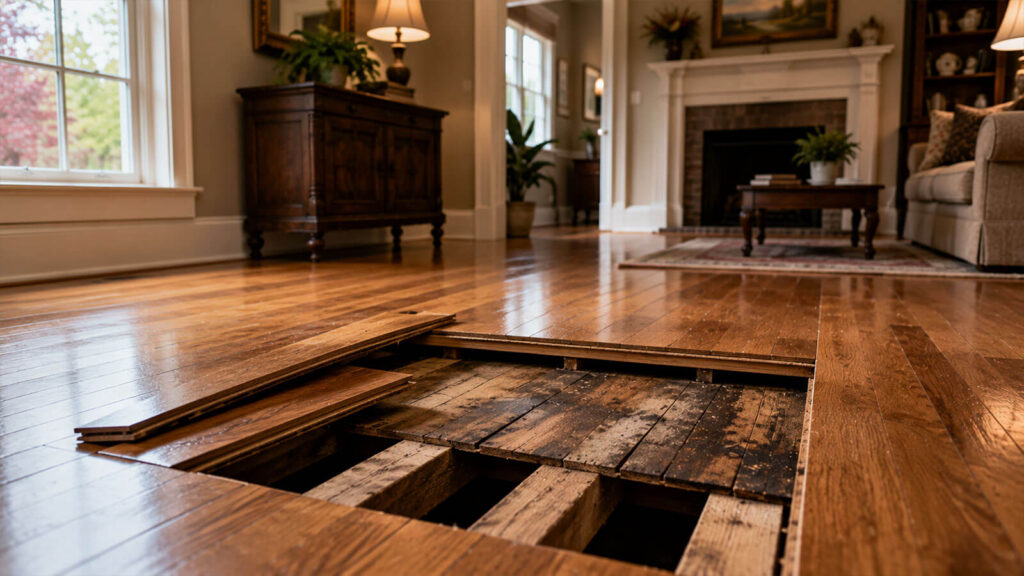
Old Floors in Hudson Valley Homes: What They’re Telling You Before the Repair Gets Bigger
Old floors rarely fail all at once. More often, they start with a little bounce near a doorway, a soft spot by the tub, a thin crack along the baseboard, or boards that suddenly seem to cup after a wet season. Homeowners notice the surface first. Contractors usually start by asking what is happening underneath it.
That difference matters. A worn floor can be a cosmetic problem, but in older Hudson Valley homes it can also be the first visible sign of moisture, structural movement, or subfloor damage. In houses with stone foundations, aging framing, or a history of basement dampness, the flooring is often the messenger, not the source.
If you’re trying to decide whether to patch, replace, or investigate deeper, it helps to look at the whole system. Flooring, subfloor, joists, drainage, humidity, and the condition of the room below all tend to be connected. And if the damage is showing up after heavy rain or a humid summer, it may be worth reading about spring drainage problems around Hudson Valley homes before assuming the floor itself is the entire issue.
What old floors usually reveal first
Homeowners often think of flooring as a finish layer, but it’s also a diagnostic clue. A contractor looking at an older floor is usually checking for movement, moisture, and past patchwork. The visible problem may be one board, but the cause may be a much larger section of the house.
Common warning signs include:
- cupping or crowning in wood flooring
- soft spots that flex under normal foot traffic
- gaps that suddenly widen during dry winter months
- musty odors near baseboards or floor vents
- tile that keeps cracking in the same area
- vinyl or laminate edges that lift after moisture exposure
The tricky part is that these symptoms can look similar even when the cause is different. A gap in winter may be normal expansion and contraction. A soft spot may mean subfloor rot. A repeating crack in tile can mean the floor is moving, not that the tile was installed badly. That’s why contractors often inspect the room below, the perimeter, and the moisture history before touching the floor surface.
Why Hudson Valley homes are especially prone to flooring problems
The region’s housing stock creates a predictable set of issues. Older homes in Dutchess, Putnam, and Westchester often have a mix of original framing, later additions, and rooms that were updated in phases. That patchwork history matters. A floor installed over a slightly uneven subfloor in one decade can hold up for years, then start failing when humidity, drainage, or settling changes the conditions around it.
Freeze-thaw cycles make things worse. So do spring rains, wet crawlspaces, and basements that never quite stay dry. In wooded neighborhoods, mature trees can also affect grading and root movement, while long driveways and sloped lots can send water toward the foundation instead of away from it. Once moisture gets under flooring, the damage often spreads quietly.
This is where homeowners get misled by the visible surface. The stain or swelling may show up in the dining room, but the actual water source could be a foundation wall, a dishwasher leak, an exterior grading problem, or condensation from poor humidity control. The stain on the ceiling often isn’t directly below the actual leak, and the same logic applies to floors.
When a floor problem is really a moisture problem
Moisture is one of the biggest reasons flooring repairs fail prematurely. Replacing boards or installing new material over a damp substrate is a fast way to spend money twice. Contractors know to look for the conditions beneath the finish, especially in basements, first floors over crawlspaces, and rooms that sit near exterior doors or poorly drained edges of the property.
Signs moisture may be involved include:
- seasonal cupping that improves in dry weather
- mold smell in closets, corners, or under rugs
- paint peeling near the floorline
- rust on fasteners or metal transitions
- discoloration along seams rather than across the whole floor
If the floor damage is happening near a basement or below-grade area, the issue may be tied to seepage, drainage, or groundwater pressure. In those cases, surface repair alone is usually a short-lived fix. Homeowners dealing with persistent dampness often need foundation and waterproofing services before any flooring replacement makes sense.
That’s not always the answer people want, because waterproofing feels like the larger project. But it’s often the cheaper one in the long run. Flooring can be replaced repeatedly; moisture problems tend to keep coming back until the path of water is addressed.
The hidden costs of delaying a repair
A lot of homeowners wait on flooring because the damage still “looks manageable.” That’s understandable. Floors are easy to live with for a while, even when they’re no longer right. The problem is that the hidden damage usually doesn’t stay still.
Once water, movement, or rot starts affecting the subfloor, the repair can grow in a few directions at once:
- trim and baseboards may need removal
- adjacent flooring can become unstable
- subfloor sections may need replacement
- fasteners and underlayment may have to be redone
- door clearances and transitions can shift
That’s where small patch jobs start turning into larger carpentry work. If framing or load-bearing elements are involved, the scope can go beyond a flooring installer and into broader project coordination. In those situations, homeowners may need general contracting help for larger repairs so the work is sequenced correctly instead of being pieced together in the wrong order.
One counterintuitive truth: a floor that feels slightly uneven isn’t always the expensive problem. Sometimes the expensive part is the moisture source, not the floor surface. Other times the floor itself is the easiest thing to replace, while the subfloor, joists, or foundation conditions are what really need attention.
What contractors usually inspect first
Experienced contractors do not start with the visible plank, tile, or board. They usually start with the pattern of damage. Is it localized or widespread? Is it near plumbing? Is it along an exterior wall? Does it change after rain or during humidity spikes? Those details usually narrow the cause faster than guessing from appearance alone.
A practical inspection often includes:
- checking for active leaks around bathrooms, kitchens, radiators, and laundry areas
- looking at the crawlspace or basement below
- testing the firmness of the subfloor
- reviewing signs of past patching or concealed damage
- looking for grading or gutter problems outside
- checking whether the floor failure matches seasonal moisture patterns
For homeowners, this is useful because it prevents the wrong fix. A squeaky board may not need replacement if the real issue is fastener movement. A cracked tile section may not be an isolated cosmetic flaw if the slab beneath it is shifting. And a floor that keeps failing in the same spot is usually telling you the repair path has been incomplete.
DIY repairs that often make the problem worse
There’s nothing wrong with a homeowner trying to buy time with a temporary fix. The trouble begins when a temporary fix is treated like a final solution. Caulk, filler, adhesive patches, and surface-level coverups can all mask a developing problem while making it harder to diagnose later.
Some of the most common missteps are:
- installing new flooring over a damp subfloor
- covering soft spots with heavier material instead of addressing the cause
- painting over water staining without checking the source
- filling movement cracks before verifying whether the floor is still shifting
- ignoring odors because the surface looks acceptable
That last one gets people into trouble more often than they expect. A floor can look fine for months while the materials underneath slowly absorb moisture or degrade. By the time the damage is obvious, the repair is no longer just cosmetic.
Why cheap flooring fixes often fail early
There’s a reason flooring contractors are skeptical of bargain repairs that only address the top layer. If the subfloor isn’t flat, dry, and secure, the new surface starts under stress. That stress shows up as squeaks, seams opening, tile cracking, or edges separating far sooner than they should.
In older Hudson Valley homes, this problem is especially common when the original floor has already been patched a few times. Layers get added over layers. One room is refinished, another is not. A previous owner may have covered damage instead of fixing it. Years later, the new homeowner inherits the result.
This is where a proper evaluation matters more than the material choice. Hardwood, engineered wood, tile, laminate, and luxury vinyl all perform differently, but none of them can outlast a bad substrate for long. Good installation starts with the base, not the finish.
Choosing the right path: repair, replace, or investigate
Not every old floor needs full replacement. Some problems are isolated and can be repaired cleanly. Others are warning signs that the floor should come up so the underlying condition can be addressed. The challenge is knowing which situation you’re in.
As a general rule:
- Repair may be enough if the damage is small, dry, stable, and clearly isolated.
- Replacement makes more sense if there is widespread wear, repeated failure, or major finish deterioration.
- Deeper investigation is needed if the floor is soft, damp, uneven, or showing signs of repeated moisture exposure.
That’s also why homeowners should be careful about asking only, “Can this be fixed?” The better question is, “What is causing it, and is the cause still active?” That small shift in thinking can save a lot of money.
When the repair scope is still unclear, it’s usually smart to speak with flooring installation contractors who can assess whether the floor can be saved or whether the safer option is replacement after underlying issues are corrected.
What to do before hiring anyone
Before you bring in a contractor, it helps to gather a few details. Not because you need to diagnose the problem yourself, but because it makes the conversation more productive and usually leads to a better estimate.
- Note when the problem first appeared.
- Track whether it changes after rain, snowmelt, or humid weather.
- Look at nearby plumbing fixtures and exterior grading.
- Take photos before the issue spreads.
- Check whether the room below shows staining, odors, or dampness.
If the problem seems connected to water intrusion, compare what you’re seeing with other moisture-prone areas in the home. Homeowners in Westchester, especially, often discover that flooring issues are tied to broader below-grade water behavior. A useful local reference is basement water issues in Westchester County, which can help connect the dots between runoff, seepage, and interior damage.
That broader perspective matters. If one area is failing because the house is taking on water, the next weak spot may be close behind.
Frequently Asked Questions
Should I replace old floors before or after fixing moisture problems?
After. If moisture is still active, new flooring can fail quickly. Contractors usually want the source of water or dampness addressed first.
Is a squeaky floor always a sign of structural damage?
No. Squeaks can come from loose fasteners, seasonal movement, or subfloor friction. But if the area also feels soft or uneven, it deserves a closer look.
Can I install new flooring over the old floor?
Sometimes, but only if the existing floor is stable, dry, and suitable as a base. Covering damage without checking underneath often creates bigger problems later.
Why do floors in older homes seem to have more issues?
Older homes often have a mix of original materials, settling, moisture exposure, and past repairs. In the Hudson Valley, seasonal weather and basement dampness can add to that wear.
When does flooring damage become a bigger carpentry or structural issue?
When the subfloor is soft, framing is compromised, or the floor movement is widespread. At that point, flooring alone is not the whole job.
What’s the biggest mistake homeowners make with failing floors?
Waiting too long because the problem still seems livable. Floors often give warning signs well before the repair becomes expensive.
Old floors are worth paying attention to because they rarely fail in isolation. If you catch the problem early, you usually have more options, a cleaner repair, and less disruption. If you’re unsure whether the issue is cosmetic or part of a larger moisture or structural concern, it’s worth getting guidance from a trusted local pro before the damage moves farther than it already has.