

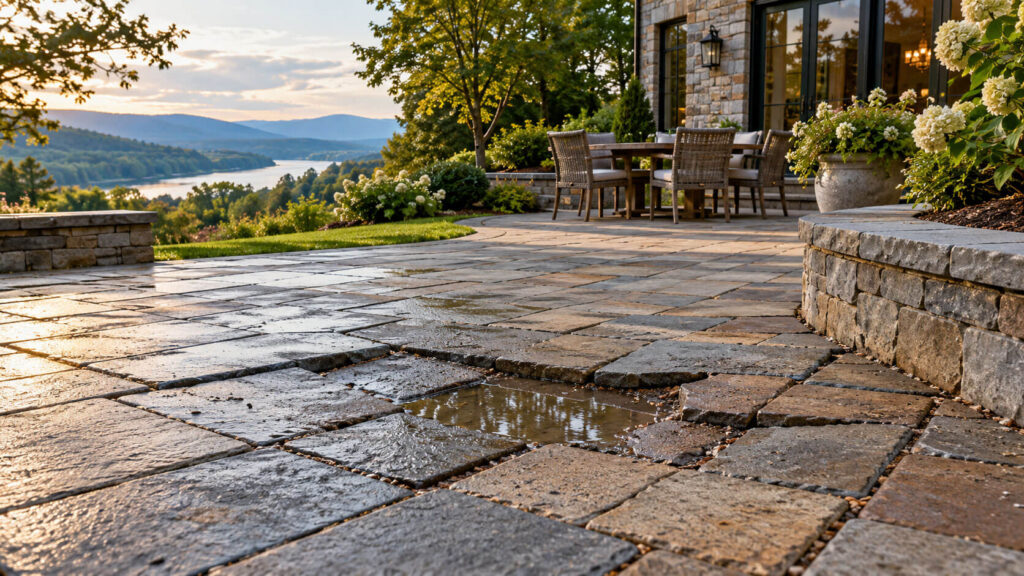
Uneven pavers are one of those problems homeowners tend to notice late. At first it looks like a minor cosmetic issue: a little wobble near the steps, a low corner by the walkway, a patio edge that no longer feels level underfoot. But once pavers start shifting, the cause is usually underneath them, not on the surface. That’s why a repair that seems small can turn into a bigger base, drainage, or grading conversation fast.
In the Hudson Valley, that matters more than people expect. Freeze-thaw cycles, heavy rain, mature tree roots, and older lots with imperfect runoff all work against patios and walkways. If the base was built lightly, or if water has been moving under the surface for years, the pavers are often just showing you the problem. For a lot of homeowners, the better question is not “Can these be reset?” but “Why did they move in the first place?”
What paver settling usually means
Settling is rarely just a paver issue. It usually points to one of a few underlying conditions: the base wasn’t compacted well enough, water is washing fines out from below, edges are failing, or the original slope is sending runoff the wrong way. Contractors usually look at the border first, then the low spots, then any signs of water movement nearby. That sequence matters because the visible dip is often the last thing to fail, not the first.
One counterintuitive detail catches homeowners off guard: the lowest spot is not always where the problem started. Water can enter from a higher edge, travel under the base, and settle out somewhere else. That’s why a repair focused only on lifting a handful of pavers can look good for a season and fail again after the next hard rain.
If the patio is part of a larger outdoor project, it may help to compare it with broader masonry contractors who handle base failure, stonework, and surface movement together instead of treating every dip as a stand-alone cosmetic repair.
Signs the patio base is failing, not just the top layer
A few warning signs usually show up before the patio becomes obviously uneven:
- pavers rocking or sinking when stepped on
- open joints that keep widening after rain
- edge restraints pulling away
- persistent puddling in one area
- sand washing out of joints
- cracks near adjoining concrete, stoops, or curbs
Homeowners sometimes assume the joints just need more polymeric sand. That can help in the short term, but it does not fix movement underneath. In fact, if the base is already shifting, repeated re-sanding can become a maintenance loop that masks the real issue while water keeps finding its way in.
That is where a proper look at drainage problems around the patio becomes part of the repair conversation. If runoff is collecting near the patio edge, the pavers are going to keep moving no matter how carefully the surface is re-leveled.
Why patios in this region settle more than people expect
Hudson Valley properties create a lot of conditions that are hard on paver systems. Older homes often sit on ground that has been reworked over time, not engineered from scratch. Stone foundations, older grading, and long-established trees can all affect how water moves across a lot. Add in steeper driveways, downspouts that dump too close to the patio, and long wet periods in spring and fall, and it becomes clear why “it was fine for years” is not a guarantee of future stability.
Freeze-thaw is another quiet factor. Water gets into joints and base material, expands when frozen, then loosens everything just enough for the next storm to move it a little farther. Over several seasons, that gradual movement becomes visible. The repair mistake homeowners make most often is treating it like a one-time reset when it is really a water-management problem with a surface symptom.
What contractors usually inspect first
Experienced crews usually start with the perimeter, drainage path, and base depth before discussing replacement. They want to know whether the patio is sinking in one isolated area or across a broader section, whether the edge restraint is intact, whether adjacent grading is pushing water toward the surface, and whether the original installation has enough compacted stone under it. Those details tell the story faster than the top layer does.
If the movement is concentrated in one county-specific area, homeowners looking at broader repair options often compare local trade pages such as masonry contractors in Dutchess County or Putnam County masonry services to understand whether a reset, rebuild, or drainage correction makes the most sense.
When a simple reset is enough—and when it is not
A minor lift-and-reset can be a reasonable fix if the problem is localized, the base is still sound, and drainage is not actively undermining the area. That is the ideal case. But if pavers are sinking near a downspout, at the bottom of a slope, or along an edge where water exits the patio, a reset alone is usually a temporary patch.
The expensive mistake is assuming the visible damage equals the full scope of work. A patio can look like it just needs a few stones put back in place, while the real issue is that the sub-base has lost compaction or the grading is wrong. Contractors who do this work every day tend to be conservative for a reason: they know that a surface repair without base correction often turns into a callback.
That is also why some homeowners are surprised when a patio repair starts to sound more like a small reconstruction. If the base is compromised, it may be smarter to look at deck and patio construction services instead of assuming the existing structure can be saved piecemeal.
Common repair shortcuts that fail
There are a few fixes that look helpful but usually do not hold up:
- adding sand without addressing drainage
- re-leveling pavers over a weak or washed-out base
- patching one low area while leaving the edge unsupported
- covering movement with sealant instead of correcting slope
- installing new pavers on top of an old unstable section
These shortcuts are attractive because they are cheaper up front. The problem is that they often hide the symptom long enough for the underlying issue to get worse. By the time the surface starts moving again, the repair is no longer a simple reset. It may now involve more demolition, better drainage planning, and a deeper rebuild of the base material.
What a real fix usually includes
Depending on the damage, a proper repair may involve removing the affected section, correcting the base depth, re-compacting the stone, improving edge restraint, and making sure the patio sheds water away from the house and adjacent hardscape. If there is a runoff issue, the repair may need to work in tandem with gutter changes, downspout extensions, or grading adjustments nearby.
Homeowners sometimes focus only on the pavers themselves, but the surrounding system matters just as much. Water management, soil conditions, and the structure of the base all affect how long the repair lasts. If those pieces are ignored, even a clean-looking finish can fail early.
For homes where patio movement is connected to runoff patterns, it is worth reviewing broader drainage problems around the patio before choosing a repair path. The right fix often starts outside the patio footprint.
Why delaying a repair gets expensive
What starts as a trip hazard can turn into a water intrusion issue near the house, a settlement problem at steps or thresholds, or a full patio rebuild if the base keeps eroding. Uneven pavers also become a maintenance burden. Weed growth increases, joints wash out faster, and any attempt to stabilize the area becomes harder once the surface keeps shifting.
There is also a resale angle that homeowners often underestimate. Buyers may not care about one uneven paver, but they do notice when a patio looks tired, poorly drained, or patched over in a way that suggests deeper problems. Outdoor hardscape is part of the home’s first impression, and a failing patio can quietly lower confidence in the rest of the property.
How to think about hiring help
With settling pavers, the best contractor conversation is usually not “How fast can this be fixed?” It is “What caused the movement, and how do we keep it from coming back?” That question separates surface repairs from real solutions. A good contractor should be able to explain whether the issue is base failure, drainage, edge restraint, or a combination of all three.
In some cases, a localized repair makes sense. In others, the work is really about rebuilding the area correctly so it does not keep becoming a problem every spring. For homeowners in denser suburban areas, especially where patios tie into walkways, retaining edges, or older hardscape layouts, comparing options through pages like Westchester masonry pros can help frame the repair as part of the larger property condition rather than a one-off patch job.
Frequently Asked Questions
Can settled pavers be lifted and reused?
Often, yes. If the pavers are in good shape, they can usually be removed, the base corrected, and the same materials reset. The key is whether the base and drainage issues are also addressed.
Why do pavers sink more after heavy rain?
Because water is usually part of the problem. If runoff is getting under the patio, it can wash out fine material, soften the base, and speed up movement.
Is a small dip in the patio something to worry about?
Usually, yes. Small dips often grow into bigger issues because water follows low spots. Even a minor settlement can become a drainage path over time.
Can I just add more sand under the pavers?
Not if the base is failing. Adding sand without fixing compaction or drainage usually delays the real repair and can make the issue harder to diagnose later.
How do I know if the patio needs repair or replacement?
If the movement is isolated, repair may be enough. If multiple areas are settling, the edge is failing, or water is consistently pooling nearby, a more complete rebuild may be the better long-term option.
What kind of contractor should I call first?
Start with a masonry professional who understands patios, base work, and drainage. The right inspection should cover more than the visible pavers.
If your patio is starting to move, the safest next step is usually a careful local assessment before the damage spreads. The right contractor can tell the difference between a straightforward reset and a deeper base or drainage problem, which is often the difference between a lasting fix and a repeat repair.
