

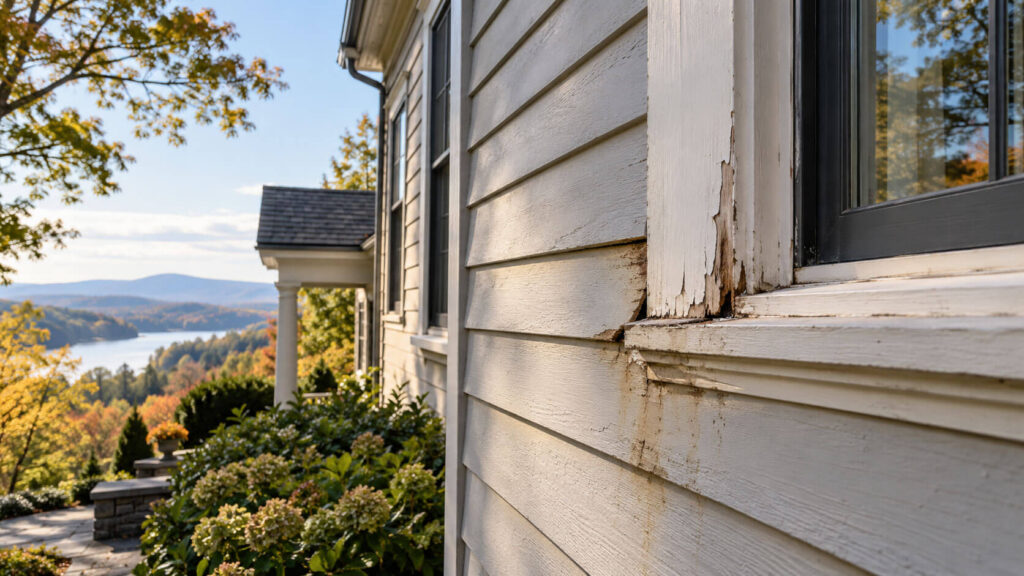
Siding gaps rarely start as a dramatic problem. More often, they show up as a little discoloration near a window, a loose corner board, or a draft that seems too small to matter. Then a heavy rain, a hard freeze, or a windy week later, the issue is suddenly no longer cosmetic. Water finds the weakness. So does rot.
That’s especially true on older homes across the Hudson Valley, where siding, trim, gutters, and window details often have to work harder than they did when the house was built. Mature trees, steep grades, freeze-thaw cycles, and aging exterior materials all make small failures more expensive than they look at first glance.
When siding gaps are more than a cosmetic issue
A gap in siding is not automatically an emergency, but it should never be dismissed as “just a little opening.” Contractors usually look at what the gap is telling them: movement, failed fasteners, water entry, or an underlying trim problem. The visible gap is often the symptom, not the cause.
One of the most common homeowner mistakes is assuming caulk alone will solve the issue. Sometimes it helps temporarily. But if the siding has shifted, the flashing is compromised, or the sheathing underneath has started to absorb moisture, a bead of caulk just hides the problem for a while. That’s how repairs get repeated instead of resolved.
It’s also worth remembering that the stain or soft spot you notice may not line up exactly with the leak source. Water can travel along trim, behind siding, or around window openings before it shows up inside. That’s why experienced contractors often inspect the entire wall assembly, not just the obvious gap. If the problem seems connected to openings, trim, or storm exposure, it may overlap with water intrusion around windows and trim.
What usually causes siding to pull apart
In this region, siding movement often comes down to a few recurring issues. Some are climate-related. Some are installation-related. Some are just the reality of older homes settling over time.
Freeze-thaw movement
Moisture gets into tiny openings, expands when temperatures drop, and slowly works fasteners loose. That process is especially hard on trim joints, corner boards, and lower wall sections that take the most splashback.
Failed caulk and aging sealants
Caulk is not permanent, even when it looks fine from a distance. Sun, wind, and seasonal movement break it down. On the exterior of a house, a sealed joint can fail before the siding itself looks damaged.
Loose or undersized fasteners
Sometimes the siding was never fastened ideally in the first place. In other cases, repeated temperature swings and vibration from wind gradually loosen nails or screws. Once a section starts to move, the gaps tend to spread.
Rotting trim or sheathing
This is the hidden problem homeowners miss most often. If the material behind the siding is deteriorating, the surface repair won’t hold well for long. Contractors usually check the framing edges, trim returns, and wall base first because that’s where water damage tends to reveal itself.
Why Hudson Valley homes are especially vulnerable
Some parts of the country can get away with more forgiving exterior details. The Hudson Valley usually is not one of them. Homes here deal with long wet periods, snow load, fast temperature swings, and summer storms that push water sideways into places it should never reach. Add in older clapboard, fiber cement, wood trim, or mixed-material additions, and the risk goes up.
Wooded properties create another problem: less sun, slower drying, more debris in gutters, and more trapped moisture around the lower walls. If the drainage around the house is weak, siding damage often starts on the side that takes the most runoff. That’s why a thoughtful post-storm exterior damage check is worth doing after heavy weather, even if the house looks fine from the driveway.
And if the issue seems to cluster near roof edges or upper wall lines, don’t ignore the roof system. Contractors frequently find that what looks like siding failure is actually tied to roof flashing problems that send water behind siding. The siding gets blamed because that’s where the damage shows up, but the source can be higher up.
What contractors usually inspect first
When a homeowner calls about exterior gaps, a good contractor is usually not starting with the most visible crack. They’re looking for the pattern. Is the damage isolated or widespread? Is it on one elevation or multiple sides? Is the problem near windows, roof edges, gutters, or ground-level splash zones?
That early inspection usually includes:
- failed or missing caulk around joints and trim
- warped or soft trim boards
- rusted or loose fasteners
- visible water staining or mildew
- gaps where siding meets soffit or fascia
- signs of gutter overflow or downspout discharge issues
- soft sheathing, especially near the bottom of the wall
Gutters matter more than most people expect. Overflowing gutters can dump water straight onto siding, and clogged downspouts can keep one wall wet for weeks at a time. If runoff is part of the problem, it may make sense to look into gutter repair and drainage help before replacing siding that is only failing because water is hitting it in the wrong place.
Why quick fixes often fail
The tempting repair is usually the cheapest one: caulk it, paint it, and move on. Sometimes that buys time. But if the wall assembly has already been exposed to repeated wetting, a quick fix can create a false sense of security. The outside looks tidier while moisture continues doing damage behind it.
Another common shortcut is replacing only the visibly damaged board. That can work when the issue is truly isolated. But contractors often discover that the “one bad board” is sitting next to other compromised material. If the surrounding trim is already moving or the flashing is weak, the new piece just becomes the next failure point.
That’s where homeowners get into trouble with repair timing. Waiting too long usually doesn’t make the job easier. It just increases the odds that the repair expands from siding to trim, then into sheathing, then possibly into insulation or interior wall damage. The original issue may have been modest; the delay is what drives the bill.
When the problem is probably bigger than siding
There’s a point where a siding issue stops being an exterior maintenance item and starts becoming a water-management problem. If you are seeing repeated gaps, peeling paint, staining inside the wall, or soft spots near the base of the home, the repair may need to involve more than the siding surface.
Watch for these warning signs:
- persistent musty smell near the wall
- paint bubbling indoors or around window returns
- warped trim that keeps coming loose
- softness when lightly pressed near the damaged area
- mold-like spotting on exterior wood
- recurring leaks after storms despite past patching
Once water starts affecting the wall system, it may be wise to talk with Hudson Valley siding contractors who understand exterior wall repair as a whole, not just surface replacement. And if the moisture has already worked its way lower into the structure, foundation and waterproofing contractors may also need to weigh in, especially on homes with damp basements or grading problems.
What a sensible repair plan usually looks like
The best repair strategy is usually the one that addresses the cause, not just the visible damage. That may mean reworking trim, replacing a compromised section, correcting flashing, improving gutter discharge, or repairing the lower wall area where splashback is constant.
On many homes, the smartest sequence is:
- identify where water is coming from
- stop the active entry point
- replace any damaged backing material
- repair or replace the siding section
- restore proper sealant and flashing details
- fix the drainage conditions that caused the problem
That last step is the one people skip most often. But if the roof edge, gutter line, or grade is wrong, the siding repair may not last. In some cases, the true fix starts outside the wall with gutter repair and drainage help or, when water is traveling from above, a closer look at roof flashing problems that send water behind siding.
DIY or hire it out?
Very small repairs can be a reasonable DIY project if the homeowner knows exactly what failed and can reach it safely. A single trim joint with dried-out caulk is one thing. A recurring gap on a second-story wall with possible water entry is another.
DIY becomes risky when any of the following are true:
- the area is above a ladder-safe working height
- the siding type requires special cutting or fastening
- the wall has signs of rot or softness
- the leak source is not obvious
- the repair is near electrical, vents, or roof transitions
In other words, if the visible problem is small but the cause is unclear, that’s usually the moment to slow down. Exterior repairs are easy to underestimate because the most expensive part is often what you can’t see.
How to protect the house before the next storm
Not every homeowner needs a major project right away. Sometimes the right move is a practical checklist and a sharper eye. Walk the perimeter after heavy rain. Look at where water collects. Check whether downspouts are carrying water far enough away from the foundation. Watch for peeling paint, loose trim, or siding that seems to ripple instead of lying flat.
In the Hudson Valley, that kind of seasonal attention matters because weather here tends to expose weak points quickly. A house can look fine through dry weather and then show all its vulnerabilities after one wet stretch. The goal is not paranoia. It’s catching the problem before it becomes a wall repair, basement issue, or recurring insurance headache.
Frequently Asked Questions
Is a small gap in siding something I can ignore for a while?
Usually not for long. If the gap is exposed to wind or rain, water can reach the wall cavity or trim behind it. The longer it stays open, the more likely it is to turn into rot or staining.
Can caulk solve a siding gap permanently?
Only if the joint is stable and the underlying material is sound. If the siding is moving or the trim is failing, caulk is a temporary measure, not a permanent fix.
How do I know if the problem is siding or roof-related?
If the damage is near the top of the wall, around eaves, or shows up after wind-driven rain, the roof edge and flashing should be checked too. Water often enters above the point where it becomes visible.
Why does the damage keep coming back after repairs?
Because the cause probably wasn’t fully addressed. Repeated failures usually point to drainage, flashing, rotted backing material, or ongoing movement in the wall assembly.
Should I replace a whole wall section or just repair the damaged area?
That depends on how far the moisture has spread. If the issue is isolated, a targeted repair may be enough. If there is rot, widespread movement, or multiple failure points, a larger section often makes more sense.
What should I do first if I suspect water is getting behind siding?
Start by checking gutters, downspouts, trim, and nearby roof edges. Then have the problem inspected before the damage spreads into the wall structure or interior finishes.
If your home is showing early signs of siding failure, it’s worth getting a local opinion before the repair turns into a bigger exterior project. The right contractor will look beyond the surface, connect the clues, and help you fix the real problem instead of paying twice for the same one.
