

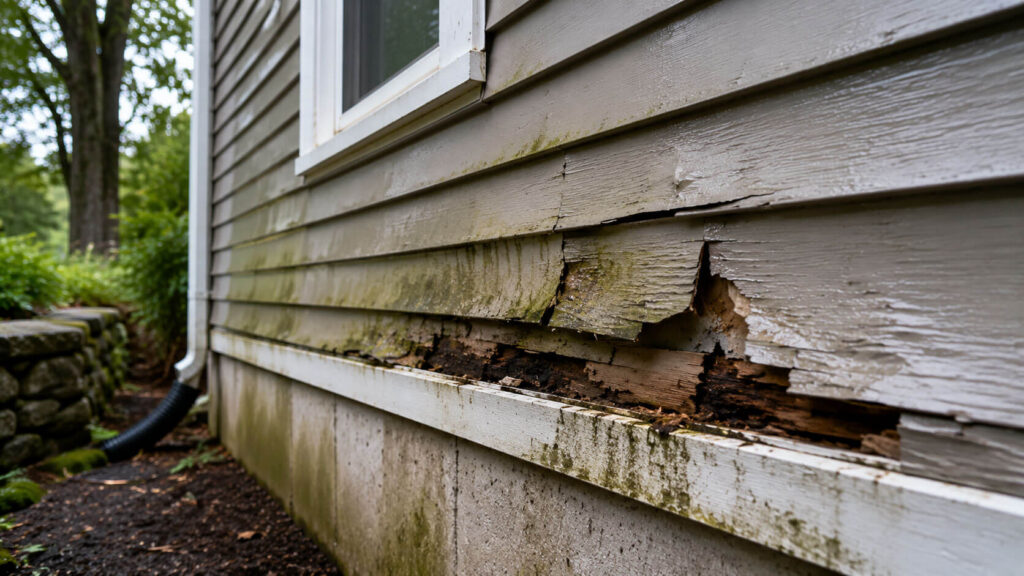
Siding can look fine from the driveway while water is quietly getting behind it. That is part of what makes exterior moisture problems so frustrating: by the time a homeowner notices staining, soft trim, peeling paint, or a musty room, the issue has usually been active longer than it seemed. In the Hudson Valley, where wind-driven rain, freeze/thaw cycles, and older wall assemblies all work against a house, small drainage failures can turn into expensive siding and framing repairs faster than most people expect.
The hard part is that the visible damage is often not the real problem. A warped panel, bubbling paint, or a dark line at the bottom of a wall may be the result of something upstream—overflowing gutters, failed flashing, a roof edge leak, poor grading, or water splashing up from the foundation after heavy rain. Before anyone replaces siding, it helps to understand where water usually starts and why the wrong repair can leave the problem intact. If you are already seeing signs of siding and gutter damage after a storm, it is worth slowing down and tracing the moisture path first.
Why siding water damage is often misread
Homeowners often assume siding is the failed component because that is where the symptom shows up. Contractors tend to look differently. They usually start with the roof edge, gutter line, downspouts, trim transitions, window openings, and lower wall exposure. That is not because siding is unimportant; it is because water rarely respects the neat boundaries of a single system.
A common Hudson Valley pattern is this: the house takes on repeated wetting from spring rain, the gutters overflow or discharge too close to the foundation, and the lower wall stays damp long enough for caulk joints, trim boards, or sheathing to weaken. Once that happens, the damage spreads quietly. Paint fails. Fasteners corrode. Wood swells. Insulation can hold moisture. Inside the home, the first clue may be a faint smell rather than an obvious leak.
One counterintuitive thing contractors see all the time is that the stain on the interior wall is often not directly below the real leak. Water can travel along framing, behind trim, or through insulation before it shows up somewhere else. That is why a “patch the stain and repaint” approach usually disappoints.
What usually causes hidden exterior water intrusion
There are a few repeat offenders in local homes, especially in older properties with mixed additions and several decades of incremental repairs.
- Overflowing or undersized gutters that push water over the edge during heavy rain.
- Downspouts dumping too close to the house, especially where grading slopes back toward the foundation.
- Failed or missing flashing at roof intersections, windows, or siding transitions.
- Cracked sealant around trim that was never intended to be the only water barrier.
- Splashback from hard ground or stone surfaces that keeps the lower wall wet.
- Ice and snow buildup that forces meltwater into places it would never reach during a summer shower.
In wooded parts of Dutchess, Putnam, and Westchester counties, mature trees and heavy leaf drop make gutter issues more common than homeowners realize. Once gutters clog, water does not just overflow visibly. It can also back up at the fascia, run behind the gutter line, and soak trim boards before anyone notices there is a problem. If your drainage layout is already questionable, the issue often overlaps with broader drainage problems around Hudson Valley homes that deserve attention before the next storm.
Why small repairs sometimes fail fast
Cheap exterior repairs usually fail for one reason: they fix the symptom, not the water path. A homeowner may recaulk a joint, swap a few damaged boards, or repaint a section of siding and feel like the issue is handled. Then the next season brings the same stain, the same soft trim, and sometimes a larger repair bill.
That happens because water intrusion tends to exploit the weakest transition point. If the roof edge is shedding water poorly, if the gutter pitch is wrong, or if the siding is trapping moisture because of a missing drainage gap, patching one visible crack may do almost nothing. In older homes, especially those with additions or previous owner repairs, there may be several failure points layered together. Contractors often uncover more damage after removing the first damaged section than homeowners expected to find at all.
This is why a “quick fix” can become the most expensive option. A neat-looking repair can delay the real diagnosis, and every season of delay gives moisture more time to reach sheathing, framing, insulation, and interior finishes.
What contractors usually inspect first
A good exterior diagnosis does not start with replacement materials. It starts with tracing water behavior.
The roof edge and flashing
Leaks near siding often begin above the siding line. Roof-to-wall junctions, step flashing, and chimney-adjacent details can send water where it should not go. If you are also dealing with roof repair after a storm, that issue may be part of the same moisture problem rather than a separate one.
Gutters and downspouts
Contractors check whether gutters are pitched correctly, clogged, undersized, or simply not carrying water far enough away from the house. In many cases, the gutter system is not failing dramatically; it is just failing in a way that only shows up during prolonged rain or a freeze-thaw cycle.
Lower wall exposure and grading
At ground level, the question is whether water is splashing back, pooling, or soaking the siding near the foundation. If the grade slopes the wrong way, water management becomes a recurring issue. In homes with stone foundations, older drainage patterns, or basement moisture concerns, this is where problems multiply. In some cases, homeowners need help beyond a siding repair crew and into foundation and waterproofing services.
Window and trim transitions
Water often gets in at joints, not through broad sections of siding. Window heads, corner boards, band boards, and trim interfaces deserve a close look because they are common entry points that get overlooked during cosmetic repairs.
When DIY is reasonable and when it is risky
Some exterior maintenance is fair game for a careful homeowner. Cleaning gutters, extending a downspout, or replacing a visibly failed bead of sealant may help in the short term. But once a wall has signs of soft wood, swollen trim, recurring staining, or interior moisture, DIY can become a guessing game.
The risk is not just doing the wrong repair. It is covering up evidence before the source is identified. That makes later diagnosis harder and can allow hidden rot to spread. If siding is already loose, layered, or visibly deteriorated, removing a few pieces without understanding the build-up behind them can also create more damage than it solves.
For anything involving structural sheathing, widespread softness, or repeated leakage, many homeowners are better off comparing options through general contracting help for wall repairs rather than treating it like a simple cosmetic project.
Why Hudson Valley homes are especially vulnerable
The region’s housing stock matters here. A lot of homes in the Hudson Valley have older framing, mixed materials, stone or block foundations, long rooflines, detached garages, or additions built in different eras. Those details complicate water management. The house may have been patched over time in ways that look fine from the outside but create hidden transitions where water can slip through.
Seasonal weather adds another layer. Heavy rain can expose drainage issues in spring. Summer humidity can slow drying. Fall leaves can clog gutters just when the next storm hits. Winter snow load and ice can force water behind materials that would otherwise hold up. That combination is rough on siding, trim, and the wall assembly behind them.
Homes with oil heat, older insulation, and less air sealing can also mask moisture problems longer because the interior symptoms are not always obvious right away. By the time peeling paint or a damp basement becomes hard to ignore, the wall cavity may already have been wet for some time.
What to do before damage gets more expensive
If you suspect exterior water intrusion, the most useful next step is not replacing siding immediately. It is confirming where the water is coming from and how far it has traveled. A practical inspection should account for roof runoff, gutter performance, downspout discharge, grading, trim condition, and any visible interior impact.
That is also the point where homeowners benefit from identifying the right kind of help. Some situations need a gutter correction. Others need exterior carpentry, drainage work, or coordinated wall repair. If you are not sure where to start, it can be helpful to find the right contractor trade instead of hiring the first person who says “it looks like siding.” A more complete fix is often cheaper than repeating partial fixes every season.
For homes with repeated runoff issues, a conversation with gutter service contractors can be a smart early move, especially if the gutter system is overflowing, pulling away from the fascia, or dumping water too close to the foundation.
How to avoid repeat repairs
The homeowners who stay ahead of these problems tend to do a few simple things consistently. They clean gutters before the rainy season. They extend downspouts away from the house. They watch for new staining after storms. They do not ignore a soft trim board just because the paint still looks decent from a distance.
Just as importantly, they treat repeated moisture as a system issue, not a one-off cosmetic defect. If one side of the home keeps failing, there is usually a reason. That reason may be hidden in the roof edge, the drainage pattern, or the way the exterior wall was built or repaired years ago.
In practice, the best repair is the one that stops the water path, not just the one that looks tidy on day one.
Frequently Asked Questions
What are the first signs of hidden siding water damage?
Look for bubbling paint, soft trim, warped boards, dark staining, caulk separation, and any musty smell near the affected wall. Inside the home, early signs may be subtle.
Can bad gutters really damage siding?
Absolutely. Overflowing or poorly pitched gutters can send water behind siding, soak fascia and trim, and keep the lower wall damp long enough for rot to start.
Should I replace damaged siding right away?
Not until the water source is identified. Replacing siding without fixing the cause often leads to the same failure again.
Is a small stain on the wall usually a big deal?
It can be. Small stains often point to repeated moisture, and repeated moisture is what turns a manageable repair into a larger one.
What kind of contractor should inspect the problem first?
That depends on the source. It may be a gutter specialist, roofing contractor, exterior carpenter, or a broader general contractor if wall damage is already involved.
Why does this happen so often in older Hudson Valley homes?
Older homes often have layered repairs, mixed materials, and drainage patterns that were never designed for today’s storm intensity. Freeze/thaw cycles only make those weak points more obvious.
If something on the exterior keeps getting wet in the same place, it is usually worth a closer look before the repair grows into sheathing, framing, or interior damage. A careful diagnosis now can save a lot of disruption later, and it makes it much easier to choose the right local contractor with confidence.