

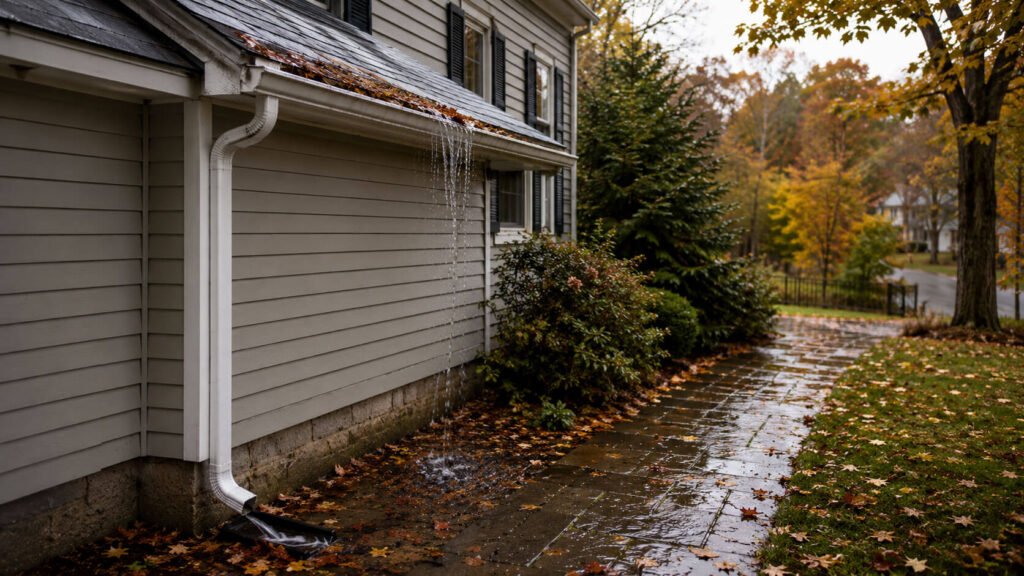
When Gutters Stop Doing Their Job: What Hudson Valley Homeowners Should Watch Before Water Starts Winning
A gutter problem rarely announces itself with drama. More often, it shows up as a damp basement corner, a patch of washed-out mulch, a streak of staining on the siding, or a downspout that seems to dump water in exactly the wrong place every time it rains hard. By the time a homeowner notices, the issue is often no longer just “dirty gutters.” It has usually become a drainage problem, and drainage problems have a way of spreading into foundations, walkways, landscaping, and finished space below grade.
That is especially true in the Hudson Valley, where older homes, mature trees, steep lots, and freeze-thaw cycles can make exterior water management harder than it looks from the street. A gutter system that seems fine in dry weather can fail the moment a heavy storm hits. And when that happens, the real problem is often not the gutter itself. It is where the water goes after it leaves the roof.
Why gutter trouble becomes expensive faster than people expect
Homeowners tend to think of gutters as a roof accessory. Contractors think of them as part of the home’s drainage system. That distinction matters. If gutters overflow, slope the wrong way, or discharge water too close to the foundation, the damage doesn’t stay at the roofline. Water can work into fascia, soffits, siding, basement walls, window wells, and soil near the footing. In older homes with stone foundations or marginal grading, that movement can be relentless.
One counterintuitive thing contractors often notice: the water stain on the basement wall is not always directly below the roof leak you were worrying about. Sometimes the issue starts at a clogged elbow, a short downspout extension, or a spot where runoff is being concentrated at one corner of the house. In other words, the problem may be a few feet away from where the damage shows up.
That’s why homeowners dealing with repeat runoff issues often end up needing more than a cleaning. In some cases, the real fix involves gutter pitch, downspout routing, splash blocks, grading, or better exterior discharge. For homes in counties with plenty of tree cover and older housing stock, it may make sense to look at Dutchess County gutter services for runoff issues before the next storm turns a nuisance into a repair project.
What contractors usually inspect first
When a contractor looks at a gutter complaint, the first question is usually not “Is it dirty?” It is “Where is the water trying to go?” That means checking the roof edge, gutters, downspouts, elbows, extensions, and the ground conditions around the house. If the system is overflowing, they’ll want to know whether it’s from debris, undersized gutters, poor pitch, heavy rainfall, or a section that has pulled loose over time.
On the ground, the next things matter just as much. Is the soil sloping away from the house? Is water pooling near the foundation? Are downspouts dumping at the same point where a walkway, driveway, or driveway apron traps water? In the Hudson Valley, where many homes have uneven lots and long private driveways, those details can determine whether water drains harmlessly or ends up in the wrong place.
Contractors also pay attention to the conditions homeowners often overlook: buried discharge lines that are crushed, extensions that disconnect, clogged underground leaders, and gutters that look fine from a ladder but sag between hangers. A gutter can appear serviceable while still failing every time a real storm arrives.
Signs the issue is more than seasonal debris
Leaves and twigs are part of the story, especially under mature maples and oaks. But they are not the whole story. If you notice any of these, the system deserves a closer look:
- water spilling over the same section during moderate rain
- soil washing out beneath downspouts
- peeling paint or staining along fascia boards
- rust, separation, or visible gaps at seams and joints
- standing water near the foundation after storms
- wet basement spots that get worse after heavy rain
- erosion near steps, walkways, or patios
Homeowners sometimes assume that if the gutters were cleaned once, the problem should be gone. But if the system is undersized, pitched poorly, or discharging too close to the house, cleaning is only a temporary reset. It won’t fix a design problem.
That’s where a broader drainage look becomes useful. A good seasonal check should consider spring drainage problems around the home, because gutter runoff is often only one part of a larger water-management issue.
Why quick fixes often fail
There are plenty of temporary solutions that make a gutter problem look better without actually solving it. Extending a downspout a few feet, for example, can help in the short term. But if the extension ends where the yard slopes back toward the house, the water still ends up doing damage. The same goes for patching leaks at a seam when the real issue is that the gutter is holding water because the pitch is off.
Cheap repairs fail for a simple reason: they usually address the symptom closest to the homeowner, not the cause a contractor is trained to look for. That is why a quick caulk job or a new splash block often buys time but not a real solution.
In older Hudson Valley homes, this can get tricky fast. A 1950s ranch with settled grades behaves differently from a newer house with modern footing drains. A stone foundation will react differently than poured concrete. And homes surrounded by tree cover often need more frequent attention because debris load, moisture, and runoff patterns all work against the system.
When downspouts are the real problem
Downspouts get overlooked because they seem simple. They are not. If a downspout is too short, disconnected, frozen at the outlet, or routed to a spot that collects water, the whole gutter system becomes less effective. A lot of basement moisture problems begin with where the roof water is discharged, not with the basement itself.
That is one reason homeowners dealing with repeated runoff issues should not treat the downspout as an afterthought. In some cases, the most useful repair is not replacing the entire gutter run. It is improving the discharge path so water gets away from the foundation before it can soak in. For homeowners who want contractor-focused help with that kind of problem, professional gutter services for downspout repairs can be the difference between a short-term patch and a real fix.
There’s also a seasonal issue here that catches people off guard. In cold snaps, discharge lines can freeze outside the house even when the gutters themselves are clear. The pump or gutter system may look like the failure point, but the real choke point is often farther down the line.
What to do before the next storm
If you already suspect water is leaving the roof in the wrong place, don’t wait for a bigger weather event to prove it. The first practical step is a visual walk-around during or right after rainfall. Look at where the water is spilling, where it is pooling, and whether any downspouts are simply dumping too close to the structure. If you see erosion, staining, or repeated wet spots, that is information worth taking seriously.
From there, it usually makes sense to think in layers: clean the system, confirm the pitch, inspect hangers and joints, extend discharge where needed, and check grading near the foundation. If the home has a recurring water issue, the inspection should not stop at the gutter line. The ground around the house matters just as much.
For heavy-rain preparation, it’s smart to prepare gutters before heavy Hudson Valley rain rather than waiting until water is already overflowing. That advice may sound obvious, but in practice it’s where many repair bills start.
Homeowners in Putnam and Westchester run into the same pattern for different reasons. Tree cover, older rooflines, and varied grading can all create runoff surprises that don’t show up until the first serious storm. In those cases, a local contractor who understands drainage behavior on real properties is far more useful than a one-size-fits-all fix. That’s where Putnam County gutter contractors who handle drainage problems or Westchester County gutter help for misplaced runoff can be a practical next step when the issue keeps returning.
Why waiting usually costs more
Gutter and drainage problems are rarely urgent in the first week. That is part of what makes them dangerous. They tend to look manageable until the third storm, the first hard freeze, or the season when soil stays saturated long enough to push moisture into the basement.
Once water has been allowed to repeatedly hit the same part of the house, the repair scope can expand. Fascia boards begin to rot. Paint fails. Soil erodes. Foundation cracks that were once cosmetic start to admit moisture. Then the conversation shifts from maintenance to remediation, and the price jumps with it.
That is why experienced contractors tend to prioritize water direction before almost anything else. If the house is collecting moisture where it shouldn’t, solving the path the water takes is often more valuable than treating the visible damage in isolation.
Frequently Asked Questions
How do I know if my gutters need cleaning or repair?
If the issue only appears after leaf fall and disappears after cleaning, it may be maintenance. If water still overflows, pools near the foundation, or stains keep returning, there is probably a pitch, discharge, or drainage problem that cleaning alone won’t solve.
Can bad gutters really cause basement leaks?
Yes. If roof water is dumping too close to the house, it can saturate the soil around the foundation and find its way into the basement. That’s especially common with older homes, settled grading, or homes with short downspout extensions.
Why does the leak seem far from where the water is entering?
Water often travels along framing, fascia, or foundation surfaces before it becomes visible. The stain or damp spot is not always directly below the entry point, which is why diagnosis can be misleading without a full exterior check.
Should I extend every downspout as far from the house as possible?
Usually, yes, but only if the water is still being carried to a safe discharge area. An extension that ends in a low spot, walkway, or slope back toward the house can create a new problem.
Is gutter repair worth it on an older Hudson Valley home?
Usually it is, because older homes are often more vulnerable to moisture intrusion, foundation seepage, and exterior rot. Preventing water problems early is typically cheaper than repairing the damage they leave behind.
What should I ask a contractor about gutter drainage?
Ask where the water is going, whether the gutter pitch is correct, whether the downspouts discharge far enough from the foundation, and whether grading near the house is helping or hurting the system.
If gutter runoff is starting to affect your siding, basement, or landscaping, the safest move is usually to get a local contractor’s opinion before the next storm makes it more expensive. A little informed attention now can save a lot of repair work later.