

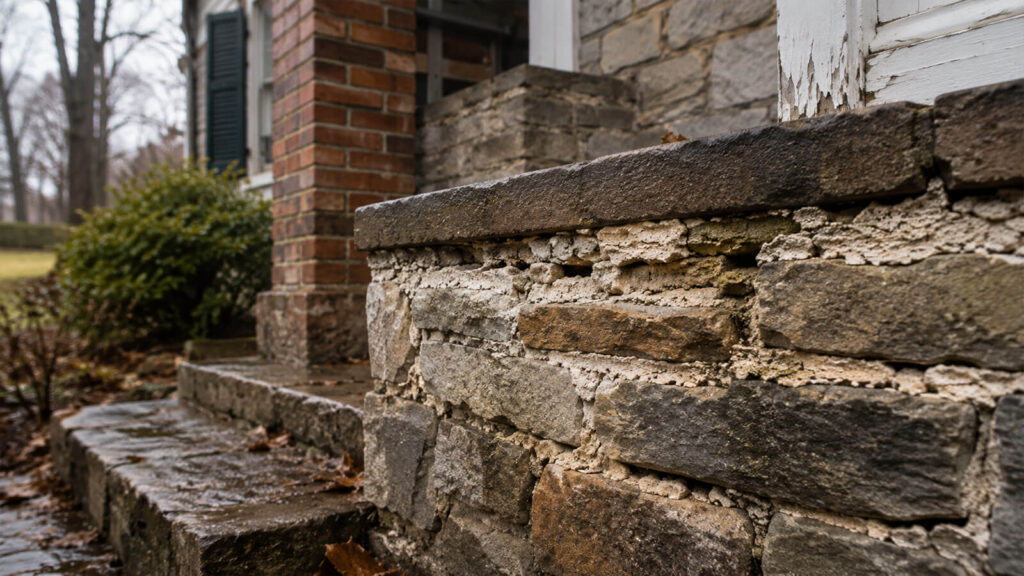
Crumbling Mortar Isn’t Just Cosmetic: What Hudson Valley Homeowners Should Know Before It Gets Worse
It usually starts small. A little sand in the joints. A hairline crack along a stone step. A patch of mortar that looks darker after rain and dries out looking powdery again. Most homeowners don’t notice it until a porch corner, chimney, or foundation wall starts looking tired enough to ignore no longer. By then, the question is rarely “Is this worth fixing?” The real question is how much water has already found its way in.
Mortar deterioration is one of those problems that gets dismissed as aging, when it is often the early warning sign of a larger moisture issue. In older Hudson Valley homes, especially those with stone foundations, brick chimneys, fieldstone steps, or patio walls, the joints can weaken long before the structure itself looks obviously damaged. That’s why experienced contractors usually look beyond the missing mortar and ask what’s feeding the breakdown in the first place. If water is the driver, patching the surface alone is usually a short-lived fix.
If you’re already seeing loose joints around a chimney, retaining wall, or front stoop, it may be worth reviewing how nearby water is moving. Problems like poor grading and runoff can make masonry damage worse, especially after heavy rain or a hard freeze. That’s one reason homeowners often end up comparing masonry concerns with drainage problems that can worsen masonry damage before they decide on the next step.
Why mortar breaks down faster here than people expect
Mortar is not supposed to last forever, but Hudson Valley weather can be hard on it. Freeze-thaw cycles are a big part of the problem. Water gets into small openings, freezes, expands, and slowly opens the joint further. Add shaded areas, heavy tree cover, roof runoff, or snow sitting against a wall, and the deterioration speeds up.
Older homes are especially vulnerable because many were built with softer mortar than the products commonly used in modern repairs. That matters. A lot. When a repair uses mortar that is too hard or too dense for an older wall, the brick or stone can be damaged instead of protected. Contractors who work on historic or aging masonry know that matching the right mortar mix is not a cosmetic detail; it affects how the wall breathes, drains, and survives the next season.
One counterintuitive thing homeowners often miss: the wall that looks the worst is not always the wall that needs attention first. Sometimes the most visible crumbling happens where water is actually exiting the system, not where it is entering. That is why a chimney, parapet, or porch face can look like the problem when the real culprit is flashing failure, a blocked gutter, or a grading issue a few feet away.
What contractors usually inspect first
When a contractor evaluates deteriorating mortar, the work rarely starts with the joints alone. The first questions usually focus on water. Where is it coming from? Where is it collecting? Is the damage concentrated at the base of the wall, near a roofline, at a corner, or around a capstone? Is the wall exposed to splashback from pavement or soil?
Those clues matter because the repair plan changes depending on the cause. A few common things get checked early:
- cracked or missing mortar joints
- spalled brick faces or crumbly stone edges
- failed flashing around chimneys or roof intersections
- gutter overflow and downspout discharge
- settling or movement in steps, walls, or foundations
- moisture at the base of the wall after rain
In other words, masonry damage is often a symptom, not the whole diagnosis. That’s why homeowners sometimes spend money on spot repairs only to see the same problem come back within a year or two. The wall was repaired, but the water path was left alone.
If the damage showed up after a recent storm or a rough winter, a broader exterior walkaround can be worth the time. A focused set of post-storm exterior damage checks can help catch issues around roofs, chimneys, siding edges, and masonry before they become more expensive to fix.
Where homeowners usually misread the warning signs
Loose mortar is easy to see. The harder part is reading what it means. Some homeowners assume the issue is purely age, which can lead to delay. Others assume a tube of sealant will solve it, which can make matters worse. Sealants and caulking have their place, but masonry usually fails in patterns, not random spots. Smearing over the wrong area can trap moisture and hide the actual problem.
Another common mistake is treating patio or walkway mortar issues as low priority because the structure is “just outside.” That thinking gets expensive when water starts undermining a step, pulling away a cap, or working into a wall adjacent to the house. The same applies to chimney repairs. Once mortar starts opening around the crown, flashing, or tuckpointed joints, water can move into places homeowners never inspect until there is staining inside.
Fresh deterioration after a winter thaw is often more serious than it looks. The wall may dry out and appear stable, but the underlying bond has already been weakened. That’s when a small patch becomes a recurring repair cycle.
When a small repair is enough, and when it is not
Not every cracked joint means a major rebuild. Sometimes selective repointing is the right move, especially when the wall is otherwise stable and the damage is limited to a manageable area. The key is whether the surrounding masonry is still sound. If the bricks are soft, the stone is delaminating, or the wall is moving, a simple mortar patch is not a real solution.
This is where homeowners can get stuck paying twice. A quick repair that ignores the cause may buy time, but it often fails early. Cheap fixes are especially risky on older walls because the wrong mortar, poorly cleaned joints, or shallow patching can look acceptable for a season and then start breaking out again.
Contractors usually become more cautious when they see:
- repeated failure in the same area
- white staining or efflorescence on the surface
- bulging or leaning in a wall or chimney
- soft brick faces that flake under light pressure
- cracks that run through the masonry, not just the joints
Once movement enters the picture, the conversation changes from cosmetic repair to structural judgment. That is also when it makes sense to speak with professional masonry services that can assess whether the problem is localized or part of a larger failure pattern.
Why Hudson Valley homes need a more careful approach
Homes in this region deal with a mix of conditions that are rough on masonry: wet springs, freezing winters, mature trees, shaded walls, older foundations, and in many areas, long roof runoff paths that dump water exactly where it should not go. Add stone foundations, detached garages, or older chimney stacks, and you have more places for moisture to enter and more surfaces for mortar to wear out unevenly.
In some neighborhoods, especially where homes have been modified over time, the original masonry may have been patched with several different materials. That can make diagnosis tricky. A wall may contain original lime mortar, harder modern patch mortar, and newer sealants all in the same section. Experienced contractors notice that kind of patchwork immediately, because it often explains why one area keeps failing while another appears fine.
For homeowners in counties where older homes and mixed-age additions are common, getting the right local trade perspective matters. If you need a narrower repair path, masonry contractors in Dutchess County can help evaluate whether the wall needs repointing, partial rebuild work, or moisture correction first.
The repair mistakes that usually cost more later
The most common expensive mistake is delaying until the mortar loss becomes visible from a distance. At that point, water has usually been inside the wall long enough to cause secondary damage. The second mistake is hiring someone who treats all mortar the same. It is not all the same. The wrong mix, poor joint depth, or mismatched color may seem harmless at first, but the functional problem is whether the repair actually bonds and breathes properly.
Another trap is assuming the cheapest quote is a clean comparison. With masonry, the lowest number often reflects a narrower scope, not a better deal. One contractor may be pricing a small repointing area. Another may be including proper prep, joint cleaning, mortar matching, and spot replacement of damaged units. Those are very different repairs.
Homeowners also underestimate how often drainage and masonry work overlap. If the soil slopes toward the house, if gutters overflow, or if a downspout empties at the base of a wall, the masonry will keep taking abuse no matter how good the repointing looks. That’s why it helps to think in systems, not just surfaces. A lot of the best repair planning starts with understanding the post-storm exterior damage checks and what they reveal about moisture pathways.
What a sensible repair plan usually looks like
For a homeowner, the goal is not to overspend. It is to avoid a repair that only solves the visible symptom. A sensible masonry plan usually starts with an inspection of the affected area, then expands outward to the conditions around it: gutters, flashing, grading, caps, steps, and adjacent joints. If the mortar damage is active, the work may involve repointing, selective replacement of damaged brick or stone, and fixing the water entry point that caused the deterioration.
That often means the repair is less about one dramatic fix and more about a sequence of smaller, well-judged steps. It is not glamorous, but it is usually how the problem actually gets solved.
Homeowners with patios, steps, and outdoor hardscape features should pay attention here as well. Once masonry starts failing around entertaining spaces or walkways, the repairs can quickly become both cosmetic and safety-related. If your issue is showing up near a patio, entryway, or exterior stair, it is worth reviewing patio and masonry repairs before outdoor season before the damage spreads into the next season.
How to decide whether it is time to call a pro
If the mortar is powdering, dropping out, or widening after wet weather, the problem is no longer just visual. If the wall is showing movement, if you see staining inside the home, or if the same area has been patched before and failed again, it is time to stop guessing.
That is especially true for chimneys, foundation walls, retaining walls, and porch masonry. Those areas can look manageable while hiding much bigger moisture or structural issues behind the surface. A good contractor will not just point at the damaged joints. They’ll look for what caused the joints to fail and whether there is any chance the damage is part of a broader water-management or settlement issue.
For homeowners in neighboring counties who need a direct path to local help, masonry repair help in Putnam County and Westchester County masonry services are useful starting points when the problem needs a contractor’s eye rather than another round of patching.
Frequently Asked Questions
Is crumbling mortar always a serious problem?
Not always, but it should not be ignored. Minor surface wear can stay stable for a while, but if joints are opening, softening, or washing out after rain, water is likely getting into the wall.
Can I just seal over deteriorating mortar?
Usually no. Sealants can trap moisture or hide the actual failure point. If the joints are breaking down, the damaged material should be assessed and repaired properly first.
How do I know if the issue is from water or just age?
Age and water are often connected. Contractors usually look for clues like staining, efflorescence, gutter overflow, bad grading, or damage concentrated in one exposed area. Those signs usually point to water exposure, not simple aging alone.
Is repointing enough for an older stone or brick wall?
Sometimes, but only if the underlying masonry is still sound. If bricks are spalling, stone is moving, or the wall is leaning, repointing alone may not hold.
Why does the same spot keep crumbling after it gets repaired?
Because the cause was probably left in place. Repeated failure often points to a drainage issue, flashing problem, or incorrect mortar mix rather than a one-time defect in the wall.
When is this more than a cosmetic repair?
When the damage affects a chimney, foundation wall, retaining wall, or load-bearing section, or when there are signs of movement, water intrusion, or interior staining. At that point, the issue deserves a professional evaluation.
If mortar is breaking down around your home, the safest move is to figure out why before patching over it. A careful inspection can save you from repeat repairs, water damage, and a much bigger bill later. If you want a local contractor perspective, HV Trades is a good place to start finding the right professional guidance before the next season makes the problem worse.