

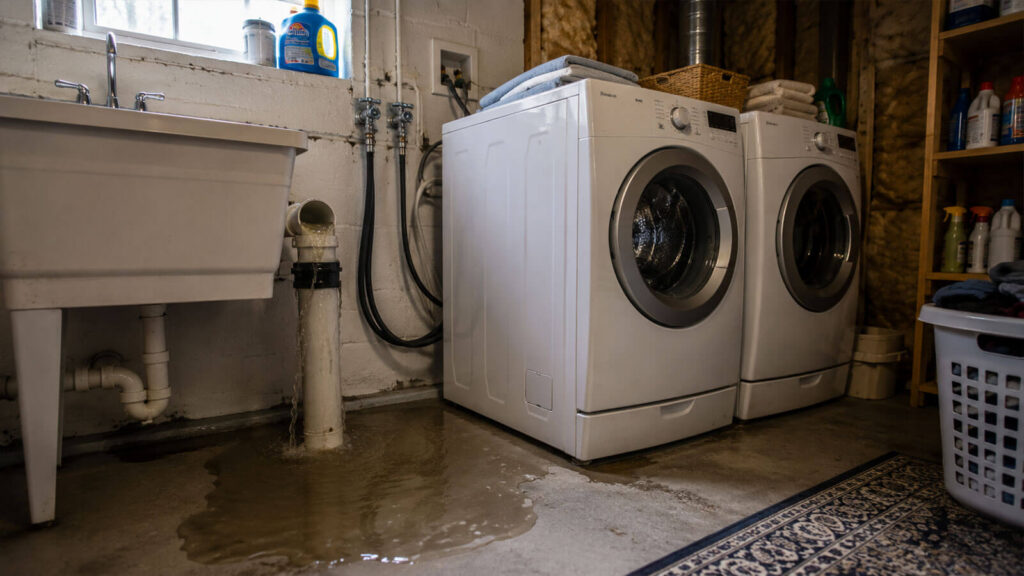
Laundry drain backups rarely start with a dramatic flood. More often, they begin as a slow, annoying problem: the washer drains a little sluggishly, the standpipe gurgles, or a faint smell hangs around the utility room after a load. That is exactly why these issues get missed until they become expensive. In older Hudson Valley homes, especially the ones with finished basements, long utility runs, or aging drain lines, a “small” laundry problem can be the first hint that something larger is developing behind the walls or under the slab.
Why a Laundry Drain Backup Is Usually a Warning, Not Just a Clog
A basic lint clog does happen. So do soap buildup and small blockages near the trap or standpipe. But when a laundry drain keeps backing up after repeated use, contractors usually start thinking beyond the washer itself. The more common culprits are partial line restrictions, venting problems, older galvanized or cast-iron piping, or a deeper obstruction downstream in the branch line or main sewer connection.
That matters because homeowners often focus on the symptom they can see: water in the laundry sink, a slow standpipe, a wet floor around the washer. The actual restriction may be farther away. One of the most counterintuitive things about plumbing backups is that the problem is not always located where the water appears. A stain, a puddle, or a gurgling fixture often shows up downstream from the real blockage.
If you are trying to gauge whether the issue is minor or a sign of a bigger repair, it helps to understand what drain cleaning may cost before deciding whether to keep pushing a DIY fix or bring in help.
The First Things Contractors Usually Check
Experienced plumbers typically do not start by assuming the washing machine is at fault. They look at the system as a whole. That usually includes the standpipe height, the trap, the venting, the condition of the visible drain pipe, and whether other fixtures are slowing down at the same time. If a laundry drain backs up and the basement floor drain also sounds off, that is a useful clue. If the issue happens only during heavy discharge, the line may be partially restricted rather than fully blocked.
In Hudson Valley homes, especially older properties with additions or converted spaces, it is also common to find mismatched piping or older drain layouts that were never really ideal to begin with. A machine that drains aggressively can expose a problem that has been there for years but stayed hidden because the previous washer discharged more slowly.
That is why quick fixes so often fail. Pouring in a chemical cleaner may buy a little time, but it does not correct poor slope, venting issues, root intrusion, or a sagging line. It can also make the eventual cleanup more unpleasant for the next person who opens the system.
Common Causes Homeowners Overlook
Lint is only part of the story. A laundry drain can back up for reasons that are less obvious and more expensive to ignore:
- Soap residue and detergent buildup narrowing older drain lines
- Improper venting that slows drainage and causes gurgling
- A partially blocked branch line shared with a utility sink or floor drain
- Cast-iron or galvanized pipe deterioration inside the wall or under the floor
- Root intrusion where the line ties into older exterior piping
- Frozen or compromised discharge or drain-adjacent plumbing in colder stretches of the property
- Exterior drainage issues adding moisture stress around the foundation
That last point gets overlooked more often than it should. If a basement already deals with seepage, damp walls, or seasonal water pressure, plumbing problems can feel worse because the whole lower level is already under stress. Homeowners sometimes treat those as separate issues when they are part of the same moisture picture. In that situation, it is worth paying attention to other drainage problems Hudson Valley homeowners should watch for, because exterior runoff and interior backup issues can feed each other.
Why Older Hudson Valley Homes Are Especially Vulnerable
Homes built decades ago often have plumbing that was perfectly serviceable for a different era of water use. Then modern washers arrive, drain faster, and move more water in a shorter burst. That extra flow can expose weak spots in a line that was already tired. Add freeze/thaw cycles, shifting soil, mature tree roots, and long utility runs common on larger lots, and drainage issues become less surprising.
Stone foundations and older basements can also complicate the picture. It is not unusual for a homeowner to blame the washer when the real issue is that the drain line, vent stack, and basement moisture conditions have all been slowly deteriorating together. A drain problem in a 1950s or earlier home often deserves more skepticism than the same symptom in a newer build.
If the laundry issue keeps returning and you are also noticing wall dampness, basement seepage, or efflorescence, it may be time to speak with foundation and waterproofing contractors as well as a plumber. That is not overreacting. It is usually the practical way to keep a recurring water problem from getting more expensive.
When DIY Makes Sense and When It Does Not
Homeowners can sometimes clear a minor blockage at the washer hose, the lint trap, or the visible drain opening. If the problem is clearly localized and the fixture otherwise behaves normally, that is a reasonable first step. The trouble starts when people keep forcing the issue. Repeated plunging, aggressive chemical drain cleaners, or improvised snaking can damage old pipe, shove debris deeper into the line, or mask a bigger obstruction long enough for water to escape somewhere else.
There is also a point where the time spent “trying one more thing” exceeds the cost of diagnosis. If the washer backs up every time it drains on a full cycle, if other fixtures are affected, or if the drain gives off a sewer odor, the problem is no longer a casual maintenance issue. At that point, the better move is to find the cause before the next overflow damages flooring, drywall, or stored items in the basement.
The Repair Pattern That Usually Costs More Later
One of the most common homeowner mistakes is assuming the backup is isolated because the rest of the house seems fine. In reality, plumbing failures often progress in stages. First the water drains slowly. Then it backs up intermittently. Then the line starts reacting badly to any higher-than-usual load. Finally, the backup becomes severe enough that the problem can no longer be ignored.
That slow progression is what makes the delay expensive. By the time a laundry backup becomes constant, contractors may find corroded pipe, hidden joints that have shifted, or a main line issue that has been growing quietly for years. The repair is rarely just “clear the clog” anymore. It may involve camera inspection, line cleaning, pipe replacement, or coordination with drainage or waterproofing work if the basement has been taking on moisture for a while.
What a Good Next Step Looks Like
If the issue is recurring, the goal is not to guess harder. It is to diagnose smarter. A good first visit usually focuses on the plumbing path from the washer to the main line, with attention to whether the backup is local, branch-level, or systemwide. That approach avoids the common mistake of spending money on a temporary fix when the real problem sits farther down the line.
For homeowners who are trying to decide how far to take the repair, it helps to compare options against the broader contractor picture. Sometimes a drain cleaning is enough. Sometimes the line needs to be inspected for slope or breakage. And sometimes the plumbing concern is telling you something about the property itself, which is why related services and the broader find the right local home service contractor path can be useful when you are not sure which trade should look first.
Why Exterior Water Management Still Matters
It may seem unrelated, but poor grading, weak gutter runoff, or downspouts dumping too close to the foundation can make basement utility areas harder to keep dry. Even if the laundry line is the immediate problem, a home with chronic moisture around the base of the foundation tends to have more complex plumbing and drain issues over time. Water does not stay politely in one category.
That is why contractors often pay attention to the yard as well as the pipe. If runoff is pooling near the house, or if the basement has repeated dampness after storms, it can be worth looking at yard drainage fixes that help protect basements. Sometimes the basement problem is not coming from the laundry room at all, but the laundry room is where the homeowner finally sees the consequences.
Frequently Asked Questions
Why does my washer drain back up only sometimes?
That usually points to a partial restriction, venting issue, or a drain line that struggles when the washer discharges a full load of water. Intermittent backups are often more telling than constant ones.
Is it safe to use drain cleaner on a laundry backup?
Usually not. Chemical cleaners can damage older pipes and do little for lint, sludge, or deeper blockages. They are especially risky in aging plumbing common in older Hudson Valley homes.
Could the problem be more than the laundry drain?
Yes. If other fixtures are slow, the issue may be in a shared branch line or the main sewer connection. If the basement is also damp, the plumbing problem may be part of a larger moisture issue.
What warning signs mean I should stop trying DIY fixes?
Recurring backups, sewer odors, gurgling at other fixtures, wet floors, or water backing up during a normal wash cycle all suggest it is time for a professional diagnosis.
Do older homes really have more drain problems?
Often, yes. Older piping, outdated layouts, tree roots, and years of mineral or soap buildup all make drainage less forgiving. Modern washers can expose weaknesses that were already there.
Can basement moisture and laundry backups be connected?
They can be. If water is already finding its way around the foundation, drain and plumbing issues sometimes show up more aggressively, and the cleanup becomes more complicated.
A recurring laundry backup is one of those issues that is easy to postpone and expensive to ignore. The safest move is to treat it as a diagnostic clue, not just an inconvenience. If you want to avoid the trial-and-error cycle, it helps to work with a trusted local pro who can trace the problem properly and recommend the fix that actually lasts.