

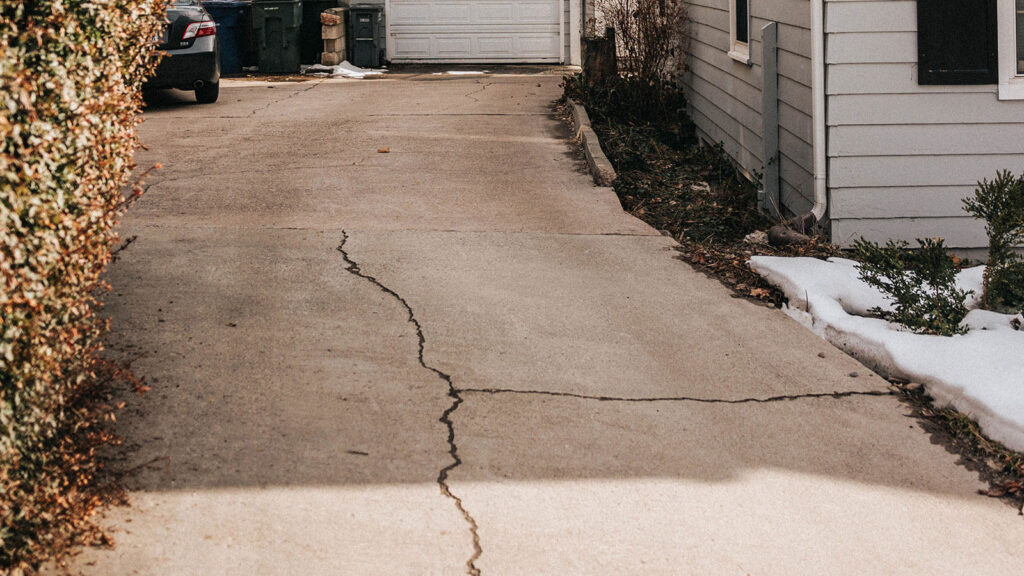
Why Driveway Edges Break Down Faster Than the Rest of the Driveway in the Hudson Valley
A lot of homeowners notice the same frustrating pattern: the middle of the driveway still looks fine, but the edges start crumbling, sinking, or breaking apart. That edge damage is easy to shrug off at first. It looks minor. It usually isn’t. By the time the sides start failing, water, soil movement, and freeze/thaw stress have usually been working on the pavement for a while.
In this region, driveway edges take a beating that is easy to underestimate. Heavy rain, snowmelt, roadside runoff, steep grades, and saturated soil all push pressure toward the weakest part of the pavement. If you’ve already started noticing soft edges or broken asphalt, it’s worth thinking about the whole water path on the property, not just the cracked strip you can see. In many cases, driveway damage is tied to broader driveway runoff and spring drainage problems that never got corrected after the last storm season.
What driveway edge failure usually means
When the outer edge of asphalt starts to crumble, the problem is often more than surface wear. The edge is where pavement loses support first. Once that support is gone, traffic loads, snowplow blades, lawn equipment, and water infiltration finish the job.
Contractors usually look for a few things right away: soft or collapsing base material, edge exposure from eroded soil, poor compaction, water pooling after storms, and signs that the driveway was never properly supported at the shoulder. On older properties, especially those with mature trees or uneven grading, the edge can slowly wash away without creating a dramatic visible defect until the failure is already advanced.
One counterintuitive thing homeowners often miss: the visible crumble at the edge is rarely the true starting point. The actual problem is frequently below it, in the base or in the drainage pattern feeding the edge. By the time asphalt begins to fracture, the support underneath has usually already been compromised.
Why Hudson Valley driveways are especially vulnerable
Driveways in the Hudson Valley deal with a combination of conditions that are hard on pavement. Freeze/thaw cycles expand tiny cracks. Heavy rains move water across sloped lots. Snowplows catch loose edges. In wooded neighborhoods, leaf buildup and shaded pavement keep moisture around longer than homeowners expect. On rural properties, long driveways often have sections that were patched over time instead of rebuilt properly, which can leave weak transitions at the shoulders.
That’s why a small edge issue in Dutchess County or Putnam County can turn into a bigger repair much faster than it might in a drier, flatter climate. Asphalt doesn’t fail in one dramatic moment. It usually weakens through repeated water intrusion, settlement, and traffic stress.
If the driveway edge is breaking down near gutters, downspouts, or a sloped side yard, it may be worth checking whether roof runoff is concentrating in the wrong place. A surprising number of pavement problems start with water management issues that were never tied back to the driveway itself. In some cases, the right fix starts with a gutter and downspout service, not with patching asphalt.
Common homeowner mistakes that make edge damage worse
The first mistake is patching the top without addressing the shoulder. Cold patch or store-bought filler can help temporarily, but it won’t hold if the edge is unsupported. The second mistake is letting soil and mulch build up against the driveway. That can trap moisture against the pavement and hide early erosion. The third is waiting until a plow or tire breaks off a larger chunk. Once the edge loses structural integrity, the repair becomes more involved and more expensive.
Another common misread: homeowners often assume the problem is “just asphalt aging.” Aging does matter, but a driveway that is failing early is usually telling you something about drainage, compaction, or grading. Contractors pay close attention to what the driveway is doing at the perimeter because the perimeter often reveals the real cause.
DIY fixes become risky when the edge is soft, sinking, or undermined. At that point, the issue is not cosmetic. Filling over a weak edge can create a false sense of security while the base keeps washing out underneath.
What contractors usually inspect first
When a paving contractor looks at an edge failure, the first questions are usually practical ones: Is water getting under the asphalt? Is the base still stable? Is the edge breaking because of traffic load, snow removal, or erosion? Is the shoulder low enough that the pavement is now unsupported?
They’ll also look at how the driveway meets the lawn, stone border, gravel shoulder, garage apron, or road connection. Edges often fail where the transition is weakest. A driveway can look fine in the center and still be structurally compromised where it ties into a drainage swale or a sloped embankment.
If the damage is isolated and the base is solid, a targeted repair may be enough. But if there’s ongoing washout, recurring cracking, or soft spots, the issue may call for broader correction. That’s where homeowners sometimes benefit from using the right local contractor type instead of assuming every driveway problem belongs to the same trade.
When a small crack becomes a larger repair
Edge damage becomes expensive when water starts moving into the base. Once that happens, the pavement around the edge can settle, separate, and break apart in sections. If the driveway slopes toward the house, the same drainage pattern that damaged the pavement can also contribute to moisture issues near the foundation, especially in older homes with stone foundations or basement seepage history.
That’s why delaying repair usually costs more than homeowners expect. What starts as a narrow edge repair can turn into edge rebuilding, drainage correction, and a larger resurfacing or replacement conversation. The longer the edge stays exposed, the more likely the damage spreads inward.
It also matters whether the driveway is asphalt, a paved apron, or a mixed surface with gravel shoulders. Asphalt and stone fail differently, and the fix should match the material. If the goal is to restore long-term function, not just hide the damage, the repair approach has to account for the support system under the pavement. That’s one reason homeowners often turn to asphalt and paving contractors when the failure goes beyond a simple patch.
Drainage fixes that actually help
Good drainage is not glamorous, but it is usually what keeps driveway repairs from repeating. If downspouts dump near the pavement, if the yard slopes toward the driveway, or if runoff travels along the same edge every time it rains hard, the asphalt will keep taking damage.
Sometimes the answer is as simple as redirecting downspouts farther away from the paved area. Other times it means correcting grade, improving shoulder support, or reshaping the surrounding landscape so water stops cutting along the edge. In more stubborn cases, a homeowner may need to think about landscaping drainage fixes that keep water away from pavement before spending money on another surface repair.
For properties with steep slopes, wooded runoff, or chronic wet spots, drainage and paving should be considered together. Separating them is how homeowners end up paying for the same repair twice.
How to tell whether you need repair now
There are a few signs that should move driveway edge damage from “watch it” to “deal with it soon.” If the edge is crumbling underfoot, if the pavement flexes when a vehicle pulls close to the side, if weeds are growing through edge breaks, or if water sits against the damaged area after rain, the problem is active.
Other red flags include:
- the edge looks lower than the rest of the driveway
- chunks are breaking off after storms or plowing
- the shoulder has washed away
- cracks are spreading inward from the side
- you can see loose base material under the asphalt
If you’re seeing more than one of those at once, the driveway is probably past the “simple touch-up” stage. At that point, the goal is to stop the damage from moving farther into the slab or strip.
Why cheap repairs often fail first
Homeowners are often drawn to the fastest, least expensive fix, which makes sense. The issue is that a weak driveway edge is usually not a surface-only problem. A patch placed over loose material, soft base, or active runoff may look good for a short time and then fail at the first hard rain or winter cycle.
That doesn’t mean every repair has to be a full replacement. It means the repair has to match the cause. If the edge failed because the shoulder washed out, the edge needs support. If the problem is runoff, water needs to be redirected. If the asphalt has aged and lost flexibility, patching may only buy time. The right contractor will usually explain that tradeoff clearly instead of promising a miracle fix.
That level of judgment matters in the Hudson Valley because many homes here have layers of old repairs, older grading decisions, and mixed materials that no longer work together cleanly. The cheapest fix is not always the least expensive over time.
Frequently Asked Questions
Can driveway edge damage be repaired without replacing the whole driveway?
Often, yes. If the damage is localized and the base is still stable, a targeted edge repair may work. But if the shoulder has washed out or the pavement is sinking, a patch alone usually won’t hold.
Why does the edge fail before the middle of the driveway?
The edge has less structural support and is more exposed to water, runoff, plow stress, and soil erosion. Once that support weakens, the edge breaks down long before the center.
Is driveway edge damage a drainage problem or a paving problem?
Sometimes both. The paving surface shows the damage, but water movement is often what starts it. That’s why contractors usually look at grading, runoff, and shoulder support before recommending a repair.
Can I just seal the cracked edge and be done?
Only if the damage is superficial. If the edge is crumbling, sinking, or soft, sealing over it is usually a temporary cosmetic fix, not a real repair.
What time of year is best to address driveway edge problems?
Before winter is often smartest if the damage is already active. Once freeze/thaw cycles start, small edge issues tend to spread faster and become harder to stabilize.
Should I talk to a paving contractor or someone else first?
If the issue is clearly asphalt failure, start with paving expertise. If the driveway is being hit by runoff, downspout discharge, or grading problems, it may help to compare the right local contractor type before committing to one repair path.
Driveway edge damage is one of those problems that looks small until it starts moving. The sooner a homeowner identifies whether the cause is drainage, support loss, or aging pavement, the easier it is to avoid bigger repairs later. If you’re not sure what’s really driving the damage, it’s worth getting guidance from a local professional who understands both the pavement and the water around it.