

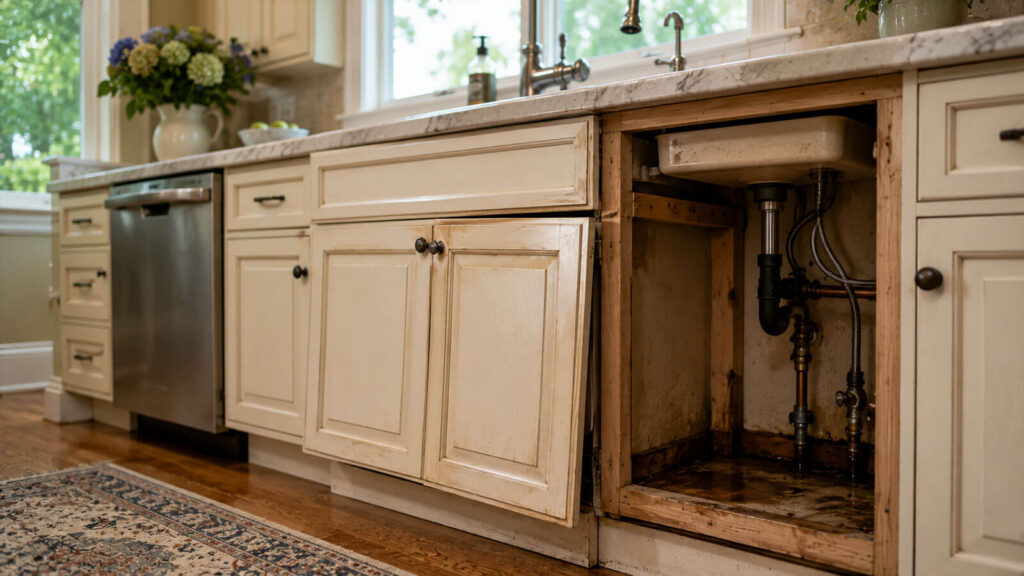
Why Swollen Cabinet Doors Happen in Hudson Valley Homes — and What They Usually Signal
A cabinet door that suddenly starts sticking, swelling, or refusing to close cleanly is easy to dismiss as a minor kitchen annoyance. In practice, it is often one of the first visible signs that something in the home’s moisture balance has changed. Sometimes the cause is obvious, like a dishwasher leak or a sink issue. More often, it’s the kind of problem homeowners don’t notice until wood begins to move, finishes start to fail, or the surrounding cabinet boxes begin to distort.
That matters more in older Hudson Valley homes than many people realize. Between damp basements, seasonal humidity swings, aging plumbing, and the way many homes were built before today’s moisture-control standards, cabinet swelling is not always “just a cabinet issue.” It can be a clue that points to broader conditions in the house. And if those conditions are ignored, a simple adjustment can turn into a larger repair conversation.
What swollen cabinet doors are actually telling you
Wood, MDF, plywood, veneer, and painted cabinet surfaces all react differently to moisture, but the pattern is familiar: once a door or drawer front starts to swell, warp, or rub, the finish is usually already under stress. A small amount of humidity may cause seasonal expansion. More persistent swelling usually means the material is absorbing moisture from somewhere nearby.
Contractors usually look first at the most likely sources: the sink base, the dishwasher, plumbing shutoffs, toe-kick areas, and the floor around the cabinet run. If the cabinet damage is concentrated near the sink, there’s a reason. Slow leaks often travel farther than homeowners expect, and they can keep the underside of a cabinet damp long before there’s a visible puddle.
What surprises people is that the cabinet face is not always where the problem started. The stain, swelling, or peeling finish may show up on the most visible part of the cabinet, but the source can be behind the dishwasher, under the flooring, or in a nearby wall cavity. That is why experienced contractors do not just look at the door. They trace the moisture path.
The most common causes homeowners overlook
Some causes are straightforward. Others are easy to miss because the kitchen still seems usable.
- Small plumbing leaks at the sink trap moisture inside the cabinet base.
- Dishwashers can leak slowly along the side or underneath where it is hard to see.
- Humidity from basements or crawl spaces can migrate upward, especially in older homes.
- Unvented or poorly vented kitchens can hold moisture after cooking and dishwashing.
- Exterior drainage issues can contribute to long-term dampness inside the home.
- Past repairs that sealed over the real cause can delay discovery until damage spreads.
That last point is worth emphasizing. A lot of homeowners try to solve cabinet swelling with a quick cosmetic fix: sanding a swollen edge, repainting a door, or tightening a hinge. Sometimes that buys time. Sometimes it hides the symptom while the cause keeps working. If the moisture source is still active, the repair is temporary at best. That is where small jobs turn into recurring expenses.
If the home also has basement dampness, a musty smell, or seasonal moisture problems, it may be worth looking at the bigger picture. In some cases, cabinet swelling and a damp lower level are part of the same issue. That is why homeowners dealing with recurring moisture often benefit from speaking with foundation and waterproofing contractors, especially when humidity or seepage seems to be part of the pattern.
Why Hudson Valley homes are especially prone to this problem
Hudson Valley housing has its own rhythm. Older framing, stone foundations, steep lots, tree cover, and freeze-thaw cycles all create conditions where moisture management matters more than people think. A home might look dry most of the year, then suddenly show symptoms after a wet spring, heavy summer storms, or a winter thaw that pushes water where it has no business going.
Cabinet swelling is often worse in homes with:
- unfinished or partially finished basements
- older kitchens with dated sink plumbing
- limited ventilation or weak range hood performance
- poor grading around the foundation
- mature landscaping that holds moisture near the structure
- detached or add-on kitchens in older farmhouses and colonials
The tricky part is that homeowners tend to focus on the room where the symptom appears. Contractors tend to look at the whole system. A swollen cabinet door may be a kitchen problem, but it may also reflect a drainage problem, a humidity problem, or a building-envelope problem. That broader view matters because a local patch only works if the home is not constantly reintroducing moisture.
For a good example of how exterior water behavior affects interior conditions, it helps to review spring drainage problems around Hudson Valley homes. A lot of indoor moisture issues start outside the kitchen.
What contractors usually check first
When a contractor is asked about swollen cabinet doors, the first question is rarely “How bad is the door?” It is usually “What changed?” A new dishwasher, a plumbing repair, a recent storm, a basement seepage issue, or a shift in household humidity can all change the diagnosis.
The inspection usually starts with the cabinet base, the underside of the counter, and any plumbing lines beneath the sink. Then comes the surrounding floor, especially if the door is now rubbing or not hanging square. If the cabinet boxes are swelling at the toe kick or along the side panels, that can point to repeated exposure rather than a one-time spill.
Experienced contractors also check whether the problem is isolated or systemic. One swollen door near the sink can be a local repair. Multiple doors throughout the kitchen can suggest ambient moisture, poor ventilation, or a broader material issue. That distinction matters because homeowners sometimes assume every sticky cabinet needs replacement, when in reality the underlying fix may be much smaller.
When a simple adjustment is enough
If the swelling is minor and the moisture source has already been corrected, sometimes the fix is mechanical: hinge adjustment, door rehanging, minor sanding, or localized refinishing. That is especially true when the cabinet boxes are still square and dry.
When the repair is no longer minor
If the door is swollen because the cabinet core has absorbed water, if the finish is peeling, or if the base material is soft to the touch, the damage may be deeper than it first appears. In those cases, replacing a single door may not solve anything if the box or adjacent panels are compromised.
That is usually the point where it makes sense to involve a local remodeling contractor who can assess whether the issue is confined to cabinetry or part of a larger kitchen repair. A good contractor should be able to tell you what can be saved, what needs replacement, and what is still worth monitoring.
The mistake that costs homeowners the most
The most expensive mistake is waiting for the cabinet damage to “settle down” on its own. Wood does not un-swell if the moisture source keeps feeding it. In fact, repeated wet-dry cycles can make the damage worse because the materials expand, contract, and break down over time.
Another common mistake is assuming the visible symptom is the whole story. A swollen cabinet door may be the first obvious clue, but contractors often discover damaged toe kicks, warped fillers, softened floor edges, or plumbing issues that have been leaking for weeks or months. By the time the homeowner notices the door, the cabinet may have already been through several moisture cycles.
That’s one reason cheap cosmetic repairs often fail. A quick paint touch-up might improve the look temporarily, but if the underlying humidity problem remains, the swelling usually comes back. Sometimes it comes back faster than before because the surface has already been weakened.
Don’t ignore moisture conditions elsewhere in the house
Kitchen cabinet problems do not always begin in the kitchen. Homes with damp basements, crawl spaces, or chronic grading issues can carry that moisture upward. Even if the kitchen looks dry, the indoor air may be holding more moisture than it should, especially in shoulder seasons when windows stay closed and ventilation habits change.
If the home has persistent dampness below grade, the cabinet issue may improve only after the broader moisture problem is handled. That is where exterior drainage, foundation management, and landscaping all start to matter. In some cases, the right prevention steps outside can reduce repeated trouble inside. For homeowners thinking through that chain of cause and effect, landscaping drainage fixes that reduce moisture problems can be a useful next read.
And when drainage or grading is part of the picture, even a well-built kitchen can keep showing symptoms until the surrounding conditions change. That is why some homeowners eventually need help from the right type of home contractor rather than trying to force the issue through one narrow repair category.
How to respond before the damage spreads
If you notice swelling, do not panic, but do not ignore it either. Start by checking for obvious water sources: the sink trap, supply lines, dishwasher connection, shutoff valves, and any signs of staining inside the cabinet. If the floor feels soft, the baseboards are discolored, or the cabinet bottom is lifting, the issue deserves faster attention.
It is also worth paying attention to odor. A persistent musty smell, especially in lower cabinets, can signal hidden moisture long before visible damage appears. In older Hudson Valley homes, that smell often gets brushed off as “just an old house smell.” Sometimes it is. Sometimes it is the first warning that water has been sitting where it should not.
Homeowners should also be careful about aggressive drying. Space heaters, high heat, or prolonged fan use can sometimes cause finish problems or mask the real issue without solving it. Drying the area is useful only after the source is identified. Otherwise, you are treating the symptom and hoping the leak disappears on its own, which is rarely how these problems behave.
Repair choices that make sense, and ones that usually don’t
If the cabinet damage is limited, a targeted repair may be the smartest path. That could mean replacing one door, reworking hinges, sealing a small leak, or refinishing a localized area. If the cabinet box is soft, swollen in multiple spots, or no longer square, replacement may be the more durable option.
What usually does not make sense is paying repeatedly for small cosmetic fixes while the same moisture source keeps coming back. That cycle becomes expensive because each repair is framed as “small,” but the total cost grows every time the problem returns.
In practice, the best decision is the one that stops the issue from recurring. That may be a plumbing repair, a ventilation fix, a cabinet replacement, or a broader moisture-control project. The right answer depends on what caused the swelling in the first place.
Frequently Asked Questions
Can swollen cabinet doors go back to normal?
Sometimes, if the swelling is minor and the material has not been damaged deeply. But once MDF or wood-based cabinet material has absorbed significant moisture, the shape and finish often do not fully recover.
How do I know if it’s a leak or just humidity?
Look at the location and pattern. Damage near the sink or dishwasher often points to a leak. Widespread seasonal swelling, especially with basement dampness or poor ventilation, can point more toward humidity.
Should I replace the whole cabinet or just the door?
If only the door is affected and the box is dry and square, a door replacement or adjustment may be enough. If the cabinet base is soft, warped, or stained, replacement becomes more likely.
Can a damp basement cause kitchen cabinet swelling?
Yes. Moisture can move through a home in less obvious ways than people expect, especially in older houses with poor air sealing, stone foundations, or long-standing drainage issues.
Is it safe to keep using the kitchen if a cabinet door is swollen?
Usually yes, but only if you are sure there is no active leak, electrical risk, or structural damage. If the cabinet floor feels soft or the issue is spreading, it’s better to have it looked at soon.
What’s the biggest mistake homeowners make with this problem?
Waiting too long because the damage looks cosmetic. Swollen cabinet doors are often one of the earliest signs of a bigger moisture issue, and early diagnosis is usually far cheaper than waiting for the cabinet box or flooring to fail.
If a cabinet problem is nagging at you, the safest move is usually not a guess. It’s a careful look at the surrounding moisture conditions, the cabinet structure, and the systems feeding the problem. That approach helps protect the kitchen, the resale value of the home, and your budget. When the cause is unclear, it’s worth getting guidance from a trusted local professional before a small repair turns into a much larger one.