

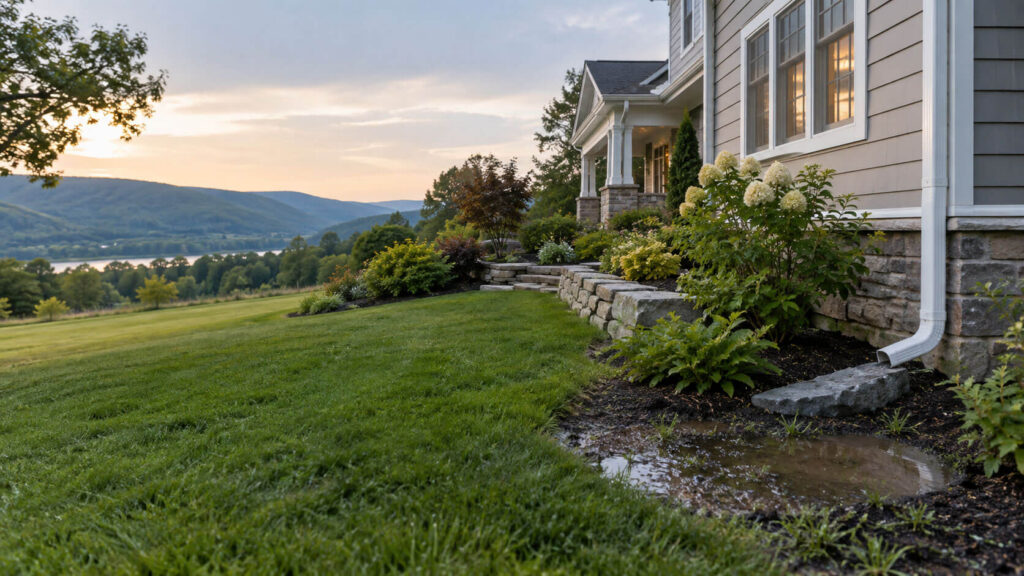
When a landscaping project goes sideways, it usually is not because the plants were the wrong color or the mulch was the wrong shade. It is because the property itself had a problem the homeowner could not see yet: drainage, grading, boundary confusion, access issues, or a plan that looked simple on paper and became expensive once digging started. That is especially true in the Hudson Valley, where older homes, sloped lots, wet springs, and long-established trees can turn a “quick yard upgrade” into a real sitework project.
Before You Start a Landscaping Project, Ask What the Yard Is Already Telling You
A lot of homeowners focus on the visible part of landscaping first: beds, walkways, privacy screening, maybe a new patio edge or a cleaner lawn layout. Contractors usually start somewhere less glamorous. They look at water movement, soil conditions, runoff paths, settlement, and how close the project sits to foundations, driveways, fences, septic components, or utility lines.
That order matters. A yard can look tidy and still be quietly working against you. If water always pools near one corner of the house after heavy rain, the issue may not be the landscaping itself; it may be the slope, the downspout discharge, compacted soil, or an area where previous work redirected runoff toward the foundation. In places like Dutchess County and Putnam County, where freeze/thaw cycles are hard on soil and hardscape, small drainage mistakes tend to show up fast.
If you are comparing project options or trying to decide how much to do at once, it helps to think in terms of property systems rather than decorative upgrades. Good landscaping contractors are often paying attention to what will still matter after the first heavy rain, the first winter, and the first season of settling.
The Mistake Homeowners Make Most Often: Treating a Drainage Problem Like a Planting Problem
This is where many well-intentioned projects fail. A homeowner sees muddy spots, soggy turf, or a strip of dying shrubs and assumes the fix is to replant, add fresh topsoil, or “dress up” the area. Those moves can help the appearance, but they often do nothing if the actual problem is runoff, poor grading, or compacted subsoil.
Contractors usually check the simplest explanations first. Are gutters dumping too close to the house? Is a downspout extension missing? Is the yard sloping toward the structure instead of away from it? Is there a low point caused by settling? Is water coming from an uphill neighbor’s property or a hard surface nearby, like a driveway or patio? Those answers matter more than the plant palette.
The counterintuitive part is that the stain, puddle, or dead patch you see is often not the true source of the issue. Water can travel under mulch, through root zones, around stone edges, and along compacted paths before it shows itself. That is why homeowners sometimes spend money fixing the wrong part of the yard and then wonder why the problem comes back.
If your project is already tied to runoff concerns, it is worth reviewing yard drainage problems after heavy rain before you commit to cosmetic work that may not last.
Property Lines, Access, and Neighbor Issues Can Complicate “Simple” Yard Work
Some of the costliest landscaping mistakes have nothing to do with the landscape itself. They happen when the work crosses into property-line questions, shared drainage, easement access, or a fence line that was never measured carefully in the first place. In suburban and semi-rural parts of the Hudson Valley, that kind of oversight can lead to awkward conversations and expensive corrections.
Before any larger project, contractors often want to know where the work begins and ends, whether equipment can access the site without damaging lawns or stone driveways, and whether there are boundary-sensitive elements like retaining walls, hedges, or existing fencing. If the plan includes screening, privacy planting, or boundary cleanup, it is smart to think beyond the bed itself and into the full edge of the property. Projects that touch shared boundaries can quickly overlap with fencing contractors for property line projects, especially when homeowners want better privacy or a cleaner transition between yards.
In places like Westchester County, where lots can be tighter and neighborhood expectations are often more formal, that planning step becomes even more important. In more rural pockets, the issue may be the opposite: plenty of space, but unclear lines and difficult access for machinery.
What Experienced Contractors Usually Inspect First
Before anyone starts promising a low-maintenance landscape, a solid contractor is usually looking at the boring stuff:
- how water drains after rain
- where the downspouts discharge
- whether the soil is sandy, clay-heavy, or compacted
- how much sun and shade the area gets during the season
- whether roots from mature trees are affecting the site
- whether the project could disturb a foundation, septic area, or utility run
- how winter plowing, snow storage, or ice melt will affect the finished work
That last one gets overlooked constantly. A landscape can look great in June and fail by February because it was built too close to a plow route, too close to a driveway edge, or in a spot that collects snowmelt and salt. Hudson Valley homeowners with long private drives, detached garages, or slopes down to walkout basements know how fast winter reshapes a yard.
That is one reason the cheapest bid is not always the least expensive project. Low bids often price the visible work and ignore the site conditions that make the job durable.
Why Older Hudson Valley Properties Need a More Careful Approach
Older homes often have older assumptions built into the property: old stone foundations, settled grade around the perimeter, mature trees with aggressive roots, and drainage patterns that have shifted over decades. That does not mean the property is “bad.” It means the yard may have layers of history that a fresh landscaping plan needs to respect.
In this region, it is common to see properties where one small improvement triggers another issue. A new bed exposes drainage that was previously hidden by overgrowth. A cleaned-up slope reveals runoff that had been absorbed by thick roots. A patio extension changes where snow piles end up. None of that is unusual. It is simply how aging properties behave.
Homeowners sometimes expect landscaping to be a straightforward visual upgrade. Contractors often see it as a balancing act between appearance, water management, and long-term maintenance. That is why a thoughtful plan for landscaping drainage fixes can save far more money than a prettier but shorter-lived install.
When DIY Helps and When It Starts Creating Bigger Problems
There is nothing wrong with homeowners taking on smaller landscaping tasks. Mulching, simple planting, trimming, and seasonal cleanup can absolutely make sense. The trouble begins when a project crosses from maintenance into site correction.
DIY becomes risky when the job involves major regrading, rerouting runoff, trenching near the house, changing hardscape elevations, or cutting into roots from mature trees. Those are the kinds of tasks where a small mistake can create a larger one later. A bed that looks level might actually send water toward the foundation. A trench that seems shallow can disrupt irrigation, lighting, or buried lines. A quick fix made with the wrong fill can settle badly and leave a visible dip by the next season.
Another common homeowner assumption is that “a little slope” is good enough. Sometimes it is not. Even a subtle pitch can matter when the soil is dense, the rainfall is heavy, or the site already has nowhere for water to go. That is especially true near basements, walkout entries, and garage aprons.
Permits, Rules, and the Uncomfortable Questions Homeowners Skip
Not every landscaping project needs a permit, but more of them raise questions than homeowners expect. The moment a project affects drainage patterns, retaining height, property access, or nearby structures, the conversation becomes less about planting and more about compliance, safety, and long-term impact.
That is why it helps to ask direct questions before work begins:
- Will this change where water goes?
- Could this affect a neighbor’s yard or a shared boundary?
- Is heavy equipment likely to damage existing surfaces?
- Will the project require coordination with other trades?
- Are there site conditions that could change the scope once work starts?
Homeowners often feel awkward asking these things, but good contractors do not. In fact, the best ones welcome them because they know the expensive surprises usually come from the questions nobody asked early enough. If you are comparing options by county, local familiarity matters too. A contractor used to Dutchess County landscaping services may have a different read on soil, slopes, and municipal expectations than someone who mainly works in flatter or more heavily developed areas.
How to Protect the Budget Without Cutting the Wrong Corners
If the project scope feels bigger than expected, the answer is not always to do less. Sometimes it is to do the right parts in the right order. That might mean handling drainage and grading first, then planting later. Or it might mean leaving a future patio expansion in mind while finishing the grading now. The point is to avoid spending money on anything that will be torn up in the next phase.
This is where homeowners get into trouble with “just get it done” thinking. A temporary fix can be reasonable if it truly buys time. But some shortcuts are just expensive delays. Fresh topsoil on a bad slope will not solve runoff. Decorative stone over compacted wet ground can look neat and still fail. New shrubs planted in a poorly drained bed can struggle for years and never really recover.
In practical terms, the better question is not, “What is the cheapest way to make this look better?” It is, “What has to be corrected so I do not have to pay for this twice?”
Choosing Help That Understands the Property, Not Just the Planting List
Homeowners do not need a contractor who talks only in technical terms. They need someone who can explain what is happening in the yard, what is urgent, what can wait, and what is likely to get worse if ignored. That kind of judgment is especially valuable on properties with a mix of mature landscaping, drainage challenges, and older infrastructure.
In Putnam County, where wooded lots and sloped terrain are common, even a modest project may need more site awareness than expected. If you are looking for landscaping contractors in Putnam County, the best fit is usually the one who asks about runoff, access, and seasonal maintenance before talking about finish materials.
For bigger projects or homes that have been patched together over time, this mindset matters even more. The point is not to overcomplicate the job. It is to avoid the false economy of repairing the visible symptom while ignoring the reason the symptom keeps returning.
Frequently Asked Questions
Do all landscaping projects need drainage work?
No. But if water pools, soil stays soggy, or the yard slopes toward the house, drainage should be part of the conversation. Ignoring it usually leads to repeat problems.
What is the biggest mistake homeowners make with yard upgrades?
They often start with the decorative parts and leave grading, runoff, and access questions until later. That can turn a manageable project into a repair job.
How do I know if a landscaping issue is actually structural?
If you see recurring settling, foundation moisture, persistent low spots, or cracks near hardscape edges, the issue may be tied to site conditions rather than the planting itself.
Can I fix bad drainage with more mulch or topsoil?
Sometimes those help with appearance, but they rarely solve the underlying issue. If water has nowhere to go, extra material can hide the problem instead of fixing it.
When should I bring in a contractor instead of handling it myself?
Bring in a professional when the project affects slope, water movement, retaining height, property lines, or buried utilities. That is where small mistakes become expensive.
Why do landscaping projects cost more after work starts?
Usually because the site conditions were more complicated than they looked from the surface. Hidden drainage issues, roots, poor access, and old construction details are common reasons.
A well-planned landscaping project should make a home easier to live with, not create a new round of maintenance headaches. If you are weighing options, it is worth taking time to understand the site first and then finding local professionals who respect the realities of Hudson Valley properties. That is often the difference between a project that looks good for one season and one that still makes sense five years later.
