

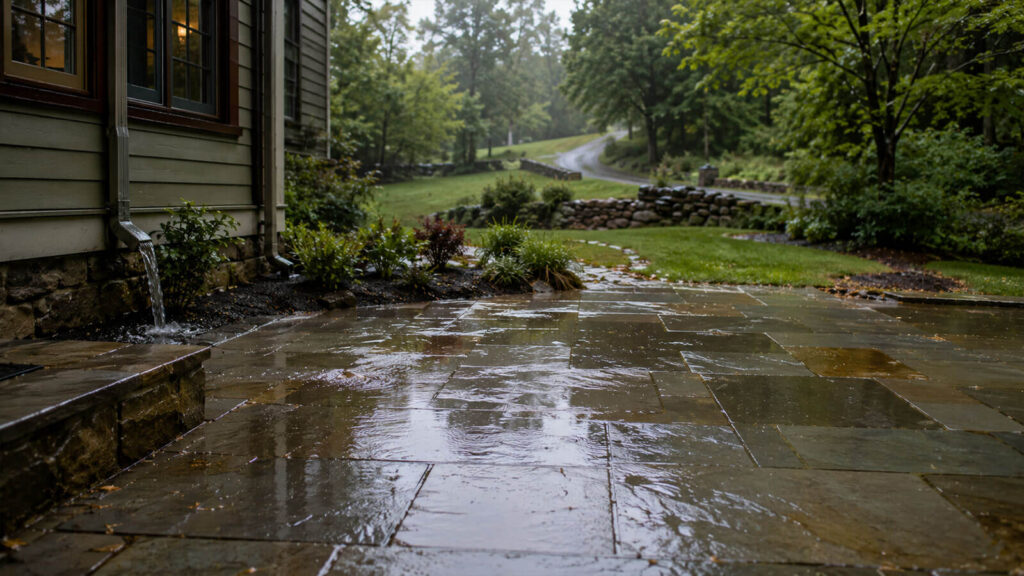
Why Patio Flooding Keeps Coming Back After Every Heavy Rain in the Hudson Valley
A patio that holds water after a storm is usually trying to tell you something. And the problem is not always the patio itself. In a lot of Hudson Valley homes, what looks like a simple low spot is actually a grading issue, a downspout problem, a settlement issue, or a combination of all three. That is why the same “quick fix” often works once, then fails again the next time the ground saturates.
Homeowners usually notice the puddle first. Contractors usually start by looking at where the water is coming from. Those are not the same thing. The stain in the patio joint, the soggy mulch bed, or the edge that stays damp for days is often just the symptom. The real cause may be runoff from the roof, compacted soil, a sunken section of hardscape, or water moving across the yard because the slope is wrong. If the property has mature trees, a stone foundation, or older additions, the pattern can get even harder to read.
That is also why patio flooding can be a useful warning sign. It often shows up before the bigger damage does. If water is pooling near the house after heavy rain, it is worth paying attention to the drainage pattern around the entire property—not just the patio surface. In many cases, the next issue is not the patio at all, but basement seepage, eroding beds, or water pushing toward the foundation.
What usually causes patio flooding
Most patio flooding problems trace back to one of a few familiar causes. The first is poor pitch. A patio should shed water away from the house, but settling, sloppy installation, or years of freeze-thaw movement can change that slope in small ways that matter a lot. A half-inch of bad pitch can be enough to keep water sitting where it should not.
The second common cause is runoff from nearby surfaces. Roof water is a major culprit. If gutters overflow or downspouts dump too close to the patio, the water has to go somewhere. So does water from driveway runoff, especially on sloped properties or long private drives where stormwater races downhill faster than the yard can absorb it.
The third issue is drainage capacity. Some patios sit in areas where the soil simply does not drain well. Clay-heavy soils, compacted fill, and areas that have been repeatedly regraded can all hold water longer than homeowners expect. Once the ground is saturated, even a properly sloped patio can stay wet because the surrounding soil is acting like a sponge.
For homeowners trying to understand whether the problem is isolated or part of a larger pattern, it helps to look at the yard as a system. A patio is often affected by the same forces behind recurring lawn and patio drainage problems, especially after spring storms or a fast snowmelt.
The mistake that causes a lot of repeat repairs
The most common homeowner mistake is treating the visible puddle instead of the source. Filling a low corner with sand, adding decorative gravel, or sealing the patio surface rarely solves the underlying issue. In fact, sealing can sometimes make the drainage problem more obvious because the water has fewer places to escape.
Another mistake is assuming the patio needs replacement when the yard is actually the problem. Contractors see this all the time: the patio gets blamed because it is where the water shows up, but the grading around it is what is really failing. That is where an experienced eye matters. A good contractor will usually inspect the surrounding slope, gutter discharge, soil conditions, and nearby hardscape before recommending any major work.
Counterintuitive but true: the wettest spot is often not the source of the problem. Water follows the easiest path, not the most obvious one.
This is especially relevant on older Hudson Valley properties where the ground has been disturbed over time by additions, driveway work, past landscaping, or settling around detached garages and side yards. The drainage pattern may have changed years ago without anyone noticing until one storm finally made it impossible to ignore.
What contractors usually check first
When a contractor looks at a flooded patio, the first pass is usually practical and unglamorous. They check the slope of the hardscape. They look at where the downspouts end. They look for signs of soil washout, sunken edging, clogged drains, and places where water is being redirected by a nearby walkway, retaining wall, or planting bed.
If there is a drainage system already in place, that becomes a key inspection point. French drains, catch basins, and dry wells can all fail in ways homeowners do not notice right away. A drain may not be broken in the dramatic sense; it may simply be undersized, clogged with sediment, or no longer pitched correctly. In the Hudson Valley, freeze-thaw cycles and leaf debris can turn a decent drainage setup into a frustrating one in just a few seasons.
Contractors also pay attention to what is happening farther away from the patio. Water often enters the problem from outside the immediate area. That might mean a gutter on the opposite side of the house, a driveway edge that slopes the wrong way, or a lawn that channels runoff toward the patio every time it rains hard. The fix is usually broader than the symptom.
For homeowners comparing repair options, speaking with landscaping contractors who handle drainage and grading is often the most practical starting point. Patio flooding is rarely just a hardscape issue; it usually involves how the whole site moves water.
Why the Hudson Valley makes this problem more stubborn
Local conditions matter here more than people sometimes expect. Older homes, stone foundations, clay pockets, wooded lots, steep grades, and long driveways all make drainage less forgiving. A patio that seems fine in midsummer may struggle badly in March or April when snowmelt, saturated soil, and rain all hit at once.
In Dutchess, Putnam, and Westchester counties, a lot of properties have layered landscaping from different eras. A patio may have been added after the original drainage plan. A garden bed may have been built up over time. A gutter extension may have been shortened because it was inconvenient. None of those choices looks dramatic on its own, but together they can create a water path that keeps pushing toward the patio.
That is why local drainage guidance is often more useful than generic advice. A homeowner in a wooded part of Putnam County may be fighting leaf-clogged drains and heavy runoff. A Westchester property on a slope may be dealing with water racing off hard surfaces. A Dutchess County lot with older masonry and uneven grading may be seeing water pool because the soil and the patio are settling at different rates. If you are trying to compare solutions, county-level resources like landscaping contractors in Putnam County and Westchester County drainage and landscaping help can be a more realistic match than a one-size-fits-all approach.
When a patio problem is really a larger drainage problem
One reason patio flooding deserves attention is that it can be an early warning sign for the rest of the house. If water is lingering near the foundation, it is worth considering whether the same runoff is also working its way toward the basement. That is especially true on properties where the exterior soil already sits high against the foundation or where the grade has gradually drifted toward the house.
Homeowners sometimes focus on the patio because that is the visible part of the issue. But if the yard holds water, the basement often becomes the next place to pay the price. Moisture problems do not always announce themselves with a dramatic leak. Sometimes it starts with damp walls, musty smells, or a dehumidifier running more than it should.
If the drainage pattern is not obvious, it can help to look at broader site water movement before making cosmetic changes. A useful place to start is drainage problems before the next heavy rain, especially if the patio flooding appears after storms rather than during everyday use.
Fixes that tend to work, and the ones that usually do not
Some solutions are practical and durable. Regrading a section of lawn so water moves away from the patio can make a real difference. Extending downspouts farther from the house often helps more than people expect. Clearing clogged drainage components is obvious, but it is also one of the most overlooked maintenance tasks. If a catch basin or drain line is full of sediment, the whole system can back up even though nothing looks broken from the surface.
In some cases, a patio needs a structural adjustment rather than a patch. That may mean resetting pavers, correcting settlement, or improving the base so water no longer collects in the same low area. If the patio was built with the wrong pitch, repair work that ignores the foundation of the installation tends to fail again later.
What usually does not hold up is the shallow fix: adding a little material to one edge, sealing the top, or hoping that mulch will absorb enough water to make the problem go away. Those approaches can make the area look better for a while, but they rarely change how water is actually moving.
For homeowners weighing whether the patio itself needs more involved work, it can be helpful to review related deck and patio construction services before assuming the issue is purely landscaping. Sometimes the hardscape was never built to handle the site conditions it sits on.
Why delaying the repair gets expensive
A small flooding issue can turn into a larger one faster than most people expect. Water that sits near the patio can erode soil, undermine edging, wash out joints, and create settlement around adjacent surfaces. Once the base starts moving, repairs get more involved. What could have been handled with grading or drainage work can become a patio reset or a broader site correction.
There is also the hidden cost of living with a bad drainage pattern. Saturated soil stresses plants, attracts mosquitoes, damages mulch beds, and makes outdoor spaces less usable. Over time, repeated water intrusion can affect steps, foundation edges, and even nearby walkways. The longer homeowners wait, the more the project tends to spread.
That is why drainage-focused repair work is often worth addressing sooner rather than later. Spring is especially important. A lot of homeowners first notice the issue when snowmelt and heavy rain hit together, and that is often the moment when a small site problem reveals its full size. Resources like spring landscaping drainage fixes can help homeowners understand what kinds of exterior corrections are typically worth discussing before the next storm season.
How to judge whether you need a contractor
If water is pooling repeatedly after rain, if the patio stays damp for days, if the soil around it is washing away, or if you are seeing water move toward the house, it is time to get a professional opinion. Those are the kinds of problems where guessing gets expensive. A contractor who understands drainage, grading, and hardscape construction can usually tell fairly quickly whether the issue is surface-level or structural.
Homeowners should be cautious about anyone who recommends a fast cosmetic fix without looking at the whole site. Good drainage work is usually based on observation, not guesswork. The best recommendations typically come after checking slope, runoff paths, soil conditions, and nearby structures together.
If you live in an area with recurring runoff issues, an outside assessment may also help you compare whether the problem belongs with landscaping, hardscape repair, or a more involved exterior water management solution. In many Hudson Valley neighborhoods, that distinction matters more than the repair label itself.
Frequently Asked Questions
Why does my patio flood even when it looks level?
A patio can look level to the eye and still hold water if the pitch is slightly wrong. Even a small settlement or slope issue can stop water from draining away properly.
Can clogged gutters really cause patio flooding?
Yes. If roof water is overflowing or dumping too close to the patio, the runoff can overwhelm the area fast. Downspout placement is one of the first things contractors check.
Is patio flooding usually a patio problem or a yard problem?
Often it is both, but the yard is usually part of the cause. Grading, soil conditions, and runoff patterns around the property are usually more important than the surface puddle itself.
Will adding gravel fix the drainage issue?
Not reliably. Gravel can improve appearance or help in a small area, but it does not correct bad slope, clogged drainage, or runoff coming from elsewhere.
When should I worry that the problem is affecting the foundation?
If water sits near the house, soil keeps washing away, or the basement starts showing moisture signs, it is worth treating the drainage issue as more than a patio nuisance.
What is the best first step if my patio keeps flooding?
Start by checking gutter discharge, nearby grading, and whether the patio itself has settled. If the pattern keeps repeating, a drainage-focused contractor can help identify the real source before repairs get bigger.
Patio flooding is usually less about the puddle and more about the way the property handles water. The sooner that pattern is understood, the easier it is to avoid repeat repairs, protect the home, and make a fix that actually lasts. If you are comparing options, it is worth working with trusted local professionals who understand Hudson Valley drainage conditions and can help you choose the right repair the first time.