

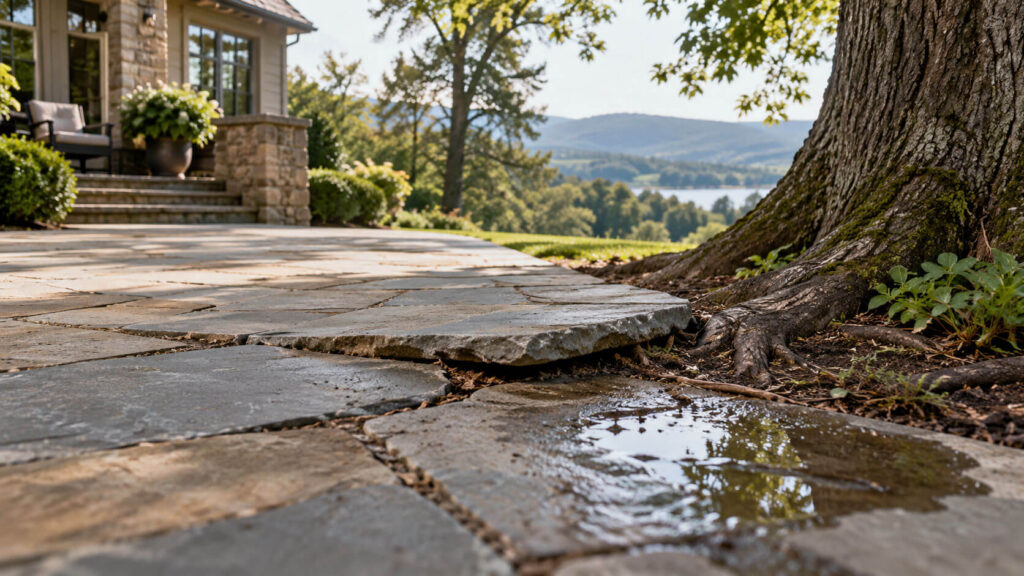
Tree roots rarely cause trouble in a dramatic way. They don’t usually crack a slab overnight or send a driveway edge buckling in one clean motion. More often, the damage starts as a small lift, a slight separation, or a corner that stays damp long after the rain has passed. By the time a homeowner notices it, the real issue is often already part landscaping problem, part drainage problem, and part structural nuisance.
That’s why root damage to patios, walkways, and driveways gets misread so often. A slab looks “just a little off.” A paver edge looks like it only needs re-leveling. A driveway crack seems cosmetic. In practice, those are the warning signs contractors pay attention to first, because root pressure usually works in combination with soil movement, water intrusion, and freeze/thaw cycles. In the Hudson Valley, that combination is everywhere.
If you’re trying to decide whether the problem is minor or heading toward a bigger repair, it helps to understand what usually sits underneath the surface. When exterior concrete or paving starts moving, homeowners often get better results by thinking in terms of cause and pathway, not just the visible damage. In some cases, that means talking with patio repair and replacement contractors before the crack spreads into a trip hazard or the surface becomes too unstable to salvage.
Why roots lift hard surfaces in the first place
The common assumption is that roots “push” from below with brute force. Sometimes that happens, but the more typical pattern is quieter. Roots expand into softened soil, follow moisture, and gradually displace the material supporting the slab, paver bed, or driveway edge. Once that support starts to fail, the surface settles unevenly. The root itself may be part of the problem, but the underlying loss of support is often what creates the visible damage.
That distinction matters. Contractors usually don’t start by blaming the tree. They look at where water goes after a storm, whether the soil stays saturated, how the base was installed, and whether the edge of the hardscape was ever properly contained. On older properties especially, a patio can fail because of a root issue and a drainage issue at the same time.
One counterintuitive thing homeowners often miss: the biggest crack is not always the main problem. A smaller section that rocks, sinks, or feels hollow can tell you more about the underlying movement than a visible fracture does. That’s the kind of detail that helps determine whether a repair will hold or just buy time.
What to look for before the damage spreads
Not every uneven surface means immediate replacement. But a few signs are worth taking seriously:
- slabs or pavers that have lifted at one edge
- hairline cracks that are widening after wet weather or frost
- sections that feel loose, hollow, or unsettled underfoot
- water pooling along the same area after each storm
- roots visibly crowding the perimeter of a patio, walkway, or driveway
- gaps opening between hardscape and the house, steps, or garage apron
In the Hudson Valley, these issues often show up first near mature trees, shaded sections that dry slowly, and properties with poor runoff control. Long private driveways, stone retaining edges, and older patios built without modern base prep can all make the problem worse. The surface may look like it failed on its own, but the real story is usually in the soil and water beneath it.
If the issue seems tied to runoff or puddling, it’s smart to look at drainage problems that affect exterior surfaces before spending money on resurfacing that may not last. A new slab over bad drainage is one of the fastest ways to repeat the same repair.
Why quick fixes usually fail
Homeowners often try to stabilize a lifted edge with patch material, leveling compound, or a little fresh fill at the perimeter. Those fixes can make the surface look better for a while, but they don’t address the movement causing the problem. If roots are still growing, the sub-base is still saturated, or the soil is still washing out, the repair is temporary at best.
That’s especially true with older patios and walkways in wooded lots. A simple patch may bridge the visible gap, but it won’t restore load-bearing support. Contractors usually check the base depth, compaction, drainage path, and whether the root has already altered the grade. If the root line is active and the slab has shifted enough to create a slope, the safer fix may involve removal and rebuild rather than a cosmetic patch.
Homeowners also get tripped up by the assumption that all root-related damage needs tree removal. Not always. In many cases, selective pruning, drainage correction, and hardscape reconstruction are enough. But that decision should be based on how the surface has moved, not on how obvious the root looks above ground.
Driveway edges deserve a closer look
Driveway problems often begin at the edges, where root systems, soil, and pavement meet. A slightly lifted border may not seem like much until it starts breaking apart under plow pressure, tire pressure, or winter freeze/thaw cycles. Once the edge loses integrity, water gets in, the base softens, and the damage travels inward.
That’s why root damage near asphalt is more than a cosmetic issue. If the affected area is near the driveway entrance or transition zone, it may be worth consulting driveway paving contractors before the surface starts to crumble through winter. Patching an edge that has already lost its base support often ends up being a short-lived expense.
For homeowners with mature trees lining a gravel or paved drive, the risk is even higher if runoff is already poor. Water tends to follow the low side, which means the same root line can create both uplift and softening. That combination can turn a manageable repair into a full edge replacement.
What contractors usually inspect first
Experienced contractors usually begin with the cause, not the crack. That means looking at the slope around the surface, the condition of the base layer, where water settles, and how far the roots have actually displaced the material. They also check whether the surface can be reset or whether the material underneath has degraded too much to support reuse.
In practical terms, that inspection often includes:
- measuring how far the slab or paver field has moved
- checking for soft spots, erosion, or voids under the surface
- identifying whether water is being trapped against the edge
- looking at adjacent structures like steps, garage aprons, or retaining walls
- determining whether the roots are active, cuttable, or structurally embedded
This is where homeowners sometimes get stuck trying to diagnose the problem from the top down. A surface crack can look serious while the real repair decision depends on what is happening below it. That’s one reason broader exterior work often overlaps with general contractors for exterior repairs, especially when grading, demolition, and reconstruction all need to be coordinated.
When DIY becomes risky
DIY is tempting when the problem looks localized. A homeowner can see a lifted corner, a shifted paver, or a crack that seems easy enough to fill. The risk is that the visible area is only the symptom. If the base is still moving, any cosmetic repair can fail quickly—and in some cases make the area more uneven than before.
Cutting roots without understanding the tree’s location can also create new problems. Large roots can affect tree stability, and aggressive cutting near a mature tree can stress it in ways that aren’t obvious right away. On wooded Hudson Valley properties, that matters. Mature trees are part of the appeal, but they also bring ongoing maintenance tradeoffs that are easy to underestimate.
If the slab has become a trip hazard, the repair should be treated as more than a weekend project. Uneven hardscape near entryways, steps, and backyard traffic paths can become a safety issue fast, especially after rain or frost. That’s the point where a careful repair plan is usually cheaper than a rushed one.
Why moisture and roots are so often linked
Root damage does not happen in isolation. Moist soil invites root growth, and wet soil loses strength under heavy surfaces. That’s why drainage and root intrusion are so closely related. A yard that holds water against a patio or driveway edge is essentially telling roots where to go—and weakening the structure at the same time.
Homeowners who want to avoid repeat repairs should think beyond the slab itself. Grading, gutter discharge, downspout extensions, and runoff control all influence whether a hardscape repair lasts. In some neighborhoods, especially where older lots have settled over time, small changes in water management can make a bigger difference than the repair material.
That’s also why it helps to look at landscaping drainage fixes around the yard when exterior surfaces start shifting. The most durable solution is often a combination of soil correction, drainage improvement, and targeted surface repair.
How to think about repair timing
Waiting is expensive when root damage is part of a larger moisture problem. A small lifted edge today can become a broken section next season, especially after freeze/thaw stress. Once water starts entering the gap, the repair often gets harder because the base deteriorates faster, not slower.
There’s a point at which it makes sense to act before the damage gets dramatic. That doesn’t mean replacing every uneven surface immediately. It means getting a clear look at whether the movement is active, whether the root system is still encroaching, and whether the repair can be done in a way that prevents recurrence.
For homeowners trying to keep outdoor spaces usable without overcommitting to a full rebuild, a good next step is often to compare the damaged area against broader seasonal planning. If you’re already thinking about surface cleanup or upgrades, it may be helpful to review deck and patio repairs before outdoor season so the work is handled before traffic and weather make it worse.
Frequently Asked Questions
Can roots damage a patio without cracking the concrete?
Yes. Root growth can shift the base underneath before the surface cracks. Uneven sections, hollow spots, and small height differences are often the early warning signs.
Is it better to cut the roots or replace the hardscape?
It depends on how much the surface has moved and whether the drainage problem has been corrected. If the base is still failing, cutting roots alone usually won’t solve it.
Why does the same area keep lifting after repair?
Repeated lifting usually means the underlying cause was not fixed. Active roots, poor drainage, and weak base prep are the usual repeat offenders.
Should I worry if a driveway edge is starting to crumble near a tree?
Yes, especially if water pools there or the edge gets hit by plows or vehicle tires. What starts at the edge often spreads into the main paved area.
Do all root-related slab problems require tree removal?
No. Many can be addressed with selective root management, drainage correction, and proper reconstruction. Tree removal is usually a last-resort decision, not the default.
What’s the biggest mistake homeowners make with lifted patios or walkways?
Trying to patch the visible problem without checking why it moved. If the base is unstable or moisture is trapped, the repair is likely to fail again.
Root damage to patios, walkways, and driveways is one of those problems that looks smaller than it really is. The good news is that it’s usually manageable when it’s caught early and evaluated the right way. If you’re weighing whether a repair is cosmetic or structural, it’s worth getting local guidance from people who understand how Hudson Valley properties actually behave over time.
