

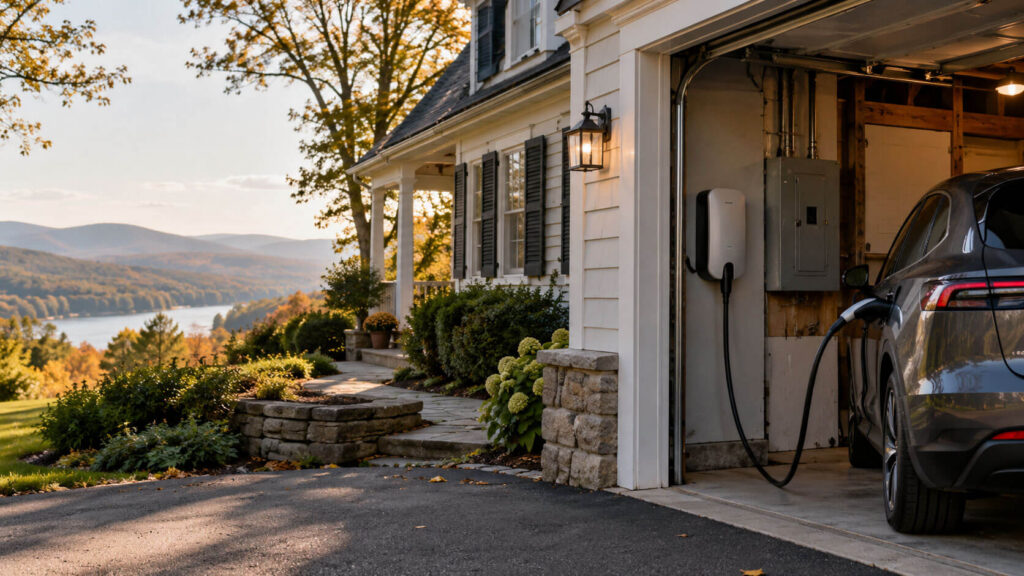
EV charger installation sounds straightforward until an older panel, a tight garage, and a few surprise code issues turn it into a bigger project than expected. That’s the part many homeowners don’t see at first. The charger itself is often the easy piece. The real question is whether the house can safely handle the added load without creating problems elsewhere.
What homeowners should understand before adding an EV charger
In the Hudson Valley, especially in older homes around Westchester, Dutchess, and Putnam counties, electrical systems often grew up in stages. A house may have been fine with its original service for decades, then picked up a finished basement, a hot tub, a mini-split, a workshop, or an air compressor along the way. Add an EV charger to that mix and the panel can run out of headroom fast.
That’s why a proper evaluation matters before anyone starts running wire. A lot of people assume the answer is simply “install a 240-volt outlet in the garage.” But experienced electricians look at the whole system: panel capacity, breaker space, existing demand, grounding, wire size, outlet location, and whether the service itself needs upgrading. If you’re weighing options, it helps to understand the differences in what electrical repair quotes should include before comparing estimates.
One counterintuitive thing catches homeowners off guard: the charger is not always the expensive part. Sometimes the project cost is driven by the path to get power there safely, or by a panel upgrade that had been overdue for years. That’s especially common in homes with older 100-amp service, aluminum branch wiring, or cramped panels with no easy room for another breaker.
Why older Hudson Valley homes need a closer look
Homes here often have a mix of old and new electrical work. A 1970s panel may have been updated once, but not necessarily sized for modern living. A garage might be detached. A driveway may be long. The charger may need to be installed in a place that isn’t close to the main service equipment. Each of those details adds complexity.
Contractors usually inspect a few things first:
- Panel amperage and available breaker space
- Main service condition and grounding
- Wire route from panel to charger location
- Whether the garage is attached or detached
- Existing high-load appliances already in use
- Signs of previous DIY electrical work or undersized circuits
If the home is in Westchester and the electrical system has already been pushed by HVAC upgrades or kitchen remodels, it may be time to talk to Westchester County electrical services before assuming a charger can be added without broader work. In Putnam and Dutchess County, older homes can have the same issue even when everything “seems fine” day to day.
The mistakes that make EV charger projects more expensive
The most common mistake is trying to force a fast install without checking load first. That’s how homeowners end up with a quote for the charger, then a second quote for a panel upgrade, then a third correction when the inspector flags something that should have been addressed at the start.
Another frequent problem is choosing the cheapest installer without asking what is actually included. A low number can hide real gaps: no permit support, no load calculation, no subpanel planning, or vague language about whether the existing panel can handle the new circuit. That is exactly how projects get delayed.
In practice, the cheapest-looking job often becomes the most expensive one after corrections. A rushed install may technically power the charger, but still leave the homeowner with nuisance tripping, poor cable routing, or a setup that makes future electrical work harder. It’s worth taking a minute to see panel capacity and permit issues as part of the same conversation, because the same underlying limitations show up in more than one kind of home project.
What electricians are really looking for during an estimate
A good electrician is usually trying to answer a few practical questions:
Can the home carry the added load safely?
This means more than checking whether a breaker slot is open. A panel may have room, but still not have the capacity. That’s where load calculations matter. If the house already has electric heat, a heat pump, or a heavy workshop setup, the margin can disappear quickly.
How far is the charger from the main service?
Long wire runs cost more. Detached garages, stone foundations, finished walls, and older layouts all make routing harder. The cleanest-looking solution in the garage is not always the easiest or safest path behind the walls.
Does the installation need to be future-proofed?
Some homeowners only want one charger today. Others know a second EV is likely later. A thoughtful electrician may recommend a setup that can support future expansion instead of forcing the whole system to be reopened a year from now.
Why DIY shortcuts are risky with EV charging
There’s a temptation to think of a charger as just another appliance. It isn’t. EV charging can place sustained electrical demand on the system for long stretches, which is different from a toaster or even many other 240-volt appliances. A circuit that seems to work during a short test may still be marginal during daily use.
DIY mistakes here are often subtle, which makes them more dangerous. Undersized wire, loose terminations, poor grounding, and sloppy conduit runs can all create problems later. Sometimes the issue doesn’t show up as a dramatic failure. It shows up as heat, nuisance breaker trips, slow charging, or hidden wear that shortens the life of the equipment.
This is where experience matters. A licensed electrician is not just wiring a box to a wall; they’re checking how the whole electrical system behaves under load. Homeowners who value safety and clean workmanship usually do better working with licensed electrical contractors instead of trying to piece together advice from forums and product manuals.
When a panel upgrade is worth it
Not every home needs a panel replacement, but some do. The warning signs are usually there: a full panel, outdated equipment, frequent tripping, warm breakers, obvious corrosion, or a service that has already been stretched by previous additions.
Homeowners sometimes resist the idea of a panel upgrade because it feels like an expensive detour from the charger project. In reality, it may be the part that protects the rest of the house. A better panel can improve reliability, make inspection easier, and create room for future upgrades like a heat pump, hot tub, or workshop circuit.
In some parts of Dutchess County, where older homes may still be living on dated service equipment, it’s smart to ask directly about Dutchess County electrical services if the panel looks tired or undersized. Putnam homeowners with similar setups may want to compare options with electrical contractors in Putnam County who regularly work on older homes and outbuildings.
How to compare quotes without getting misled
Good estimates for EV charger work should be specific. You want to know whether the quote includes the charger circuit, conduit, breaker, permit handling, inspection coordination, and any panel work that might be needed. If the quote is vague, the final invoice usually is not pleasant.
A strong estimate should make it clear whether the electrician is pricing a simple installation, a subpanel addition, or a full service upgrade. It should also explain what happens if the inspector requires an adjustment. That kind of clarity matters because EV projects often sit right at the edge of what an older home can support.
When homeowners compare quotes carefully, they usually avoid the trap of paying twice: once for the first attempt, and again for the correction. That’s why it’s worth learning the basics of what electrical repair quotes should include before you choose anyone for the job.
Why timing matters more than people think
If you know an EV is coming, don’t wait until the car is already in the driveway. Electrical work can be delayed by permitting, material availability, weather, and the need for a utility coordination in some cases. Winter can make things slower in the Hudson Valley, especially if the installation involves an exterior run, detached garage, or frozen ground.
Planning ahead also gives you room to solve the real problem instead of settling for a temporary workaround. Temporary solutions are often where homeowners get into trouble. They look cheaper up front, but they can create a messy electrical layout that’s harder to correct later.
That’s especially true in houses with older wiring or limited panel space. If the system is already tight, a little delay now is usually better than rushing into a setup that doesn’t age well.
Frequently Asked Questions
Can any home support an EV charger?
Not always. Many can, but the panel, service size, and existing electrical load have to be checked first. Older homes often need some level of upgrade before a charger can be added safely.
Is a 240-volt outlet the same thing as a dedicated EV charger circuit?
No. A charger should usually be on a properly sized dedicated circuit with the right breaker, wire, and installation details. A generic outlet setup is not the same as a properly planned EV charging circuit.
Do I need a permit for EV charger installation?
In many cases, yes. Permit requirements depend on the town or county, but electrical work of this kind usually needs inspection. A contractor should be able to tell you early whether permitting is part of the job.
What usually makes an EV charger installation more expensive?
Long wire runs, detached garages, panel upgrades, trenching, and code corrections are common cost drivers. The charger hardware itself is often not the main expense.
Should I wait until I buy the EV before getting the work done?
It’s better to plan early if you already know a vehicle is coming. That gives you time to evaluate the panel, get quotes, and avoid rushing into a subpar installation.
What if my panel is older but seems to work fine?
“Working fine” does not always mean “ready for more load.” Older panels can function for years while still being too tight, too full, or too outdated for a new EV charging circuit.
If you’re trying to avoid guesswork, the best next step is usually a straightforward evaluation from a local electrician who understands older homes, permitting, and real-world load limits. A careful assessment now is often the cheapest way to avoid a bigger electrical problem later.
