

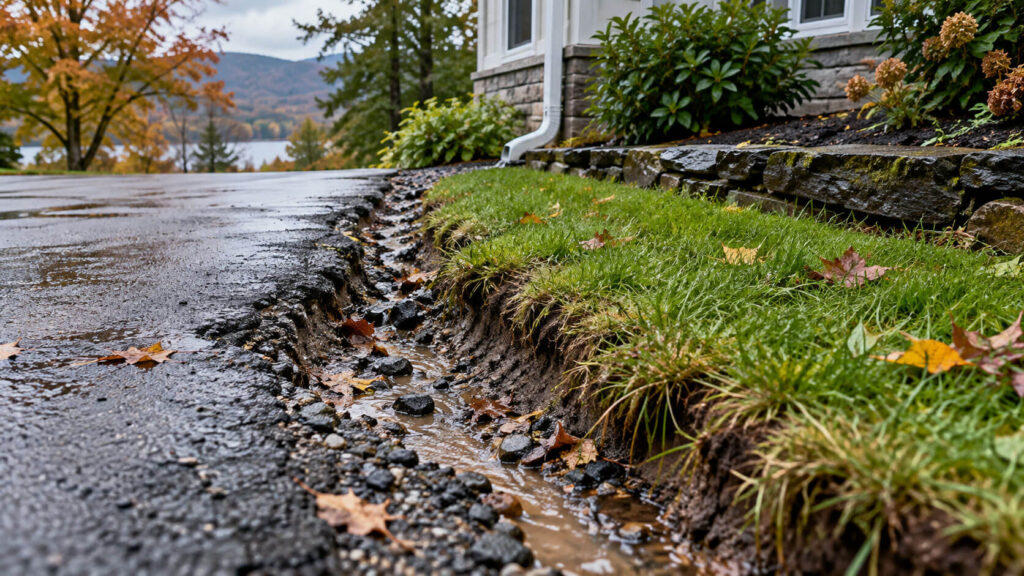
Why Yard Edges Keep Washing Out in the Hudson Valley — and What Actually Fixes It
That thin strip of lawn along a driveway, patio, fence line, or low corner of the yard is often where a bigger drainage problem first shows up. At first it looks minor: a little mulch moved, a few exposed roots, a patch of grass that never dries out. Then a hard rain hits, the soil slumps again, and suddenly the “small” issue is turning into a repair that keeps coming back.
In a region with steep grades, mature trees, older homes, and plenty of freeze-thaw movement, yard edge washout is rarely just about dirt moving around. It usually means water has found the easiest path downhill and is cutting into the landscape wherever the ground is weakest. That is why a fix that looks tidy from the surface can still fail after the next storm. In many cases, what homeowners think is a landscaping problem is really a runoff problem, and it often overlaps with landscaping contractors who handle drainage and grading problems as much as it does with basic yard cleanup.
What yard edge washout usually tells you
When soil keeps disappearing from the same spot, contractors usually look past the visible erosion and ask one simple question: where is the water coming from, and why is it concentrating there? The answer is rarely “just heavy rain.” More often, it is a mix of roof runoff, downspout discharge, compacted soil, slope, and a landscape that never had a proper drainage path in the first place.
In Hudson Valley neighborhoods, this can show up around older driveways, gravel shoulders, stone walkways, patio edges, and the low side of a sloped lot. Water follows those hard edges, then drops into softer soil and starts carving channels. Once that happens, patching the visible hole without changing the flow pattern usually buys only a season or two.
That is also why homeowners sometimes misread the problem as “bad mulch” or “poor grass.” The ground may actually be reacting to runoff from a roofline, a swale that no longer works, or a grading issue left behind by past landscaping work.
The signs the problem is more than surface erosion
Some washout is easy to see. Other signs are subtler, and they matter because they help you catch the issue before it reaches foundations, patios, or retaining walls.
- Exposed roots along a border that used to be covered
- Mulch or topsoil ending up in the same low spot after every storm
- Small rivulets cutting through the lawn after rain
- Standing water near downspouts or hardscape edges
- Soft, sinking areas where foot traffic used to feel firm
- Washed-out seams between lawn, pavers, and gravel
If the same edge keeps breaking down, it is worth looking at the broader drainage pattern rather than treating each washout as a separate event. For a related look at how runoff can build up across a property, see recurring yard drainage problems after heavy rain.
Why quick cosmetic fixes fail
One of the most common mistakes is to top off the eroded area with fresh soil, spread mulch, and call it done. That can make the yard look better for a little while, but it does not stop moving water. If the slope still directs runoff across that edge, the new material is usually gone after a couple of strong storms.
Another common shortcut is edging the problem area harder and harder, as if a cleaner border will solve the erosion. It rarely does. Water does not care about neat lines. If anything, a rigid edge can sometimes make the flow more concentrated and make the washing worse where the barrier ends.
A counterintuitive detail homeowners often miss: the most damaged-looking spot is not always the real source of the problem. The soil that disappears near the fence line may actually be reacting to water coming from the roof, a driveway, or an uphill patch several feet away. Contractors often inspect the higher ground first because that is where the runoff pattern begins.
What contractors usually inspect first
When a landscaping crew or drainage-minded contractor walks a property with recurring erosion, they usually start with the same practical questions:
- Where do the roof downspouts empty?
- Is the ground sloping away from the house or toward the trouble spot?
- Are there compacted surfaces nearby, like patios, pavers, or driveways?
- Has the area been patched before with soil or stone that can wash out again?
- Is there a low point where runoff is collecting before it escapes?
That inspection logic matters because erosion is often a symptom, not the actual problem. If water is not being guided away from the vulnerable edge, any cosmetic repair is temporary. This is especially true in the Hudson Valley, where freeze-thaw cycles loosen soil, spring thaw can overload already saturated ground, and a few inches of rain can expose weak grading fast.
Where homeowners get into trouble with DIY repairs
Most homeowners are not trying to make the problem worse. They are trying to protect the yard, avoid a bigger bill, and make the property look cared for. The trouble is that erosion repairs often need more than fill dirt. They need drainage logic.
Common DIY missteps include using soil that is too fine and washes away quickly, piling mulch too thick against a slope, or creating a shallow berm that traps water instead of redirecting it. Another frequent issue is placing stone as a band-aid where runoff is actually entering from above. That can move the problem a few feet, but it usually does not solve it.
In areas with older homes and long driveways, it is also easy to underestimate how much water arrives from a roofline or hard surface. A single downspout can dump a surprising amount of water in one spot during a storm, especially when the discharge pipe is short or clogged. That’s why some seemingly minor yard washouts end up tied to drainage issues around patios and hardscape edges rather than the lawn itself.
What a real fix usually looks like
A lasting repair usually starts by changing how water moves through the property. That can mean regrading the soil, extending downspouts, rebuilding a swale, improving edge drainage, or reshaping the transition between a hard surface and a vulnerable lawn border.
For some homes, the answer is simple: extend the discharge line, restore the slope, and stabilize the edge with proper plantings or erosion-resistant materials. For others, especially on steeper lots, the fix may need a more coordinated approach that balances drainage, grading, and landscaping so the same area does not keep failing.
In Dutchess, Putnam, and Westchester counties, this often comes down to the reality of the property. A wooded lot with mature trees, shallow topsoil, and irregular grades behaves differently from a newer subdivision lot. A repair that would be fine on one property may fail quickly on another if the water volume, slope, or soil conditions are different.
Why the cheapest repair is usually the most expensive one later
There is a reason experienced contractors are cautious about surface-only fixes. They can look inexpensive at first, but when they fail, you often pay twice: once for the temporary fix and again for the real solution. Worse, repeated washout can undermine nearby features like walkways, steps, patios, foundation plantings, and even the edge of a driveway.
That is where homeowners can save money by slowing down and asking what the water is doing, not just what the yard looks like. If the issue is tied to runoff, proper grading, or repeated flooding after storms, it may be worth talking with Dutchess County landscaping services or other local professionals who understand how the land behaves after heavy rain.
Repair timing matters more than most people think
Waiting is expensive with erosion because the damage tends to accelerate. Once water creates a path, it usually follows that path more aggressively during the next storm. The next storm then widens the channel, loosens more soil, and exposes more of the vulnerable edge. By the time homeowners call for help, the original issue may have grown into a drainage pattern that affects a much larger part of the yard.
That is particularly relevant after winter. Freeze-thaw cycles can break down compacted edges, lift stone, and loosen soil in a way that looks harmless in early spring but quickly fails once snowmelt and seasonal rain arrive. A yard that seems stable in dry weather can reveal its weak points fast when conditions turn wet.
When to bring in a pro
It makes sense to call in a contractor when erosion keeps returning, when water is pooling near the house, or when the washout is getting close to a foundation, retaining wall, patio, or driveway edge. It is also smart to get help if the property has a steep slope, a long discharge run, or multiple places where water seems to gather before moving downhill.
Homeowners in more challenging lots sometimes need a team that can address both landscaping and drainage as one system, not separate problems. That is where working with landscaping contractors in Putnam County can be useful for steep, runoff-prone properties, and where Westchester County landscaping help can be especially relevant for tighter lots where hardscape and runoff interact closely.
If the erosion seems tied to a larger drainage pattern across the yard, not just one border, a broader strategy is usually the better investment. It protects the home, reduces repeated patchwork work, and makes the property easier to maintain over time.
What a homeowner can do before calling someone out
You do not need to diagnose everything yourself, but a few observations can make the first conversation much more productive:
- Note whether the washout happens after roof runoff, heavy rain, or both
- Check where downspouts discharge and whether they empty near the problem area
- Look for hard surfaces uphill that may be sending water toward the edge
- Take photos before and after storms so the pattern is obvious
- Pay attention to whether the problem is getting wider, deeper, or closer to the house
That information helps a contractor separate a cosmetic erosion issue from a drainage problem that needs grading or water redirection. It also reduces the chance of paying for a repair that only covers up the visible damage.
Frequently Asked Questions
Why does the same yard edge keep washing out after every storm?
Because the water path has probably not changed. If runoff still travels across that area, the soil will keep breaking down no matter how many times you refill it.
Is fresh topsoil enough to fix erosion?
Usually not. Topsoil can improve the appearance, but if the slope and drainage are still wrong, the new material tends to wash away again.
Can downspouts really cause yard erosion?
Yes. A concentrated downspout discharge can move a surprising amount of water into one small area and carve out soil quickly, especially during heavy rain.
When does erosion become a structural concern?
When it reaches close to a foundation, retaining wall, patio base, driveway edge, or other feature that depends on stable soil support. At that point, the issue is no longer just cosmetic.
Why is erosion so common in the Hudson Valley?
Older homes, uneven grades, mature trees, freeze-thaw cycles, steep lots, and heavy rain all make drainage harder to manage. Those conditions expose weak spots quickly.
Should I repair erosion before or after landscaping work?
Usually before, or at least at the same time. If drainage is not corrected first, new landscaping often gets damaged by the same runoff pattern.
If your yard edge keeps washing out, the safest next step is usually not another patch. It is getting a clear look at where the water is moving and what is letting it concentrate there. A good local contractor will treat the yard like a system, not a collection of isolated problems, which is usually the difference between a repair that lasts and one you have to do again next season.
